
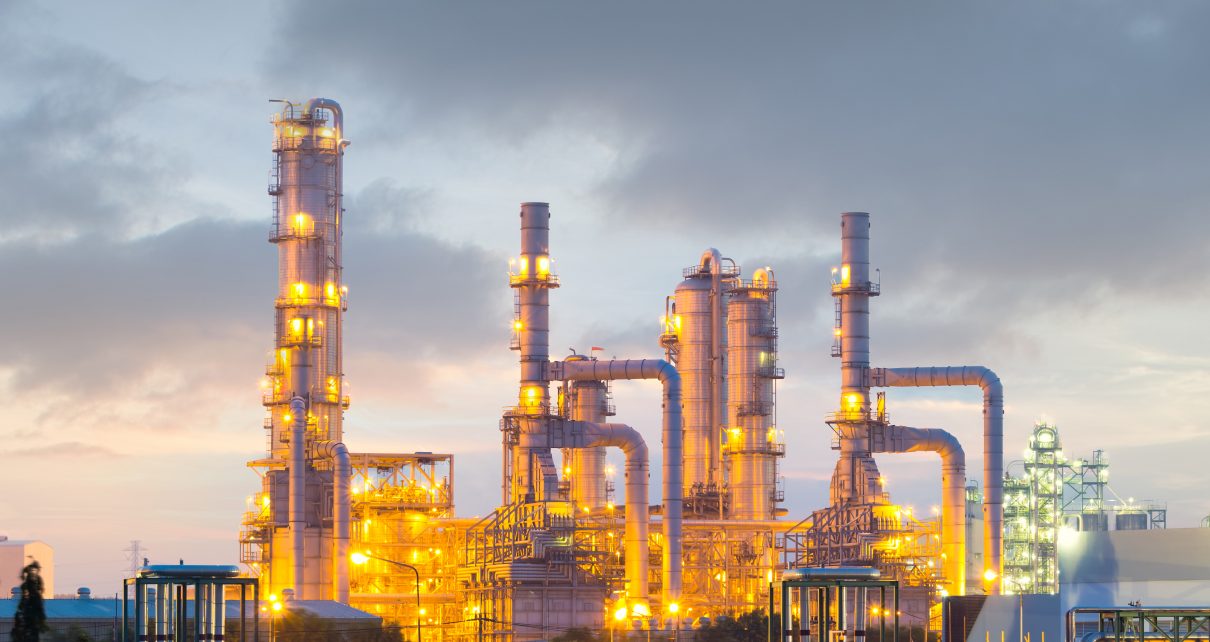
Oil Refinery Plant (Photo: chuyuss/Shutterstock)
California Blow-Up: How Sacramento Built an Energy Crisis and Called It a Climate Policy
From the Cheap Seats: Sacramento restricted drilling for two decades
By Garvin Walsh, March 25, 2026 9:00 am
Soon after the launch of U.S.-Israeli military operations against Iran, the Iranian Revolutionary Guard closed the Strait of Hormuz, shutting down the flow of nearly a third of all seaborne crude on Earth. The U.S. military, aided by its allies, has both the capability and the intent to reopen that chokepoint. Whether the strait reopens soon or a month from now, the closure has exposed a severe vulnerability, one that poses an unacceptable risk to the nation and to California.
The structural origins of that vulnerability — Sacramento’s twenty-year war on California’s energy industry — were the subject of a previous column. What follows is what that structure looks like under pressure.
California entered this crisis with a small inventory cushion. Product in storage, crude held under contract in Asia, and tankers at sea provide roughly 30 to 45 days’ supply. But even before physical shortages arrive, markets are pricing in higher risk, with gasoline prices surging. If inventories fall far enough, formal allocation of supplies will begin. Military installations, followed by civil governments, will receive priority. Truckers, farmers, and consumers will compete for the leftovers. When the cushion is gone, everything shipped by trucks will stop moving. Harvests will cease. California has roughly three days of food supply in its distribution chain. Without diesel, that chain breaks.
This catastrophic scenario, if it comes, will be the product of four distinct failures.
The first is upstream. California once produced 760,000 barrels per day from in-state wells. Today it’s down to 250,000 — not because the geology changed, but because Sacramento restricted drilling for two decades. The state imports roughly 70 percent of its crude feedstock, much of it from the Persian Gulf. Every day the strait stays closed is another day that refineries draw down that cushion.
The second is downstream. From over 40 operable refineries in the 1980s, California is down to seven. Phillips 66 is gone. Before Valero’s pending Benicia closure, a nominal six-percent margin existed between refinery capacity and in-state consumption. When Benicia closes in April, in-state demand will exceed supply even before a single tanker is delayed. Adding to the problem, Chevron has warned that cap-and-invest amendments would force closure of its Richmond and El Segundo refineries.
This deficit is not California’s alone. California supplies 88 percent of Nevada’s gasoline and a third of Arizona’s — states whose alternative supply routes are already running near capacity. In 2023, a California wildfire shut down the pipeline serving Las Vegas, prompting Nevada’s governor to declare a state of emergency over fuel supply to Nellis Air Force Base. Sacramento’s refinery policy created a multi-state, national security problem.
The third is the wall Sacramento built around itself. California’s boutique fuel specification — CARBOB — improves air quality, but without sufficient domestic production it functions in an emergency as a blockade. There are no inbound fuel pipelines, and tankers from the handful of compliant facilities worldwide take three to six weeks. Sacramento needed to protect the industry that makes CARBOB. Instead, cap-and-invest regulations are destroying it while the mandate remains. The wall is not CARBOB; it is the loss of the industry that produces it.
The fourth is the exit ramp that isn’t there. EV sales fell 36 percent nationally in Q4 2025 after federal credits expired. In California, EVs account for 21 percent of new vehicle sales, well short of the mandate for 35 percent in 2026 and 100 percent in 2035. California is not transitioning. It is suspended between an energy system it is dismantling, and a replacement that may never arrive.
If the military reopens the strait and prices ease, Sacramento will argue the system worked. That argument must be rejected. The Hormuz closure did not cause this crisis. It stress-tested a structure Sacramento spent twenty years building, revealing the structure’s failure. A threefold policy response is needed:
- stop using cap-and-invest regulation to make domestic refining unsurvivable;
- restore upstream production on federal lands where Sacramento’s authority does not reach; and
- build the pipeline infrastructure to connect California to Gulf Coast supply.
A state that produces its own CARBOB in sufficient volume, with a Gulf Coast connection as backup, protects both its air quality and its energy security. Sacramento has built a structure that protects neither.
The governors of Nevada and Arizona have standing to demand federal action. The commanders of 40 military installations have operational reasons to require it. The federal government’s job is not to bail out a failed policy. It is to protect the national interest from the consequences of one. It is time for Washington to act — to protect Californians and the nation from Sacramento’s policy failure.


- The Inheritance: California’s Spending Problem - July 20, 2026
- Political Malpractice: Reparations Were Designed to Keep Black Voters Loyal to a Party - June 20, 2026
- Misdirected Outrage - April 28, 2026
RELATED ARTICLES
-
-
 October 10, 2018
 -
 July 31, 2020
If only Washington would act to protect Californians and the nation from California Democrat’s destructive and intentional climate policy failure? Unfortunately Congress is filled with demonic Democrats intent on destroying the country by any means necessary and they have some traitorous RINO cronies in Congress to assist them? Republican Senate Majority Leader John Thune is proving to be am especially feckless deep state RINO?
Again – cross-posting this article straight from the World Economic Forum site, where they explain their religious fervor in upending the current economy, to create the economic chaos that enables their plan for a centralized governemtn (“one world order”) using the “climate change” illusion as cover for their nefarious plans….
https://www.weforum.org/stories/2025/11/not-on-track-for-net-zero-2050-how-we-get-there/
Brought to you by the same people who are sponsoring the “geoengineering” and the chemtrails that are criss-crossing the Southern California skies today…
https://www.weforum.org/stories/2026/01/first-movers-coalition-decarbonization-through-demand/