

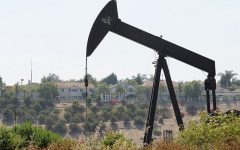
Oil pumpjack, Hwy 101, San Ardo, CA, Monterey County. (Photo: Katy Grimes for California Globe)
Ringside: Californians Will Consume AT LEAST Another Five Billion Barrels of Crude Oil
One would think the experts who define and enforce California’s energy policies would recognize the futility of destroying California’s oil industry
By Edward Ring, June 4, 2026 6:00 am
There is no realistic scenario imaginable that does not include Californians consuming at least another five billion barrels of oil before the state achieves its much touted official goal of a “clean energy future.” Here are the numbers:
In 2025 Californians consumed 484 million barrels of crude oil. To understand why another five billion barrels is the minimum remaining statewide consumption, imagine an aggressive phasing out of crude oil consumption in the state, whereby crude oil consumption in the state is completely eliminated by 2045.
To achieve this goal in twenty years, consumption has to drop by 6.8 percent per year. If that sounds feasible, compare that hypothetical reduction going forward to the historical rate of decline established over the last 20 years. In 2006 Californians consumed 655 million barrels of crude oil. That rate of consumption had been remarkably consistent over the previous 20 years, i.e., 1985 consumption was 644 million barrels, 1986 consumption was 676 million barrels, and so on; California’s annual consumption was right around 650 million barrels per year all the way through to 2005. This consistency may be attributed mostly to continuously increasing automotive MPG, countered by population increase.
But as the state’s population growth slowed while automotive MPG continued to improve with the advent of hybrids and EVs, there was an impressive decline in crude oil consumption, as noted, from 655 million barrels per year in 2006 to only 484 million barrels in 2025. But here’s the reality check. That decline, significant though it was, only equated to an annual percentage decrease of 1.6 percent.
This is an unreconcilable disparity. Between 2006 and 2025 there was a 1.6 percent decline in California’s oil consumption per year. To limit remaining crude oil consumption in California to 5 billion barrels by 2045, a 6.8 percent annual decline would be required.
It is absurd to expect it is possible to accelerate, by a factor of 4X, a trend averaging 1.6 percent a year that is already the result of state policies that have pushed available technology and economic constraints to their limits. EVs still only constitute 6 percent of California’s automotive fleet, and even if consumer demand and production capacity could deliver exponential growth in their adoption, the enabling power generation capacity, distribution, and charging infrastructure is still going to take decades to mature.
The main point here isn’t however to debunk the state’s evident goal of eliminating dependence on crude oil by 2045. It’s to make clear that even if this very best case scenario is achieved, Californians are going to consume another five billion barrels of oil. So why is the State of California doing everything in its power to drive the in-state industry into terminal decline?
It shouldn’t be necessary to revisit the ways California’s embattled oil industry is being destroyed by relentless legislation and regulations. Despite sitting on reserves estimated at 30 billion barrels, production in California was down to 110 million BBLs in 2025, filling only 23 percent of demand. With two major plants shutting down just this year, in-state refinery capacity has dropped below demand. We now not only import 78 percent of our crude oil, we now have to import 20 percent of our refined gasoline.
One would think the experts who define and enforce California’s energy policies would recognize the futility of destroying California’s oil industry when demand for oil is going to persist for at least another 20 years. Why not extract it right here? Instead we export the jobs and the environmental impact to nations with minimal standards.
The latest action by the California Air Resources Board, designed to induce the remaining refinery operators to stay open, was enacted “over the objections of environmental groups.” For the last 13 years, California’s oil refineries had to buy permits to emit CO2. The program was designed to lower the number of permits issued each year, thus raising the price refineries paid per ton of CO2 they emitted. The recent compromise CARB reached offers billions of dollars of free permits to refineries if they invest the money the permits would have cost in investments in clean energy.
But this alone may not keep open California’s remaining refineries. For 13 years, the money refineries needed to maintain their physical plant has instead been paid to CARB. Over $33 billion dollars have been allocated through the state’s “cap and invest” program, including $7.5 billion to high speed rail, $5.9 billion to affordable housing, $6.3 billion to various CARB programs including “low carbon transportation,” and additional billions spread all over the place. Notwithstanding politically motivated proclamations to the contrary, you can’t siphon tens of billions out of an industry that operates on thin margins, and not expect their plants to accumulate a deferred maintenance debt and backlog of unfulfilled upgrades that has by now put them on a potentially irreversible trajectory toward permanent shutdown.
A rational strategy on the part of California’s state regulators would be to recognize and accept that the state’s remaining future consumption of crude oil is going to be at least another 5 billion barrels, and that it wouldn’t be unreasonable to forecast twice that amount. Starting from that premise, they might engage some nonbiased financial accountants with domain expertise to tell them, in no uncertain terms, just how much more regulatory relief it’s going to take to convince oil companies that making investments with 20 year payback horizons is still a rational choice in California.


- Ringside – Geothermal Energy: A Huge Wildcard - October 1, 2026
- Ringside: El Nino Emergency Planning Must Include Dredging the Delta - September 24, 2026
- Ringside: The Energy and Water Footprint of AI - September 17, 2026
RELATED ARTICLES
-
 January 25, 2024
 -
 June 5, 2025
 -
February 5, 2026
“One would think the experts who define and enforce California’s energy policies would recognize the futility of destroying California’s oil industry.” Yes one would think. Maybe a logical person. But these people operate on purely emotions. There is not a logical Bone in their bodies. Not one, unfortunately for the rest of us.
absolutely correct. I would just like to ask governor candidate XB – what exactly has been achieved with all of the extra money for living expenses, like energy, paid out of my pocket for your climate change crusade?
such a dim bulb.