

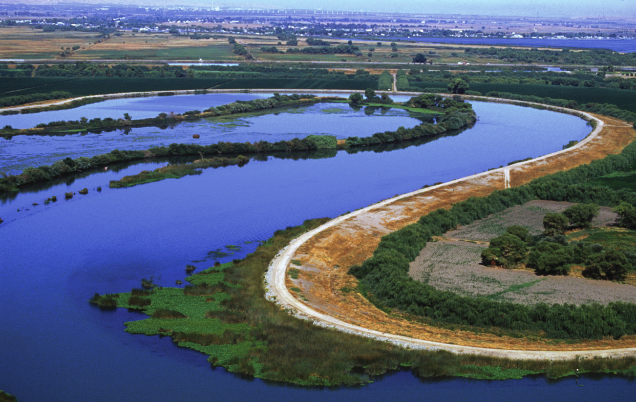
The Sacramento-San Joaquin Delta. (Photo: water.ca.gov)
Ringside: Dredging the Delta Can Prevent a Catastrophe
These silted up channels have dramatically reduced capacity to move floodwater through the delta and into the San Francisco Bay
By Edward Ring, July 22, 2026 3:00 pm
It’s January 2027, and for the last few months, a super El Nino has already delivered torrential rains to the Pacific Coast of North America. California’s reservoirs have been releasing record quantities of water to preserve space for the next round of precipitation but their remaining capacity to absorb runoff is dangerously low. From the peaks of the Sierra, through the foothills, and across the wide expanse of the Central Valley, the land is saturated. It’s another warm winter, and there isn’t much snow on the summits. The stage is set for a cataclysm, and sure enough, it happens.
Rising up from the warm ocean comes yet another Amazon sized river of moisture, pushed eastward and gathering strength with every mile. When the endless banks of swollen clouds hit the California coast they start to unload. Pushed by winds fast enough to guarantee a relentless resupply of rain but not fast enough to prevent the clouds from lingering against the ramparts of the Sierra, it rains, and pours, and then it rains and pours even more. Within days every reservoir is full and every spillway is pouring water into the Sacramento-San Joaquin river system. Levees are breached along multiple tributaries, the bypasses are filled, and still the water rises.
Finally, the inevitable happens. Throughout the Sacramento-San Joaquin Delta, water flows over the levees. The rush of floodwater erodes the walls of these levees, until nearly every one of the more than 50 reclaimed islands in the delta becomes a floodwater bypass. Where farms and managed wetlands thrived, lakes have formed. The levees are liquified. A century’s worth of reclamation is lost within hours. And then the rain stops, and the floodwaters slowly drain west into the San Francisco Bay. And on the next high tide, what had been a mostly freshwater delta habitat becomes a salt water estuary.
This risk has been known for decades. The consequences are also known. The delta pumps, capable of moving 30,000 acre feet per day into the state and federal water projects, will not be operable. Five million acres of farmland cannot be irrigated with salt water. Twenty million Southern California residents cannot drink or landscape with salt water. It will take months, if not years, to restore the delta’s plumbing to the point where fresh water can again be exported south. Cities along the south coast will be put onto emergency rationing, and throughout the San Joaquin Valley, verdant farmland will turn to dust. From Stockton to San Diego, water agencies will be challenged to replace – through rationing and fallowing – what had been an average of five million acre feet of water flowing south every year from the Sacramento-San Joaquin Delta.
It is not possible to totally eliminate the risk of massive, successive waves of precipitation overwhelming the Sacramento-San Joaquin Delta. But a solution in plain site that could significantly reduce this risk is not being implemented despite being cost effective and immediately feasible.
Dredging.
Ever since the delta was channelized around 150 years ago, and up until the 1980s, the accumulating silt was routinely dredged. The Sacramento River used to have barges and ferries that could navigate all the way north to Red Bluff. More than 1,000 miles of delta channels were kept clear of silt by public and private dredging operations. In many cases, the farmers themselves owned and operated dredging equipment that they used to remove silt in the channels adjacent to their properties. Almost all of that activity was halted, fifty years ago, due to concerns over the environmental impact.
Today, channels in the delta that used to be more than ten feet deep are only one foot deep. The problem of accumulating silt is compounded every year, as is the challenge to expel salt water. Whether the saline influx is from agricultural runoff or inflow from the estuary during high tide, silt has created chokepoints that prevent the natural freshwater flow of the rivers, especially in the southern delta, to push salt water out of the channels and back into the estuary.
Meanwhile, these silted up channels have dramatically reduced capacity to move floodwater through the delta and into the San Francisco Bay.
One great irony in all this is that although dredging was once was believed to harm the environment, not dredging has created even worse environmental problems. During the century when dredging was performed throughout the delta, salmon populations thrived. Even though bass, a salmon predator, were introduced to the delta in the 1870s, it wasn’t until recent years that bass predation began to seriously impact salmon populations. This is because bass prefer shallow, warm water, and while salmon need some shallow habitat to feed, they prefer deeper, cooler channels for migration.
Overall, choked up, stagnant, low-flow, warm and shallow water favors alien aquatic plants and species. Against this reality, dredging is mitigation. Dredging will restore the delta’s environment, in addition to preventing a catastrophic collapse of the delta’s elaborate plumbing system that delivers fresh water to millions of people and millions of acres of farmland.
While there is a growing nonpartisan consensus that resuming dredging throughout the delta is long overdue, actually doing it is mired in the same paralysis that afflicts every other major infrastructure project in California. The reasons are often political. For example, there is concern that endorsing dredging may undermine support for the Delta Conveyance, despite the fact that with or without the big tunnel, dredging is still an urgent necessity.
Other objections to dredging in the delta come from environmentalists who, at the least, demand that for every dollar spent on actual dredging, multiple dollars are spent on compensatory mitigation. Thankfully, however, many of them now recognize that the delta has deteriorated to the point where dredging is a net environmental benefit. Other objections are based on a concern that funds to pay for dredging could cannibalize funding for other water infrastructure projects, but that is an avoidable outcome. The Federal Bureau of Reclamation has billions of unallocated reserve funds, and there are unallocated billions remaining available that could be used for dredging via several Acts of Congress: the Water Infrastructure Improvements for the Nation Act (2016), the Bipartisan Infrastructure Law (2021), the Inflation Reduction Act (2022), and the Big Beautiful Bill (2025).
Finally, of course, even if the California State Legislature could find a few billion out of their record-busting recent annual budget to fully fund dredging, or to match federal funding for dredging, there is, in addition to its absolute paralysis when it comes to completing any infrastructure, what will be a predictable adverse reaction if the current federal administration tries to help.
But the risk that the neglected delta means for our water supply is compounded because alternative sources of water are even more at risk. Unless the monsoons expected in California this winter extend to the Colorado River watershed, and become prolonged, multiyear events, what has become approximately a three million acre foot per year deficit between demand and supply will only worsen. With the big reservoirs, Mead and Powell, all but dry, California is about to kiss goodbye to additional millions of acre feet from the Colorado River. At the same time, local groundwater pumping cannot possibly cover these deficits, because most of the aquifers are already dangerously depleted. Ever since water deliveries from the delta were cut starting in the early 2000s, those aquifers were drained faster than they can recharge.
This is a perfect storm. And in a perfect world, dredging equipment would already be in the channels, solving a problem that could soon become far, far worse.


- Ringside: Observations as a New Water Year Begins - October 8, 2026
- Ringside – Geothermal Energy: A Huge Wildcard - October 1, 2026
- Ringside: El Nino Emergency Planning Must Include Dredging the Delta - September 24, 2026
RELATED ARTICLES
-
 April 3, 2025
 -
 August 28, 2025
 -
It is too late to dredge. It takes 10 years to get a permit, and one season for nature to show California who’s boss.
Can you imagine California allowing dredging without some Ruby Goldberg billion dollar mercury separating machine built by an NGO for two billion dollars and doesn’t work? Like every other catastrophe in this state this one too is treated like a surprise.