

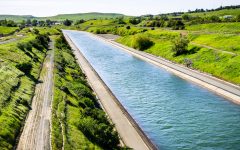
San Luis Reservoir water, 4/27/2026. (Photo: Katy Grimes for California Globe)
Ringside: Green Mega Water Projects for California
The day is not far off when we will have the ability not only to achieve water superabundance, but energy superabundance
By Edward Ring, November 19, 2026 6:00 am
Imagine if Californians were to invest in a series of water projects on the same scale as the projects completed between 1910 and 1970. Imagine spending, as a percent of state GDP, an amount of money equal to what was committed in the 1957 California Water Plan. With reasonable reforms to California’s crippling regulatory environment, for $200 billion (the new $100 billion in these inflationary times), an awful lot can be done.
As discussed last week, we can increase storage in existing reservoirs through improved weather forecasting and dredging. We can build new off-stream reservoirs. We can restore our aqueducts to full capacity, build new ones, dredge the silted up channels in the delta, and increase the height and strength of its levees. We can save more water upstream from the delta with expanded bypasses and percolation basins to recharge aquifers, and we can build fish-friendly diversion basins within the delta in order to safely withdraw more water during winter storms. We can recycle 100 percent of our urban wastewater, optimize urban storm runoff harvesting, and build massive seawater desalination plants. These projects would increase our water supply by millions of acre feet per year.
That’s a big plan, and we should do it. But then what?
If we don’t merely solve the challenge of water scarcity, but smash it to smithereens, achieving not water abundance, but water superabundance, we can restore ecosystems that today are all but impossible to restore.
Bearing that prerequisite firmly in mind, we may then start with the Hetch Hetchy Valley, an inundated wonderland on par with Yosemite. Demolishing the O’Shaughnessy Dam and draining that reservoir would only take 265,000 acre feet per year out of San Francisco’s water supply. Much of that would be recoverable downstream through increased surface withdrawals for irrigation or groundwater recharge. Break the dam. Restore the valley.
Another candidate for complete restoration is Mono Lake, where tremendous progress has already been made. The biggest missing piece needed to ensure the lake reaches its historical elevation is to get back a 16,000 acre foot allocation per year that currently is diverted to Los Angeles. Once millions of additional acre feet are available thanks to a comprehensive series of investments in new water supply infrastructure, 16,000 acre feet becomes a trivial amount of water. Bring Mono Lake back to its primordial state.
Bringing salmon migration back to the McCloud River is a visible example of what might be done for many of California’s reservoirs where their importance for flood control, firefighting, and massive storage make them far too valuable to remove. So-called green dams are a technology where California should set an example to the world. Keep the reservoir, but build the best fish ladders in the world. Lake Shasta would be a good place to start. Spare no expense. Do it right.
Another mega-project idea could become part of an economic boom that would extend from a now decrepit Bombay Beach all the way to San Felipe. There is an ingenious proposal to withdraw seawater from the Sea of Cortez, transporting it to the below sea level Salton Sea to refill the massive lake. The lower salinity of seawater would revitalize the aquatic ecosystem, and eventually desalination plants could further reduce its salinity. Irrigation runoff, with a high salt content along with other agricultural chemicals, would also have to be treated before entering the Salton Sea.
These projects cost tens of billions. And they aren’t easy. The Salton Sea itself was formed in 1905 when floods on the Colorado River breached a canal built to irrigate the Imperial Valley. Until the canal was repaired in 1907, the river poured into the below sea level depression, creating a fresh water lake that became a fishery, a new stop on the Pacific Flyway, and a tourist mecca. Now, without intervention on a massive scale, it will inevitably revert to becoming a dead sea, with salinity beyond a level that can support marine life. To dwell on the cost, however, is to ignore the amazing prospect of the Salton Sea region becoming more prosperous than ever: a source of lithium extraction, geothermal energy, and, with a revitalized sea, tourism.
Moreover, we are on the cusp of a future that challenges many, if not most, of the critical limiting premises we currently accept.
The day is not far off when we will have the ability not only to achieve water superabundance, but energy superabundance. We may also look forward to construction projects where human workers supervise robots that do most of the heavy work. Energy, AI, and robotics are going to usher in a new era where productivity is exponentially enhanced, costs plummet, and because so many more projects are possible compared to today, human employment remains steady. That is possible.
California is indeed a Cadillac Desert, to borrow a phrase coined by Marc Reisner in his classic book on the history of water in the west. We are a luxuriant civilization imposed on an arid landscape. But instead of engaging in remorse and rationing, we should embrace and enhance this marvelous terraformed paradise we have created. With nearly forty million people living here, and the most fertile farmland on earth, our job isn’t to return the state to its desert origins. Nor should our job merely be to maintain and expand the magnificent systems that irrigate our farmland and hydrate our cities. We can also enhance the natural paradise that we are privileged to call home.


- Ringside: Green Mega Water Projects for California - November 19, 2026
- Ringside: Water Abundance Means Thinking Big Again - November 11, 2026
- Ringside – Calculating the Extreme Cost of Floating Offshore Wind - November 5, 2026
RELATED ARTICLES
-
 December 11, 2025
-
-
 August 8, 2022