
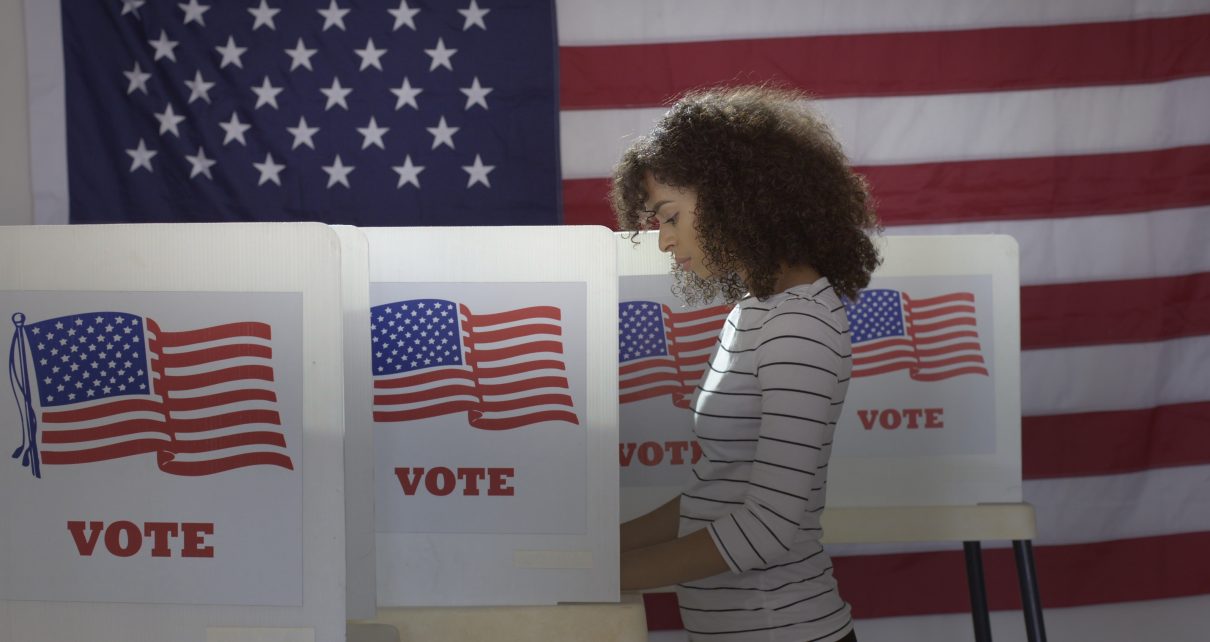
Woman in polling station, voting in a booth with US flag in background. (Photo: vesperstock/Shutterstock)
Corrupt California is Still Counting Ballots Even With Federal Lawsuit Looming Large
In 18 California counties, there are more voter registrations than citizens over the age of eighteen
By Katy Grimes, June 7, 2026 10:15 am
A federal lawsuit was filed May 20, 2026 in the U.S. District Court for the Central District of California against Secretary of State Shirley Weber alleging that 873,092 inactive voter registrations are still on the rolls. Orange County Supervisor Don Wagner, the Republican candidate for secretary of state, joined the American Independent Party of California and Judicial watch in the lawsuit.
The lawsuit states:
Section 8 of the National Voter Registration Act of 1993 (NVRA) provides that “each State shall … conduct a general program that makes a reasonable effort to remove … from the official lists of eligible voters” the names of voters who have become ineligible by reason of death or a change of residence.
The lawsuit acknowledges that:
“no registration may be cancelled on that ground unless the registrant either (1) confirms this fact in writing, or (2) fails to timely respond to an address-confirmation notice described by the statute (the “Confirmation Notice”), and fails to vote or contact the registrar for two consecutive general federal elections.”
If a registrant fails to respond to such a Confirmation Notice, and then fails to vote (or contact the registrar) during a statutory waiting period extending from the date of the notice through the next two general federal elections, the registration is cancelled. These cancellations are mandatory under both federal and California law.
Under both federal and California law, a voter registration is referred to as “inactive” when a registrant has failed to respond to a Confirmation Notice and the statutory waiting period has commenced, but has not yet concluded.
It’s pretty clear that when someone moves out of state, if they notify the Secretary of State in writing of their move, that should remove them from the state’s voter rolls. If they move and the state notifies them, and they don’t respond, they are to be removed from the voter rolls.
Instead California has allowed more than 800,000 inactive voter registrations to remain inactive and on the rolls for at least three elections — with 151,202 on the rolls after at least four consecutive elections, the suit claims.
The lawsuit also says that Sworn interrogatory responses submitted by Defendant Weber’s office in Judicial Watch, Inc. v. Weber, No. 2:24-3750 (C.D. Cal. 2024) establish that, following the close of the last EAC reporting period in November 2024 through December 9, 2025, 21 California counties (Alameda, Amador, Butte, Calaveras, Del Norte, El Dorado, Glenn, Lassen, Marin, Mendocino, Modoc, Mono, Napa, San Bernardino, Santa Cruz, Shasta, Siskiyou, Stanislaus, Trinity, Tulare, and Yuba Counties) made zero Section 8(d)(1)(B) removals.
In those same interrogatory responses, Defendant attested that another six counties made fewer than 30 removals under that provision during that period (Alpine (29 removals), Imperial (1), Lake (1), San Benito (5), San Joaquin (25), and Sutter (17)).
According to the Census Bureau, approximately 660,000 (10.8%) of California residents are not living in the same house as they were one year ago. More than 660,000 California residents moved out of state in 2024 (the most recent year for which such data is available), about 690,000 California residents moved out of state in 2023, and about 818,000 California residents moved out of state in 2022.
The lawsuit concludes:
If Defendant (SOS) was actually conducting a general program that makes a reasonable effort to cancel the registrations of voters who have become ineligible because of a change of residence, it would not be possible for ten counties with a combined total of 1,796,437 registrations to cancel zero registrations in a two-year period under Section 8(d)(1)(B).
If Defendant was actually conducting a general program that makes a reasonable effort to cancel the registrations of voters who have become ineligible because of a change of residence, it would not be possible for another ten counties with a combined total of 1,643,921 registrations to cancel a total of 218 registrations in a two-year period under Section 8(d)(1)(B).
All of this is to say that California is cheating by keeping former state residents on the voter rolls.
Compare corrupt California’s ridiculous and deliberately convoluted system to Florida’s:
Florida, which requires photo ID, uses a paper ballot-based voting system statewide, with optical scan tabulation as the primary method for counting votes. All ballots produce a voter-verifiable paper record, which serves as the official vote for audits, recounts, and verification according to the Florida Secretary of State.
There are three voting methods in Florida:
- Vote-by-Mail (VBM, formerly absentee): Request a ballot from your county Supervisor of Elections (new request needed each election cycle for most voters). Ballots must be received by the deadline (typically Election Day) and include a matching signature on the certificate. Processing and tabulation can begin weeks before Election Day after public testing of equipment.
- Early In-Person Voting: Available for a period before Election Day (varies slightly by county, often starting about 2 weeks prior) at designated sites.
- Election Day Voting: At assigned precinct polling places (polls generally open 7 a.m. to 7 p.m.).
If this feels familiar, this is how California used to run its elections, and not that long ago.
Every Florida county conducts a post-election audit with a manual hand count in random precincts/races or automated independent audit of at least 20% of ballots in random precincts. Audits are public.
Florida stands out among U.S. states for its fast, paper-based voting system with strong pre-Election Day processing, robust audits, and quick Election Night reporting. It balances accessibility (no-excuse mail voting and early in-person) with security measures like voter ID, signature verification, and mandatory paper trails, according to Ballotpedia.
Notably, there is no ranked-choice voting as it was banned in Florida.
According to MIT, Florida is more “election-night ready” than most large states due to proactive mail processing and paper-optical systems, while maintaining paper auditability that aligns with national best practices.
Additionally, Florida has high voter turnout, according to MIT:

Compared to California:

The lawsuit against California notes that “The fact that 23 out of California’s 58 counties, which reported a combined total of 5,211,158 registrations to the EAC, are cancelling so few registrations under Section 8(d)(1)(B) means that Defendant (SOS) is not complying with her obligation under the NVRA to be responsible for the coordination of state responsibilities under the Act.”
And:
Defendant (SOS) does not send Confirmation Notices to those believed to have moved out of state; does not track how or whether a registrant responded to a Confirmation Notice, independently of what county officials choose to tell it; and does not cancel registrations eligible to be removed under Section 8(d)(1)(B). Rather, Defendant relies entirely on county officials to perform these functions.
Specifically:
California counties are not removing inactive registrations that have been continuously inactive without voting history for two or more consecutive general federal elections. These responses state that, as of December 9, 2025, 873,092 California registrations had been continuously inactive for at least two general federal elections;
326,808 of these had been continuously inactive for at least three general federal elections;
151,202 had been continuously inactive for at least four general federal elections; and
33,922 had been continuously inactive for at least five general federal elections—that is, since before November 5, 2016.
Let that sink in.
And, in 18 California counties, there are more voter registrations than citizens over the age of eighteen. If the lawsuit’s plaintiffs know this, so does California Secretary of State Shirley Weber, and the voter registrars of those 18 counties.



A California native and Navy mom, Katy lives in Sacramento, CA.
- Read a Book: Save Yourself - September 20, 2026
- Newsom Signs Bill Barring Out-of-State National Guard Deployments into CA - September 19, 2026
- Richard Pan Campaign Built on Explicit Lies - September 18, 2026
RELATED ARTICLES
-

-

-
 September 17, 2018
How much do these ballots cost? Seems like a lot of wasted tax payer money.
Many companies keep paper records
Guess that Doctorate in Communications from UCLA didn’t involve a lot of math skills…
Or project management..
Or ethics….
So glad to see your coverage of this, Katy. Other concerns at the moment are unfortunately keeping me from giving this continuing outrage my full attention, but the usual behaviors of our horrible CA leadership is enough to make anyone sick. These people are sick and have no respect for anyone or anything and are just fine with spitting on our precious, sacred, hard-won vote as if it were NOTHING. Which is beyond horrifying, and it’s not like it’s their first time, either.
We can only hope that the Usual Suspects get the BOOK thrown at them by the Feds, and let’s see it happen THIS time not NEXT time, please, it’s gone on more than long enough.
Guess who is in the lead for Secretary of State? A Democrat. Whoohoo! Now the Democrats can keep the cheat machine going.
Yeah, but hold on: Don Wagner, a really good and smart guy and a Republican who used to be an OC Supervisor, will be on the general election ballot with that Shirley Weber person, and he promises a lot of discussion and exposure about the election cheating that is and has gone on in CA, that Californians have had to endure under people like her. I heard Don Wagner talking about it his morning. Something to look forward to in November when, by then, perhaps certain things will have changed for the better. We’ll see
Don Wagner is going to have to run a hell of a campaign, because the voters in this state are idiots and the cheat machine is ready and waiting. She already has 50% more votes than Wagner, and all the harvested ballots haven’t been counted yet. No matter how incompetent the Democrat politician in this state is, they get re-elected. Shirley Weber hasn’t done a damn thing other than collecting a salary. She is complicit in the election cheating with almost 900,000 ineligible voters on the voter rolls in this state.
Obviously if California election cheating isn’t somehow seriously addressed —– and soon —- all bets are off.
Now being reported Raman in second place displacing Pratt.
Hey Eyeinthesky, I didn’t see a big change in the number of votes in the primary for Governor It would be interesting to see the “Rahman Ballots” that sent her to the runoff and if a Governor vote was recorded too?
If not, why not? I assume these would be voters primed to vote for Steyner. Where did these ballots come from?
Statewide there were over 5 million unused ballots, how many in LA County?
Just Intellectual curiosity, I am not saying something is Fishy or smells real bad.
Los Angeles County Registrar-Recorder/County Clerk Dean Logan defended the integrity of California’s election system and rejected allegations that fraud is occurring during the counting process. “No evidence,” Logan said when asked about claims of cheating.
Dean Logan has been involved in significant controversy throughout his career, primarily centered on allegations of election mismanagement and a lack of transparency. Most recently in June 2026, his office dealt with election interference incidents, including burned mail-in ballots and vandalized vote centers. Logan faced accusations in 2022 of malfeasance and obstruction for refusing to allow outside observers during signature verification for the recall of District Attorney George Gascón, with organizers alleging the use of outdated signature standards to disqualify petitions. Logan has been criticized for slow vote counts and specific ballot design flaws, such as the “double-bubble” error in 2008 that initially left 50,000 ballots uncounted.
Before joining Los Angeles County, Logan was the Director of Records, Elections and Licensing Services in King County, Washington, during the highly contentious 2004 gubernatorial race between Republican Gov.-elect Dino Rossi and Democrat Christine Gregoire. The initial count showed Rossi had won by 261 votes, triggering a mandatory machine recount. The recount ended with Rossi ahead by 42 votes. A few days later, Logan’s office found 336 more ballots not previously counted, prompting Washington state Democrats to call for a hand recount. In the ensuing weeks, Logan’s office said it found more uncounted ballots and ultimately Gregoire won by 129 votes. Afterward, Logan’s office released records showing 450 people who had voted were not registered voters and that hundreds of provisional ballots were fed into voting machines without verification and by mistake, making it impossible to authenticate their legality.
Despite protests regarding this history and his lack of a college degree, the L.A. County Board of Supervisors unanimously appointed Dean Logan as Los Angeles County Registrar-Recorder/County Clerk in 2008.
It’s unbelievable how corrupt LA County is? Dean Logan is the Democrat’s election rigging stooge?
Pleeeeease, you didn’t believe Pratt would be allowed to infiltrate the entrenched regime or did you!
With Vote by Mail all of the names on the voter rolls in California, whether legitimately on the rolls or not, produce a ballot. These ballots are, in essence, like counterfeit money. They look like the real thing —- a legitimate individual voter’s choice —- but are not. Many of these counterfeit ballots are slipped to groups who will fill them out A LOT A LOT of them with the candidate or issue of the election cheater’s choice. For purposes of visualizing how it works, think of stacks and stacks of ballots going to “boiler rooms” where they are separated from their envelopes and filled out by SEIU members or other public employee union members to reflect the candidates and issues that benefit the SEIU members. Once the ballot is separated from its envelope (which has all the identifying information) there is no possible way to trace the ballot.
That’s one way the cheat is done, in a nutshell. There are other methods used also.
When someone moves out-of-state, they don’t write a letter to the Secretary of State.
Investigative reporter Nick Shirley found a Democrat voter named Doris who lives in California. According to voter rolls of California’s Democrat Secretary of State Shirley Weber, she is 126 years old and has cast ballots in 51 elections. There’s just one small problem. Doris is not 126 years old and she’s never voted in 51 elections. She was born in 1940 which makes her roughly 86 years old. When Nick Shirley showed up at her door to ask about it, she was stunned and said that the voter rolls are wrong. (https://x.com/nickshirleyy/status/2063731800334021085)
To register to vote, corrupt California allows a non-Photo ID document such as a utility bill, bank statement, government check, sample ballot booklet, voter notification card, or lease agreement, etc.
(https://elections.cdn.sos.ca.gov/pdfs/voter-id-and-reg-requirements.pdf)
State regulations direct election officials to interpret identification requirements liberally and resolve doubts in favor of allowing eligible voters to cast regular ballots.
“California allows first-time voters to register using forms of ID that most Americans would find surprising,” Federal Prosecutor Bill Essayli wrote in a post on X Sunday, listing examples that included health club membership cards, employee identification cards, credit or debit cards, prescription drug labels and insurance cards.
California elections are rife with fraud.
Perhaps with factual reporting like we see here this will be the year that turns the tide against the obvious manipulation of voting in California.
See you in court.
Thanks to California Globe!
Are you saying that some one likes the vote projections from Election Night because they can use that info to project how many ballots the will need to sink their opponent? Looks like Chad Bianco was on to something?
Just Intellectual curiosity, I am not saying something is Fishy or smells real bad…
There are three things you can count on in life: death, taxes and Democrat voter cheating.