

Political Malpractice: Reparations Were Designed to Keep Black Voters Loyal to a Party
Descendants of enslaved people were not themselves enslaved
By Garvin Walsh, June 20, 2026 7:45 am
Tom Steyer didn’t see it coming.
In the late stages of the primary election campaign, the erstwhile billionaire candidate for governor was cornered outside his SUV in a Los Angeles parking lot by a protestor, demanding to know where he stood on direct payments to descendants of enslaved Americans. It looked like an ambush. It wasn’t. It was an attempted debt collection.
During his 2020 presidential campaign, Steyer made reparations his calling card with Black voters. He spent $20 million on television and radio ads in South Carolina and claimed to be the only candidate in the field supporting them, leading to strong polling among Black voters. When the campaign ended he kept the promise alive, endorsing federal legislation to study reparations and pledging to work toward its passage. Now he is running for governor of California, courting the same constituency, and the people he spent millions cultivating have a simple question: when do we get paid?
Steyer is not alone in having to answer. His parking lot encounter exposes one of the most egregious acts of political malpractice in California history.
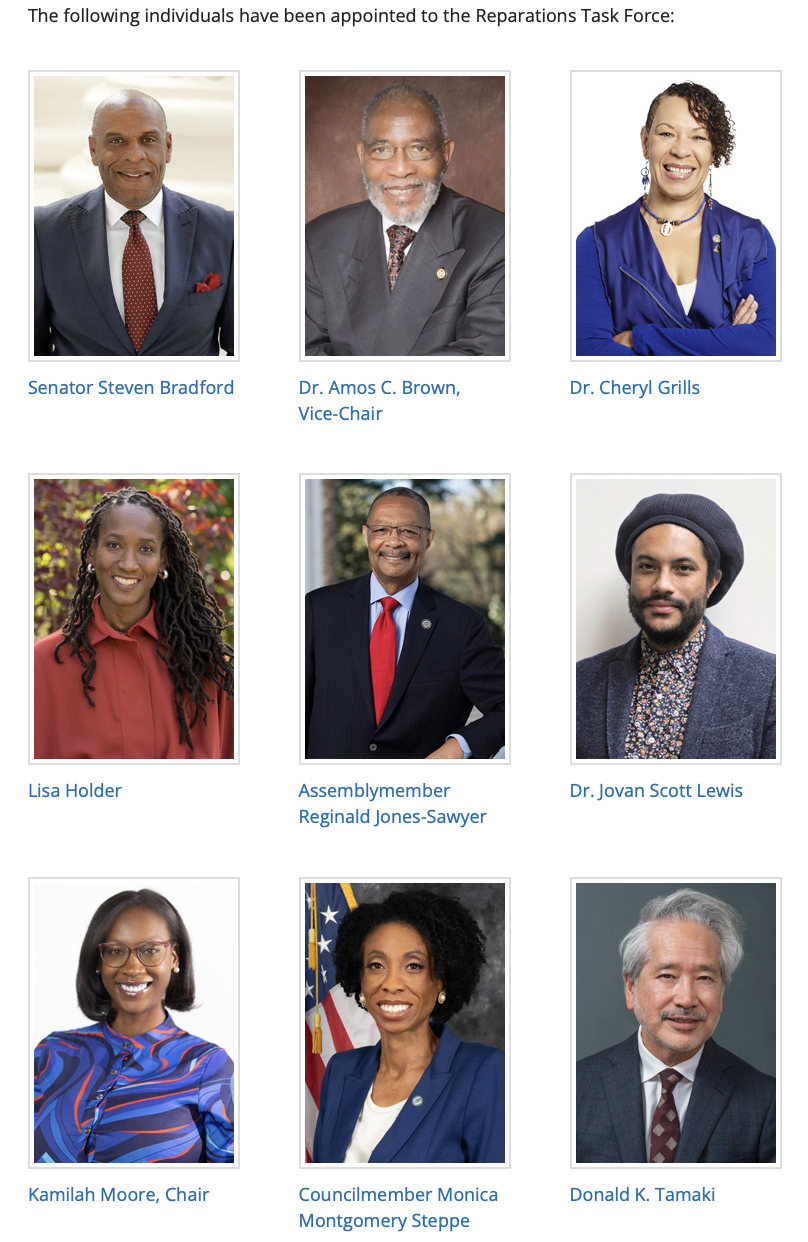
In 2020, California convened a first-in-the-nation Reparations Task Force. It ran for three years, issued more than 100 recommendations, and produced payment estimates reaching $1.2 million per eligible individual. At public hearings, activists dismissed that as insufficient — $5 million was the floor, they said, citing San Francisco’s own separate proposal. Economists put the aggregate cost at over $800 billion, roughly three times California’s entire annual budget. Allowing those expectations to propagate without correction is a detachment from fiscal reality, not a policy disagreement.
Gavin Newsom owns the largest share of the blame. He commissioned the Task Force, accepted its report, then spent two years vetoing the bills that would have made it real. He signed the symbolic measures — the apology, the Bureau for Descendants of American Slavery, the ancestry research funding — and killed everything with a price tag. College admissions preferences, eminent domain restitution, housing loan set-asides: vetoed. The target constituency got a certificate of regret and a new agency with no mandate to pay anyone. The calculation was straightforward: keep the issue alive, keep the constituency mobilized, and let the courts absorb the blame.
The Legislative Black Caucus shares the blame. The “Road to Repair” package gave every participant political cover without the burden of result. Legislative theater with a bureaucratic souvenir. Coastal San Diego’s own representatives played along — Senator Catherine Blakespear and Assemblywoman Tasha Boerner voted repeatedly for reparations legislation, apparently unconcerned that the program was fiscally impossible, constitutionally indefensible, and going nowhere. Their constituents might reasonably ask what problems, exactly, they were solving.
The constitutional obstacles were never seriously engaged — and here the malpractice becomes something closer to fraud. Federal standing doctrine requires a concrete, particularized injury traceable to a specific defendant. Descendants of enslaved people were not themselves enslaved. The Task Force’s methodology — payments calibrated to years of California residency rather than any documented personal harm — is an ethnicity-based transfer payment with a residency multiplier, not a legal remedy. The causation problem is equally fatal: California entered the union in 1850 as a free state and is not a successor-in-interest to antebellum slaveholders in any cognizable sense. Then there’s the 14th Amendment’s equal protection clause, the Supreme Court’s strict scrutiny doctrine reinforced in SFFA v. Harvard (2023), and California’s own Proposition 209. The program fails on multiple independent grounds. Every legislator who advanced it knew this or should have.
The reparations push was not a good-faith policy effort that fell short. It was constituency exploitation masquerading as justice — designed to keep Black voters loyal to a party that had ceased to deliver anything tangible in exchange for that loyalty. It may prove the most counterproductive political calculation in a generation of bad ones.
Black voters, particularly men, were already drifting toward Republicans before this cycle — not in numbers that flipped elections, but enough to alarm Democratic strategists. The episode proves what Democratic politicians do: make any promise necessary to secure a vote and honor none of them. That will not summon a disappointed constituency back into the fold. It will drive them across the aisle, handing Republicans a rare opening to make an affirmative case rather than simply an opposition one.
The activists surrounding Steyer’s vehicle weren’t wrong to hold him accountable. They had been promised something by people running for office and nothing arrived. Reparations didn’t collapse under the weight of its contradictions. It served its purpose and was discarded. The constituency it was designed to manage is only now figuring that out. For the Democrat supermajority in Sacramento that passes for a successful program.


- From the Cheap Seats: Judgment in Encinitas - September 24, 2026
- The Inheritance: California’s Spending Problem - July 20, 2026
- Political Malpractice: Reparations Were Designed to Keep Black Voters Loyal to a Party - June 20, 2026
RELATED ARTICLES
-

-
 February 11, 2026
 -
Pathetic isn’t it? Democrats attempting to “buy” off Blacks but never give them the money. What a losing argument. When will they get wise?
I agree 100% with paying blacks for reparations! And since it was the Democratic party which was the party of slave owners and who founded the KKK and started Jim Crow laws, then they should be the ones to pay it. And of course every Democratic “leader” should be forced to apologize for the racist history of their political party. Also we should start a new national holiday giving remembrance and thanks to the Republican party for their role in ending slavery. 5 million dollars to every black person in the country sounds like a fair deal to me!!
Hey, since I can become a woman by just saying I am, why can’t I identify as an oppressed black descendent of slaves and rake in all those reparation bucks?