
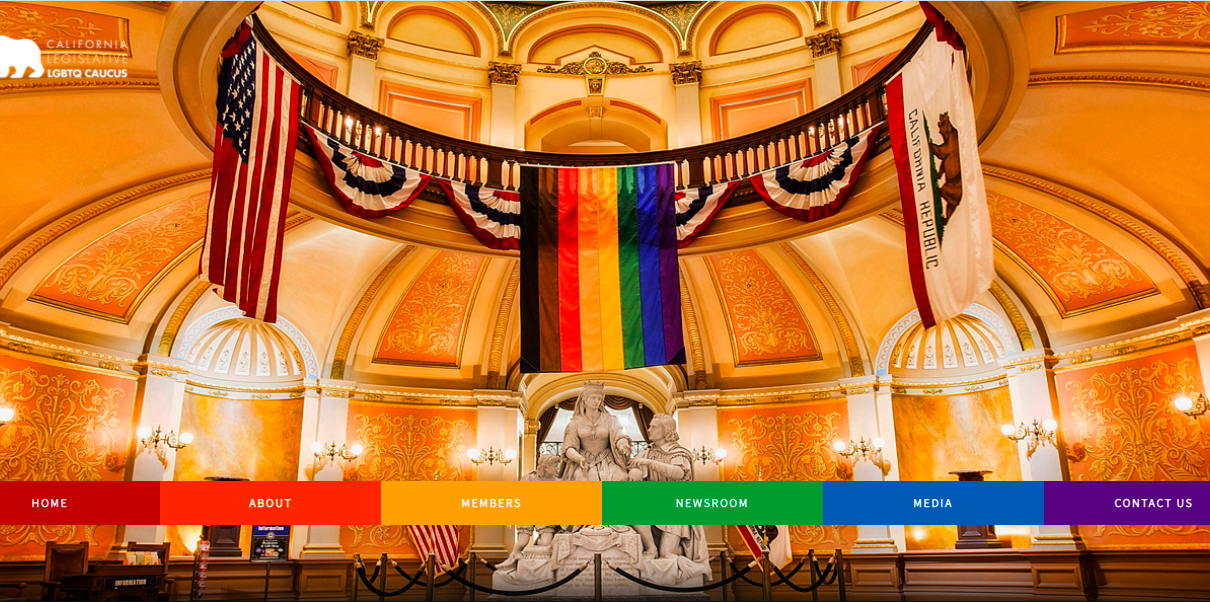
LGBTQ Caucus website photo. (Photo: https://lgbtqcaucus.legislature.ca.gov/)
The New Caste System: California’s LGBTBE Program Rewards Identity Over Merit
Sacramento is systematically dismantling the institutional infrastructure that made the state worth staying in
By Jay Rogers, June 20, 2026 6:40 am
I arrived in California in 1990, when the government was functioning and the mood was upbeat. Thirty-five years later I’m still here, watching Sacramento systematically dismantle the institutional infrastructure that made the state worth staying in.
The latest example is a program most Californians have never heard of: the CPUC’s LGBTBE supplier diversity program — a 1.5% procurement goal for LGBT-owned business enterprises that would route roughly $633 million in annual utility contracts toward firms certified on the basis of their owners’ sexual identity if the state’s large utilities actually hit the target.
Certification under CPUC General Order 156 requires LGBT organization letters, domestic partner affidavits, media mentions, and in some cases therapy documentation. False certifications carry county jail time. The entire structure has produced 451 certified LGBTBE firms in the state clearinghouse — compared to 3,750 minority-owned firms — while piling compliance overhead onto utilities like PG&E, Edison, SDG&E, AT&T, and Comcast, and ultimately onto their California customers.
At SDG&E in 2024, LGBTBE spending reached only 0.44% of total procurement, well below the 1.5% goal, while the compliance apparatus ran at full cost. About 9% of American adults identify as LGBTQ+; the program certifies a fraction of that community while generating the full overhead.
The Equal Protection Clause doesn’t come with a carve-out for fashionable identities.
The Fourteenth Amendment protects individuals, not groups. California courts have confirmed this on directly analogous facts. In April 2022, an LA Superior Court judge struck down AB 979’s board diversity quotas for race, sexual orientation, and gender identity in Crest v. Padilla II, holding that California’s Constitution bars differential treatment on those bases without a compelling, narrowly tailored government interest.
The state produced none. The CPUC’s LGBTBE procurement targets rest on the same constitutional footing and should expect the same outcome in court.
Proposition 209, which California voters passed 54.6% to 45.4% in 1996, prohibits preferential treatment in public contracting based on race, sex, color, ethnicity, and national origin. Voters reaffirmed that principle in November 2020, defeating a Prop 209 repeal by 57% to 43%.
The LGBTBE program extends the same identity-preference architecture to a new category — but the equal-protection principle the voters encoded in the state constitution is identical. Federally, President Trump’s Executive Order 14173, signed January 21, 2025, revoked the six-decade-old EO 11246, eliminated affirmative action requirements for federal contractors, and directed agencies to stop workforce balancing by race, sex, or sexual preference. Washington moved toward merit. Sacramento is running in the opposite direction.
I coached high school track and field for years. The stopwatch never asked about identity.
The kid who trained hardest cleared the hurdles, and the team that executed won meets. We celebrated effort, and athletes who earned their spots knew they’d actually earned them. California’s LGBTBE program sends precisely the opposite message. It tells the next generation that some categories earn structural advantages while others compete straight up.
That doesn’t level a field. It tilts one, and the athletes standing downhill know it.
The broader supplier diversity apparatus compounds the damage.
Each new protected procurement category fragments the polity further into competing client groups demanding their piece of the contracting pie.
The program now extends preferences that began with race and gender into a new identity category, and the logic has no natural stopping point.
Citizens aren’t naive — they see when the rules tilt by bureaucratic favor, and trust erodes accordingly. I’ve advised families on preserving wealth across generations, and I can tell you: the institutions that survive are those that reward execution. The ones that substitute process for performance don’t last. Neither do states.
Each new identity-based procurement category added to the GO 156 program creates another interest group with a stake in the program’s expansion, another certification bureaucracy, another layer of process between a California business and a public contract.
I’ve advised family offices and institutional clients for thirty years.
The institutions that endure are those that reward execution. The ones that substitute affiliation for performance metrics do not survive — not in private markets, and not in the public sector either, though the feedback loop is slower and more politically insulated.
As an expert witness on fiduciary matters in federal and state courts since 2015, I’ve watched divided incentives fracture organizations from the inside.
Management realigns around preferred constituencies. Accountability diffuses. The connection between results and reward breaks down. It operates the same way at the state level — only more slowly, and at ratepayer expense, and with enough political insulation that the people responsible rarely face the consequences of what they built.
California has watched this dynamic play out for thirty years across pension systems, housing agencies, and regulatory bodies.The LGBTBE program is a smaller version of the same architecture: a program designed to produce the appearance of a result rather than the result itself.
It certifies 451 firms against a $633 million target, reaches 0.44% spend at its largest covered utility, and declares the compliance infrastructure a success. That’s not equity. That’s California running a program that rewards affiliation over execution — the same pattern that has hollowed out institutions across the state.
The voters of California encoded a different principle in the state constitution in 1996 and reaffirmed it in 2020.
Sacramento keeps looking for ways around it. The CPUC found one by labeling a procurement mandate an aspirational goal. It won’t survive a serious constitutional challenge, and it shouldn’t.
The defense — modest, voluntary, aspirational goals — doesn’t hold. Utilities face annual CPUC reporting requirements and regulatory scrutiny for missing targets. The program carries criminal penalties for false certifications. The Crest equal-protection reasoning reaches procurement programs as directly as it reached board composition mandates. Sacramento is one lawsuit away from losing this program in court.
It would be better to repeal it first.
Support for disadvantaged California businesses can be built on neutral ground: capital access, permitting reform, workforce development. Open competition on merit. None of those tools require businesses to document their owners’ private lives to a state registry.
California should repeal the identity-based procurement targets in GO 156.
I’ve lived here long enough to remember what the state looked like when its institutions rewarded execution. I raised three sons here and watched the oldest graduate from West Point. Earned achievement is visible — it has a quality that identity-certified achievement does not and that people on the wrong end of the preference always notice. The California that built the economy worth inheriting ran on the proposition that opportunity is equal, outcomes aren’t guaranteed, and effort decides the difference.
The LGBTBE program rejects that proposition. The Constitution doesn’t permit it. The voters have twice rejected it.
The program’s own compliance record — 0.44%, spent against a 1.5% goal at full compliance cost — doesn’t justify its existence on any metric. Sacramento should repeal it and build something that actually works.


- Sacramento Flunks Civics Again - October 19, 2026
- Class President by Appointment - October 14, 2026
- Fewer Kids, More Payroll: LAUSD’s Math Problem - October 11, 2026
RELATED ARTICLES
-
 August 15, 2024
 -
 March 23, 2022
 -
 August 12, 2024
Women in government. Prove me wrong.
Lazy overnment employees who can’t speak comprehensible english.
It’s not Sacramento that is systematically dismantle the institutional infrastructure that made the state worth staying in, it’s DEMOCRATS! The CPUC commissioners oversee the Utility Supplier Diversity Program under General Order 156 and all five current commissioners are leftist Democrat stooges who were appointed by Democrat Gov. Gavin Newsom.
The Democrat party has a dark and evil history of horrific discrimination being the party of slavery, KKK, Jim Crow laws, World War II internment camps, segregation, affirmative action, and DEI.