
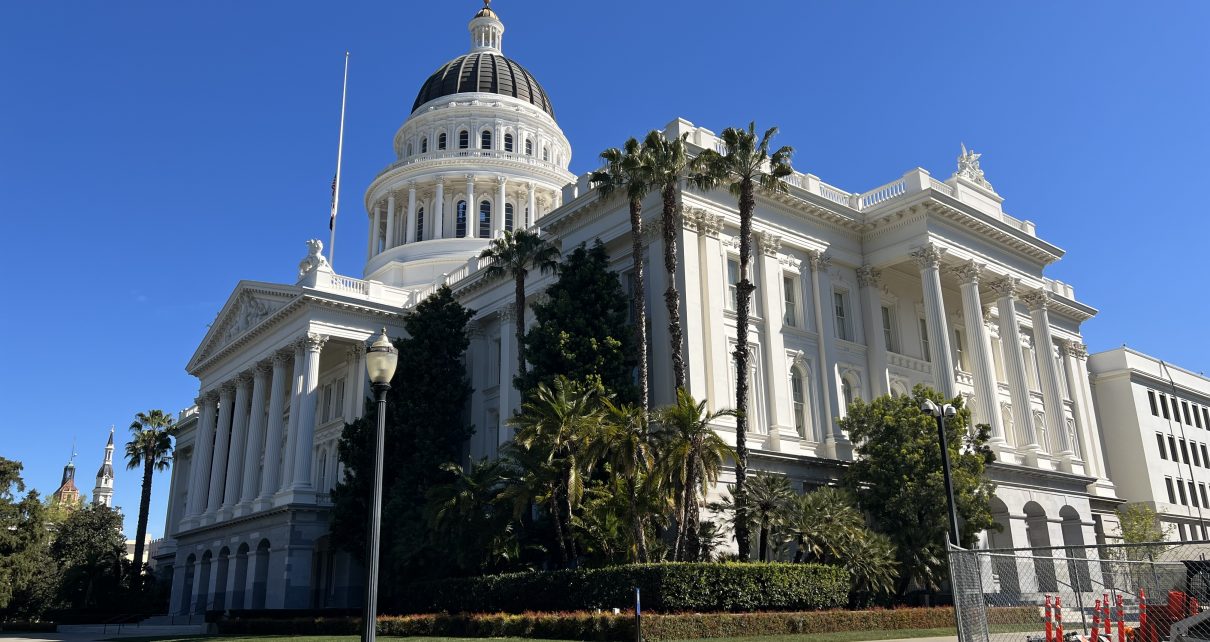
California State Capitol. (Photo: Kevin Sanders for California Globe).
Servitudes
Deals with servitudes regarding estates in real property
By Chris Micheli, August 16, 2026 2:30 am
Division 2, Part 2, Title 2, Chapter 3 of the Civil Code deals with servitudes regarding estates in real property.
Section 801 provides that the eighteen specified land burdens, or servitudes upon land, may be attached to other land as incidents or appurtenances, and are then called easements.
Section 801.5 states that the right of receiving sunlight is referred to as a solar easement. The term “solar easement” is defined, along with “solar energy system.” Any solar collector or other solar energy device whose primary purpose is to provide for the collection, storage, and distribution of solar energy for space heating, space cooling, electric generation, or water heating. A structural design feature includes three specified devices. Any instrument creating a solar easement must include all of the three specified items. The term “electric utility” is defined.
Section 801.7 says that when a right-of-way is granted to a railroad corporation whose primary business is the transportation of passengers, the grant must include a right-of-way for the location, construction, and maintenance of the railroad corporation’s necessary works and for every necessary adjunct thereto. The term “railroad corporation” is defined.
Section 802 specifies that the following land burdens, or servitudes upon land, may be granted and held, though not attached to land the right to pasture, and of fishing and taking game; the right of a seat in church; the right of burial; the right of taking rents and tolls; the right of way; and the right of taking water, wood, minerals, or other things.
Section 803 provides that the land to which an easement is attached is called the dominant tenement; the land upon which a burden or servitude is laid is called the servient tenement.
Section 804 says that a servitude can be created only by one who has a vested estate in the servient tenement.
Section 805 states that a servitude thereon cannot be held by the owner of the servient tenement.
Section 806 provides that the extent of a servitude is determined by the terms of the grant, or the nature of the enjoyment by which it was acquired.
Section 807 specifies that, in case of partition of the dominant tenement, the burden must be apportioned according to the division of the dominant tenement, but not in such a way as to increase the burden upon the servient tenement.
Section 808 says that the owner of a future estate in a dominant tenement may use easements attached for the purpose of viewing waste, demanding rent, or removing an obstruction to the enjoyment of such easements, although the tenement is occupied by a tenant.
Section 809 states the owner of any estate in a dominant tenement, or the occupant of the tenement, may maintain an action for the enforcement of an easement attached thereto.
Section 810 provides that the owner in fee of a servient tenement may maintain an action for the possession of the land, against any one unlawfully possessed thereof, though a servitude exists thereon in favor of the public.
Section 811 specifies that a servitude is extinguished in four specified instances.
Section 813 states that the holder of record title to land may record in the office of the recorder of any county in which any part of the land is situated, a description of the land and a notice reading substantially as specified in this section.
In addition, the recorded notice is conclusive evidence that subsequent use of the land during the time the notice is in effect by the public or any user for any purpose (other than any use expressly allowed by a written or recorded map, agreement, deed or dedication) is permissive and with consent in any judicial proceeding involving the issue as to whether all or any portion of such land has been dedicated to public use or whether any user has a prescriptive right in such land or any portion.
The notice may be revoked by the holder of record title by recording a notice of revocation in the office of the recorder wherein the notice is recorded. After recording a notice pursuant to this section, and prior to any revocation, the owner cannot prevent any public use appropriate thereto by physical obstruction, notice or otherwise.


- Unruh Act - October 19, 2026
- Some Suggestions for Those New to the California Executive Branch - October 19, 2026
- Support Services and the Sales Tax - October 19, 2026
RELATED ARTICLES
-
 May 17, 2026
 -
 August 22, 2024
 -
 June 1, 2026