

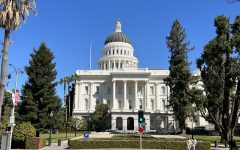
California State Capitol (Photo: Kevin Sanders for California Globe)
Domesticated Game Breeding
Deals with domesticated game breeding and commercial activities in the State of California
By Chris Micheli, August 15, 2026 2:30 am
Fish and Game Code Division 4, Part 1, Chapter 2, Article 1 deals with domesticated game breeding and commercial activities in the State of California.
Section 3200 provides that any person engaged in raising or importing, or who keeps in captivity, in this state domesticated game birds or domesticated game mammals which normally exist in the wild in this state is required to procure a domesticated game breeder’s license if the birds or mammals are kept more than 30 days after acquisition. No license is, however, required of any of five specifies circumstances.
Section 3201 prohibits persons from selling the carcass of any domesticated game bird or mammal without first obtaining a domesticated game breeder’s license from the department. The department may issue a license upon terms and conditions as the commission may prescribe, and the commission may at any time revoke such a license for sufficient cause.
Section 3202 states there are classes of domesticated game breeder’s licenses, designated “class 1” and “class 2.” Class 1 and Class 2 are defined.
Section 3203 requires the department to issue a class 1 domesticated game breeder’s license upon the payment of a base fee of $8, as adjusted under Section 713, and a class 2 domesticated game breeder’s license upon the payment of a base fee of $40, as adjusted.
Section 3204 provides that licenses issued under the provisions of this article are valid for a term of one year from January 1st, or, if issued after the beginning of such term, for the remainder thereof. A domesticated game breeder’s license must be conspicuously displayed on the property where the birds or mammals are held in captivity.
Section 3205 says that carriers for hire may carry within the State live domesticated game birds and mammals upon the terms and conditions as the commission may prescribe.
Section 3206 prohibits any domesticated game bird or mammal from being transported or sold dead unless each quarter and each loin of the carcass of each large mammal, the carcass of each bird for a domesticated game bird raised outside this State, and the carcass of each small mammal is tagged with a domesticated game breeder’s tag or seal.
Section 3207 requires the department to collect three cents ($0.03) for each tag or seal.
Section 3208 requires, on or before January 31st of each year, every person to whom a domesticated game breeder’s license has been issued to report four specified items of information to the department on a form provided by the department.
Section 3209 states that, in lieu of the tag required, poultry processing plants which process domesticated game birds received from persons licensed pursuant to this article may package each individual carcass in a nonreusable container clearly labeled on the outside with the species of bird and the wording “Product of a Licensed California Domesticated Game Breeder.” Each processor receiving domesticated game birds must keep a complete record of all birds received showing four specified items of information.
Section 3212 states that the keeper of a hotel, restaurant, boardinghouse, or club may sell portions of a quarter or loin of a large mammal, or the carcass of a game bird or mammal raised or imported under a domesticated game breeder’s license, to a patron for actual consumption on the premises only, and no license for that purpose is required of such keeper or club.
Section 3213 authorizes a retail meat dealer to sell without a license portions of a quarter or loin of a large mammal or the carcass of a game bird or mammal raised or imported under a domesticated game breeder’s license to a customer for actual consumption. Retail dealers must submit their premises to inspection by the department, and display at any authorized inspection any carcass or parts thereof held by them in storage.
Section 3214 requires domesticated game breeders or other persons holding domesticated game mammals in captivity to confine the mammals in escape-proof cages or enclosures. In the event any of the mammals escape from the cages or enclosures, the owner is required to immediately make every reasonable effort to recapture them. If the owner fails to recapture the escaped mammals, the department may capture the mammals or remove them from the wild by whatever means may be necessary.
Section 3216 requires all domesticated game birds and mammals, excepting deer, sold under the provisions of this article, to be killed otherwise than by shooting.
Section 3217 requires the carcass of a game bird which shows that it has been killed by shooting constitutes prima facie evidence that it was not a domesticated game bird.
Section 3218 allows any license issued under this article to be revoked by the commission upon conviction of the licensee of a violation of any provision of this code, and no similar license may be issued to the licensee during the same license year.
Section 3219 allows domesticated reindeer tobe imported into this State and sold only in accordance with regulations which the commission may prescribe.


- Sales Tax Presumptions - October 17, 2026
- A Unique Aspect of California Lobbying: Local Governments - October 16, 2026
- Some Suggestions for Those New to California Legislative Drafting - October 16, 2026
RELATED ARTICLES
-
 May 1, 2026
 -
 June 21, 2026
 -
 March 26, 2026
is there anything that this Democrat governing body DOES NOT REGULATE, LITIGATE, & PUNISH THOSE THAT CREATE FOOD FOR 40 MILLION PEOPLE+ USA+ THE WORLD? PROTEINS, GRAINS, FRUITS,, VEGETABLES, POULTRY, BEEF, PORK?