
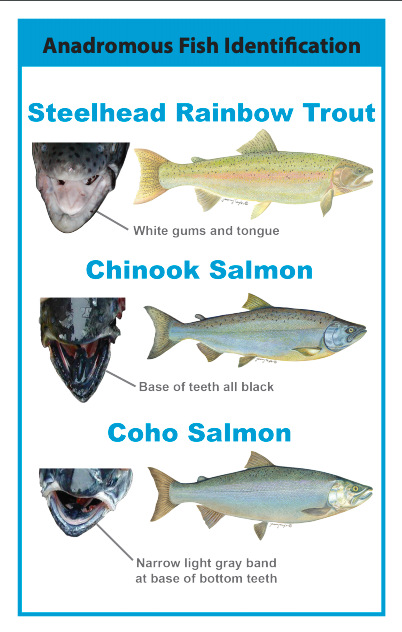
CA Sport Fishing Regulations. (Photo: nrm.dfg.ca.gov)
Powers and Duties of Department of Fish and Wildlife
Requires the department to expend funds necessary for biological research and field investigation
By Chris Micheli, August 20, 2026 2:00 pm
Division 2, Chapter 3, Article 1 of the Fish and Game Code deals with the powers and duties of the California Department of Fish and Wildlife.
Section 1000 requires the department to expend funds necessary for biological research and field investigation and for the collection and diffusion of statistics and information that pertain to the conservation, propagation, protection, and perpetuation of birds and their nests and eggs, and of mammals, reptiles, amphibians, and fish.
Section 1000.6 contains three legislative findings and declarations. The department is required to use present assessment methods to assess the salmon escapement count on the Eel River and the Smith River, as well as the Klamath River, systems, employing out-of-work fishermen, where possible, to do the counts with department personnel in supervisory capacities.
Section 1001 prohibits anything in the law from precluding the department from taking, for scientific, propagation, public health or safety, prevention or relief of suffering, or law enforcement purposes, fish, amphibians, reptiles, mammals, birds, and the nests and eggs thereof, or any other form of plant or animal life.
Section 1002 authorizes the department to issue permits, subject to restrictions and regulations that the department determines are desirable, to take or possess, in any part of the state, for scientific, educational, or propagation purposes, mammals, birds and the nests and eggs thereof, fish, amphibians, reptiles, or any other form of plant or animal life.
The department may issue a permit that is valid for 36 months from the date of issuance on the payment of a nonrefundable application fee of $100 and a permit fee of $300. The department may issue a special student permit.
Section 1002.5 authorizes the department to issue a permit to an appropriate public, private, or nonprofit entity, or a person, as determined by the department, in the name of a principal scientific investigator or the permitted entity or person. The department may approve individual temporary employees or volunteers to work under the permit, after receiving notification from the permittee.
Section 1003 provides that mammals, birds and their nests and eggs, fish and their eggs, reptiles, amphibians, mollusks, crustaceans, or any other form of plant or animal life taken under the provisions of a scientific or propagation permit may be shipped or transported anywhere within or without the state if prior written approval is obtained from the department and the shipment is accompanied by the name, address, and permit number of the person holding the scientific or propagation permit.
Section 1004 allows the department to capture and sell birds and mammals, at prices to be fixed by the commission, to persons engaged in the domestication and sale thereof in this State.
Section 1005 states that, for the purpose of exhibiting fish and game educational material at fairs or sportsmen’s shows and making other public displays, and to make conservation educational materials on fish and game available for any public use, including fairs, sportsmen’s shows, schools, and civic organizations, the department may engage in two specified actions.
Section 1005.5 allows the department to accept gifts of personal property if the donor is a county of the state and the gift is purchased with fine money derived from fish and game violations. The department must notify the Department of Finance 30 days in advance of accepting these gifts.
Section 1006 authorizes the department to inspect two specified categories of items.
Section 1007 allows the department to import, propagate, and distribute birds, mammals, or fish.
Section 1008 requires the department to investigate all diseases of, and problems relating to, birds, mammals, or fish, and establish and maintain laboratories to assist in such investigation.
Section 1009 authorizes the department to obtain for the State rights of way over private lands for the purpose of furnishing access for the public to lands or waters open to public hunting or fishing whenever such rights of way are determined by the commission to be necessary for such public use. Such rights of way cannot be acquired by eminent domain proceedings.
Section 1010 says that the department, by and with the approval of the Department of General Services, to sell grazing permits or otherwise dispose of excess vegetation or other products, produced on lands acquired by the department.
Section 1011 authorizes the department to procure insurance for any of two specified activities.
Section 1012 authorizes the department to procure insurance for its employees for injury or death against the liability of the owner or operator of any vessel boarded by an employee as an observer.
Section 1013 states that, in any lease, easement, or right-of-way entered into whereby the department leases real property or obtains a grant of easement or right-of-way in real property for the purpose of constructing, operating, or maintaining a fish screen, fish ladder, fishweir, or fishtrap, the department may agree to indemnify and hold harmless the lessor or grantor by reason of the uses authorized by such lease, easement, or right-of-way. Insurance may be purchased by the Department of General Services to protect the department against loss or expense arising out of such a lease, easement, or right-of-way.
Section 1014 provides that, if the Department of Parks and Recreation contracts with the federal government for the administration of recreation development or fish and wildlife enhancement facilities, the Department of Fish and Wildlife is authorized to operate, maintain, and replace those facilities designated as fish and wildlife enhancement facilities and to assume all costs of that operation, maintenance, and replacement, subject to appropriation of funds by the Legislature.
Section 1015 provides that, whenever the department is required, or provided an opportunity, to assess the adequacy of a project or to provide a detailed environmental impact statement or similar document, it is required to determine the extent to which salmon and steelhead resources will be protected from damage by the project in question, together with the extent to which the agency or person preparing the plans for the project has incorporated therein plans for increasing the salmon or steelhead resources of this state.
Section 1016 states that, whenever the department determines that an oil sump is hazardous to wildlife, but does not constitute an immediate and grave danger to wildlife, the department is required to quickly notify the State Oil and Gas Supervisor of the condition in order that he may take action to have the condition cleaned up or abated. The department in making the notification has to specify the hazardous conditions.
The commission is required to promulgate rules and regulations as are necessary to implement the provisions of this section, including a reasonable definition of the term “hazardous” for the purposes of this section. It is the intent of the Legislature that the department adopt, as a part of the rules and regulations, a definition of the term “wildlife,” which will provide for reasonable exclusions consistent with effectuating the wildlife protection purposes of this section.
Section 1017 makes it the policy of the state to anticipate and resolve potential conflicts between the management, conservation, and protection of fish and wildlife resources and their habitat and private and public activities that may affect them. The department may use such informal consultative procedures prior to taking any formal action as will assist in the achievement of this policy.
Section 1018 requires the director to use the department’s resources, to the fullest extent feasible, to coordinate with the federal government to promote the preservation of species, including species listed as endangered species or threatened species under the federal law.
Section 1019 requires the department of prepare draft management plans for public review within 18 months of the recordation date. Also, the department is required to submit a list of lands acquired during the previous two fiscal years and the status of the management plans for each acquisition to the fiscal committees of each house of the Legislature.
Section 1020 requires the department and the commission to develop a strategic plan to implement proposals arising from any of three specified circumstances. The department and the commission may contract for consultants to assist in the preparation of the strategic plan
.
Section 1021 authorizes the department to take feasible actions to conserve monarch butterflies and the unique habitats they depend upon for successful migration. These actions may include, but are not limited to, habitat restoration on department lands, education programs, and voluntary agreements with private landowners.
Section 1022 authorizes the commission to authorize, for research, educational, limited testing, data collection, compensation fishing, conservation engineering, or exploratory fishing, or any combination of these purposes, an EFP to be issued by the department that authorizes commercial or recreational marine fishing activity otherwise prohibited by this code or any regulation adopted pursuant to this code, subject, at a minimum, to five specified items.
The commission must establish by regulation an expeditious process for department review, public notice and comment, commission approval, and prompt department issuance of EFPs. Upon completion of the activities authorized in an EFP, or periodically under terms specified by the commission, a person fishing under an EFP must submit to the commission and the department a final report summarizing the EFP research and findings, and any scientific reports or other publications created as a result of the activity.
The following terms are defined: “compensation fishing,” “conservation engineering,” “EFP,” and “exploratory fishing.”
Section 1023 provides that, upon appropriation by the Legislature, the department may develop a pilot program to collect and compile information and data on wildlife-vehicle collisions to support wildlife conservation efforts conducted through regional conservation investment strategies approved, or any policy or project implemented to reduce the loss of wildlife from vehicle collisions.
Section 1024 requires the department to conduct a study to create a framework for cannabis site restoration projects with the goal of providing guidance for the cleanup, remediation, and restoration of environmental damage caused by cannabis cultivation. As part of the study, the department is required to do both of the specified actions.
Section 1025 requires the department to submit a report to the Legislature each year on illicit cannabis cultivation, including reconnaissance, eradication, reclamation, and restoration operations involving the department, and on the status of efforts to repair habitat degradation and other environmental damage in watersheds affected by cannabis cultivation on both public and private lands.
As part of the report prepared pursuant to this subdivision, the department has to include four specified items.


- Physically Disabled Persons - October 20, 2026
- What are Some Unique Aspects of California’s Judicial Branch? - October 20, 2026
- Employer Subrogation - October 20, 2026
RELATED ARTICLES
-
 April 22, 2026
 -
April 7, 2026
-
 March 3, 2026