
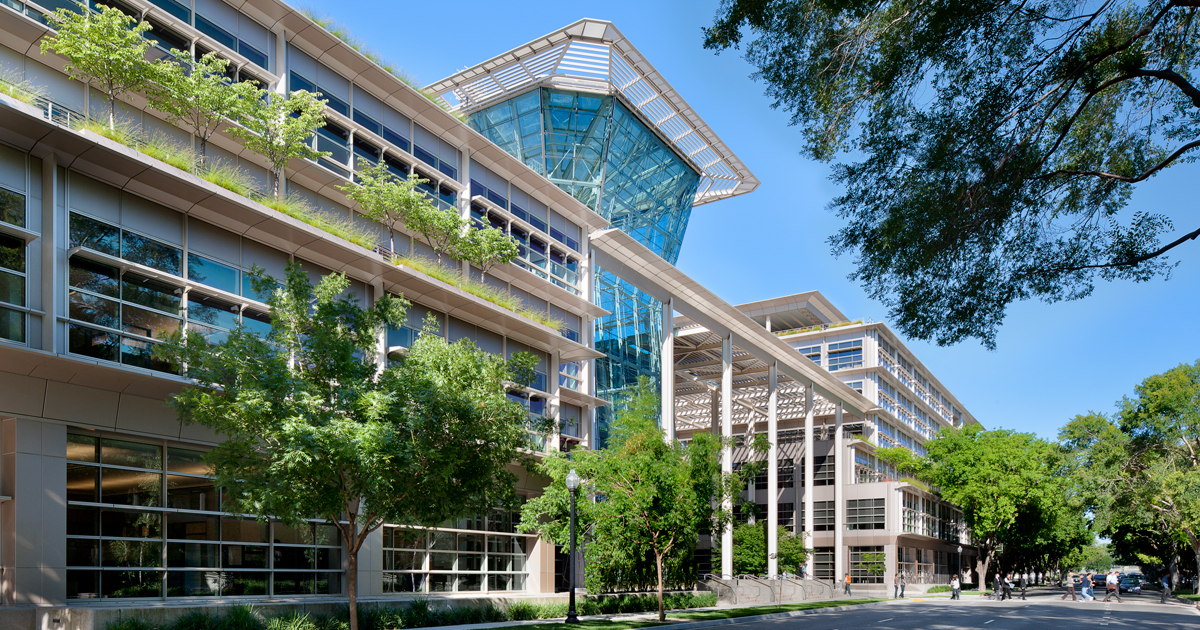
CalPERS headquarters, Sacramento. (Photo: calpers.ca.gov)
California Paid 250 State Workers More Than $600,000—One Took Home $2.3 Million
The top 10 CalPERS and CalSTRS pay packages alone totaled about $15 million in 2025—nearly double the inflation-adjusted total from seven years earlier
By Megan Barth, August 29, 2026 2:58 pm
While Gov. Gavin Newsom’s administration talks tax hikes and “budget gaps,” new state payroll records show California spends like Jordan Belfort with a CalPERS badge.
About 250 state employees collected more than $600,000 in total compensation in 2025, according to California State Controller data compiled by the San Francisco Chronicle. The highest-paid civil servant, CalPERS Chief Investment Officer Stephen Gilmore, took home more than $2.3 million, including a performance incentive of more than $1.5 million, despite CalPERS holding $563 billion in assets against $716 billion in liabilities.
Economist Stephen Moore put the numbers in blunt terms Friday. “If you are wondering where California’s tax dollars go and why the state is drowning in debt, here is a hint: 250 state employees were paid more than $600,000 last year,” Moore wrote. “California does not have a revenue problem. It has a spending problem.”
If you are wondering where California’s tax dollars go and why the state is drowning in debt, here is a hint:
250 state employees were paid more than $600,000 last year.
California does not have a revenue problem. It has a spending problem. pic.twitter.com/GfW06oY2Uh
— Stephen Moore (@StephenMoore) August 28, 2026
Gilmore’s paycheck is roughly nine times the governor’s $245,929 statutory salary and more than five times the $400,000 paid to the president of the United States. The 2025 controller files, released in late July, cover state department employees. University of California coaches and hospital physicians sit on a separate UC payroll and are not in this ranking.
Even without them, the civil-service list is staggering.
These are the best-documented top earners from the 2025 records and CalPERS’ own compensation disclosure:
- Stephen Gilmore, chief investment officer, CalPERS — about $2.3 million (roughly $721,000 salary and more than $1.5 million in “other pay,” booked as a 2024-25 incentive award).
- Arnold Phillips, managing investment director, CalPERS — $1.73 million, including about $1 million in other pay.
- Daniel Bienvenue, deputy chief investment officer, CalPERS — about $1.6 million.
- Marcie Frost, chief executive officer, CalPERS — about $1.6 million.
- Vernon Steiner, president and CEO, State Compensation Insurance Fund — about $1.2 million. Steiner is the highest-paid civil servant outside the two giant pension funds.
- Sarah Corr, managing investment director, CalPERS — about $1.33 million in fiscal 2024-25 total pay.
- James (Sterling) Gunn, managing investment director, CalPERS — about $1.27 million.
- Anton Orlich, managing investment director, CalPERS — about $1.26 million.
- Daniel Booth, deputy chief investment officer for private markets, CalPERS — about $1.24 million.
- Simiso Nzima, managing investment director, CalPERS — about $1.17 million.
More than 15 pension investment officers and executives cleared $1 million last year. In 2019, only two civil servants did. The top 10 CalPERS and CalSTRS pay packages alone totaled about $15 million in 2025—nearly double the inflation-adjusted total from seven years earlier.
Just below that club: retired CHP Chief Tai Vong at $914,554, including a $398,000 lump-sum payout; prison psychiatrists Samita Gandhi ($873,872), Olivia Del Pilar ($841,878) and Damon Walcott ($822,971); and sitting CHP chiefs James Mann ($838,272) and Donald Goodbrand ($824,122). CHP Sgt. Leonard Tomboc, the state’s overtime king, collected over $700,000 in overtime, within the last two years, on top of his salary.

A third of the 250 workers above $600,000 worked at CalPERS or CalSTRS, which together manage hundreds of billions for public employees and teachers. About half of the highest earners were at those funds or the Highway Patrol.
Executives made up roughly half the top of the list; the rest were investment managers, psychiatrists, physicians and sworn officers.
Base pay is only part of the story.
Controller records dump bonuses, incentive awards, overtime, and cash-outs of leave into “other pay.” For Gilmore, that bucket was larger than the salaries of entire agency executive leadership teams.
CalPERS told the Chronicle the $1.5 million was an incentive award tied to fiscal 2024-25 fund performance. The fund reported an 11.6 percent return that year and now oversees more than $600 billion. Defenders will say Wall Street would pay more to run a portfolio that size.
Taxpayers do not get to opt out of the bill. California still owes tens of billions toward unfunded pension and retiree-health benefits.
California Globe contributor Jay Rogers rang the warning bell in March, writing, ” Thirty years of running hedge funds, private equity deals, and now outsourced CIO roles for ultra-high-net-worth family offices taught me one ironclad rule. Optimistic assumptions in a spreadsheet are just fraud wearing a tie. I watched markets crash in 2008 and rebound in ways no model predicted. That is why the latest CalPERS numbers should alarm every California taxpayer, business owner, and parent who still believes in fiscal reality over political theater.”
Rogers added: “Even after the stock-market tailwinds that delivered an 11.6 percent preliminary return for the fiscal year ended June 30, 2025, CalPERS sits at roughly 79 percent funded. The system holds approximately $563 billion in assets against $716 billion in liabilities. That leaves a cool $153 billion hole. The state budget, meanwhile, quietly props up $11.8 billion in extra pension payments over the next four years. Newsom calls the rainy-day fund prudent stewardship. I call it pension welfare for union grifters dressed up as fiscal responsibility.”
The state is scheduled to send about $9.8 billion to CalPERS and $4.8 billion to CalSTRS in the coming fiscal year. Those contribution rates are calculated off the same payroll that just minted a $2.3 million civil servant.
Governor Newsom’s general-fund budget has grown by about $100 billion since his first full budget, from $146 billion to $248 billion, the Legislative Analyst’s Office has reported. State operations, driven heavily by employee compensation, accounted for a sizable share of that growth.
Civil-service headcount rose 23% between 2017-18 and 2024-25. Last year more than 1,700 state workers banked over $100,000 in overtime alone.
Despite the fact California collects some of the highest income, sales, and gas taxes in the country, the state still runs structural deficits. The Democrats’ fix? November’s ballot is loaded with new tax schemes.
The “civil servant” windfall is concentrated at the top: pension suites, prison psychiatry, and Highway Patrol brass, then socialized across every taxpayer who files a return despite the Democrats’ claims of “taxing the rich” to “pay their fair share.”
Moore’s line is the one Sacramento will try to talk past: the state is not short of money. It is drowning in commitments to a workforce that, at the high end, now clears presidential pay as a matter of routine. Two hundred fifty times over $600,000 is not a rounding error. It is the budget.
Editors note: See the Globe’s government pensions archive and coverage of CalPERS remaining underwater despite near-record returns.


- California Democrats Call Omar Home Search ‘Fascism’ After Cheering Mar-a-Lago Raid as Rule of Law - October 12, 2026
- ‘Game Over’: Clark County Teachers Union, Democrat DA Line Up Behind Lombardo - October 7, 2026
- White House Calls LA Times ‘Buffoons’ as Selectively Edited Trump Clip Fuels Manufactured Outrage - October 6, 2026
RELATED ARTICLES
-
 November 14, 2025
 -

-
-
Obscene state salaries combined with fraud is why young Californians have an affordability crisis.
Why are things so expensive in California? This is it!
I ask the young independent voter to do your research. Use common sense.
Our government abuses the tax base (us,the taxpayer). The Democrat supermajority solutions are never to balance or shrink the government but to impose more of the same! How do you think they support these obscene salaries? Hiking taxes whether it be a personal tax, property tax, sales tax, car registration, bridge tolls……..
Stop falling for the premise that affordability will be solved by more of your hard earned money is needed to fix the PROBLEMS THEY CREATED!
‘The problem with socialism is that you eventually run out of other people’s money.” -Margaret Thatcher
What are we paying these CalPERS people for?
For the fiscal year ending June 30, 2025, CalPERS reported a net investment return of 11.6%, while the S&P 500 climbed by 21% over the same timeframe. Consequently, CalPERS’ overall performance did not outperform the S&P 500 in that period. They could have just invested in an S&P 500 index fund, and we would have been better off without any of these useless money grubbing people.
Fire them!
No doubt CalPERS investment returns are subpar because Diversity, Equity, and Inclusion (DEI) permeates the organization and every investment decision? CalPERS employs a dedicated Chief Diversity, Equity, and Inclusion Officer, currently Shari Slate (appointed in 2026), who has a base compensation of $221,580 per year. This figure was reported in January 2026 when her hiring was announced, with CalPERS noting that her background is in corporate DEI rather than finance.
CalPERS key DEI activities include leveraging the framework to improve investment outcomes by engaging with public companies on board diversity and voting for DEI-related shareholder proposals. CalPERS also manages the Emerging & Diverse Manager Program and allocates capital to diverse investment managers, such as through the $1 billion Mosaic Project with TPG Next and GCM Grosvenor. Additionally, the system hired Chanin Kelly-Rae Consulting in late 2025 to evaluate and refine its DEI framework across investments, culture, and talent.
Yes, fire them all!