
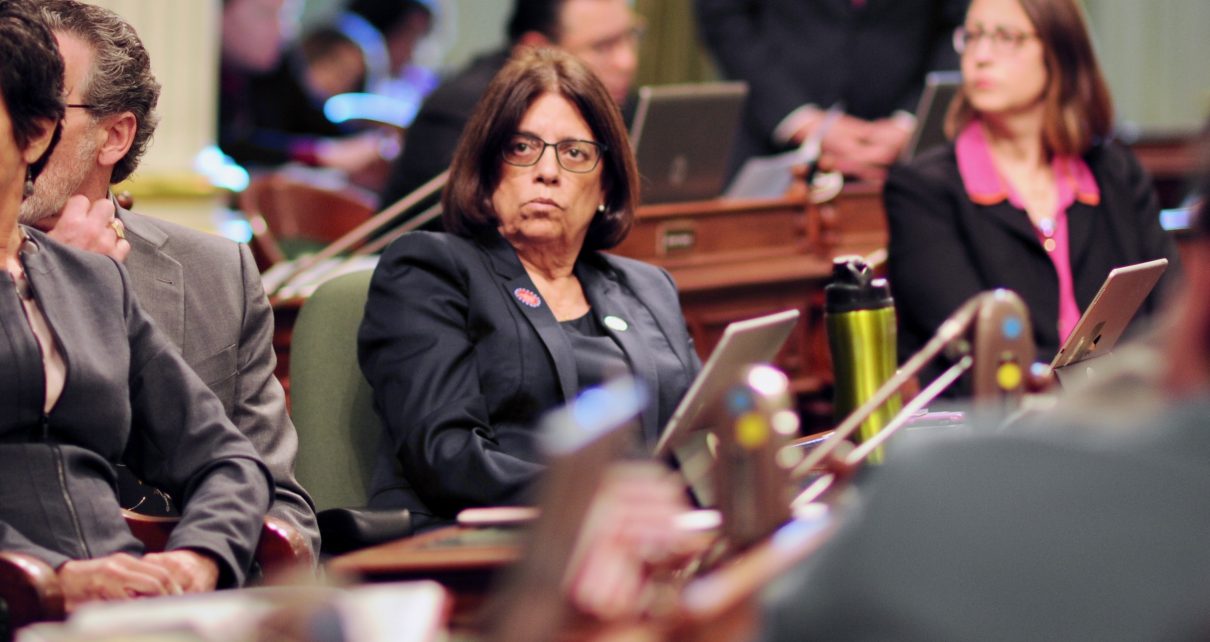
Assemblywoman Cecilia Aguiar-Curry. (Photo: Kevin Sanders for California Globe)
California Faces $670 Billion GDP Loss w/in 10 Years if AB 1776 Becomes Law
Huh? California Senate votes to end a century of ‘Monopoly Impunity’
By Katy Grimes, August 31, 2026 3:22 pm
“Legislation to rewrite the state’s robust antitrust law would wreak havoc on the Golden State’s economy and the tax dollars needed to fund vital government programs.”
That bold statement comes from the California Chamber of Commerce regarding a real business-killing bill, Assembly Bill 1776 by Assemblywoman Cecilia Aguiar-Curry (D-Winters).
They say AB 1776 is “out of step with state and federal antitrust standards and modern economic thinking and imposes changes that would prove economically devastating to a broad array of vital California industries.”
The CalChamber is right. AB 1776, if passed and becomes law, will open up a new pathway for predacious law firms to shake down businesses. It’s like the Private Attorneys General Act (PAGA) on steroids.
California is facing $670 billion loss in state GDP w/in 10 Years if Assembly Bill 1776 becomes law
That is what you need to keep in mind, while reading this announcement by the curious Economic Security California Action, celebrating passage of AB 1776 by the Senate:
Today the Senate doubled down on the promise of California’s economy. Legislators made it clear that the monopolies don’t get to write their own rules anymore.
What monopolies, besides say… the California State Lottery, the only legal lottery operator in the state? While the lottery is the clearest government monopoly according to the UC Davis Law Review, some would say utilities are monopolies, but they are the classic regulated natural monopolies. Almonds and pistachios are a standout global production monopoly. Everything else is private-sector concentration that California regulates or litigates rather than owns.
So, what monopolies are we talking about? Why is AB 1776 necessary, especially since only a few days ago it was placed on the suspense file, where bills usually go to die?
The CalChamber has scored AB 1776 as a significant Cost Driver that’s likely to worsen California’s affordability crisis and launched a multimillion-dollar public awareness advertising campaign to bring attention to the bill’s devastating impacts:
A diverse group of business, advocacy organizations, and local chambers of commerce oppose AB 1776. Twenty-five professors at California universities have urged the Legislature to reject the bill, arguing in part that it would represent a “severe and untested departure from established antitrust principles.”
They explain why:
Two new estimates — including one from the California Department of Finance — affirm what experts have been saying for months: legislation to rewrite the state’s robust antitrust law would wreak havoc on the Golden State’s economy and the tax dollars needed to fund vital government programs.
The analyses come just days before the Senate Appropriations Committee is scheduled to vote on Assembly Bill 1776 (Aguiar-Curry; D-Winters), a bill opposed by the California Chamber of Commerce and a diverse coalition including small businesses across the state.
Then there is the bill sponsor Economic Security California Action, which claims, “We’re working to build an inclusive and resilient economy so all Californians can thrive.”
Who is this group so determined to “build an inclusive and resilient economy?”
“Economic Security California Action is an affiliate of Economic Security Project, a 501(c)(3). Economic Security Project Action mobilizes resources and people behind ideas that build economic power for all Americans.”
Economic Security Project has a really catchy slogan: “We bring people together around big ideas to transform our economy and provide the resources to turn those ideas into reality.” Or should I say a really “catchall” slogan.
Economic Security Project was created in 2016 as a project of the Hopewell Fund, a funding and fiscal sponsorship nonprofit operated by “philanthropic” consulting firm Arabella Advisors, created by a a Clinton administration acolyte, described as the “mothership” of a “massive progressive dark-money group” by the Atlantic, according to Influence Watch.
In 2019, Economic Security Project announced the “Anti-Monopoly Fund,” to advocate for increased corporate regulations by the federal government. The project was funded by the Omidyar Network of eBay billionaire Pierre Omidyar, George Soros‘s Open Society Foundations, the Ford Foundation, the Nathan Cummings Foundation, and the Knight Foundation.
The Economic Security Project has previously advocated for a federal universal basic income program in which every working adult with an income under $50,000 per year would receive $500 per month, paid for by increased taxes. ESP stated that UBI programs should be implemented “in combination with robust social safety net programs.”
But WAIT! There’s MORE!
The Economic Security Project also supports a Cost-of-Living Refund, under the Earned Income Tax Credit.
All of that aside, we still don’t see the monopoly issue in California. A little research reveals that California courts have long said the Cartwright Act is “broader in range and deeper in reach” than the federal Sherman Act. Federal cases are persuasive, not controlling. “This distinction affords great leeway to the California courts, which usually give full effect to California’s longstanding tradition of vigorous antitrust enforcement, and which on the whole appear not to have been enthusiastic proponents of the more permissive consumer-welfare approach.”
The Computer & Communications Industry Association (CCIA), a global not-for-profit trade association representing a broad cross section of communications and technology firms, noted that “the bill’s own text tells a much more radical story.”
They explain in a recent report:
AB 1776 would add single-firm liability to a statute that allows indirect purchasers to sue and carries treble damages, construed under an express maximize-deterrence directive, with no defense for how challenged conduct in the supplier market benefits consumers.
We have estimated the costs of earlier versions of AB 1776, including an April analysis estimating the bill would cost about $1 trillion in foregone annual GDP ten years after enactment, and a June analysis of a revised version of the bill, finding that the revised bill would cost about $760 billion in foregone annual GDP ten years after enactment. Following new amendments to the bill text that occurred by early August, using the same model as the prior estimates but with components re-scored in response to the amendments, we estimate AB 1776 will still cost California $670 billion in foregone annual GDP by 2037.
They warn of Risk to the Startup Ecosystem: “the fiscal impact from the subset of impacts accruing to the startup ecosystem alone could be as high as $8.6 billion in lost California tax revenues over a decade, during which California is already predicted to face a structural budget deficit of about $35 billion per year.”
How is it that Economic Security California Action is driving this legislation?
Cal Chamber reports that the California Department of Finance opposes AB 1776:
“The business community’s concerns over the proposal to expand antitrust law to business practices involving a single firm — and to provide a so-called “private right of action” to allow virtually anyone to file legal action against a company — are echoed in a new staff analysis by the California Department of Finance (DOF), the government office that sets the agenda for each year’s state budget.
“Finance is opposed to this bill because it results in significant new state costs not included in the 2026 Budget Act,” the department’s analysts wrote in the review presented to the Senate Appropriations Committee.”
If you still doubt the analyses, Teri Olle, Vice President of Economic Security California Action, said this in a statement Sunday:
“What is going to the Governor is a bill that lets California’s attorney general and district attorneys go after the dominant corporations that block competitors, squeeze out small businesses, suppress wages, and drive up prices.”
What’s going to the Governor is a bill that will drive more billionaires and millionaires, and business owners out of California, and right into the open arms of pro-growth Governors.


A California native and Navy mom, Katy lives in Sacramento, CA.
- Another ‘Housing First’ Bill Passed by Legislature: No Fixed Timelines for Reductions, No Automatic Consequences if Goals are Missed - August 31, 2026
- California Faces $670 Billion GDP Loss w/in 10 Years if AB 1776 Becomes Law - August 31, 2026
- Trump Labor Department says Gavin Newsom OWES $22 BILLION to the American Taxpayer - August 31, 2026
RELATED ARTICLES
-
 May 18, 2026
 -
 May 31, 2025
 -
 January 12, 2023
Just stop it, will you? IDIOT Dem legislators! Knock it off. Take a break from killing California, okay?
“AB 1776, if passed and becomes law, will open up a new pathway for predacious law firms to shake down businesses. It’s like the Private Attorneys General Act (PAGA) on steroids.”
As if we don’t have ENOUGH pathways ALREADY for predatory law firms to shake down businesses.
GAH