
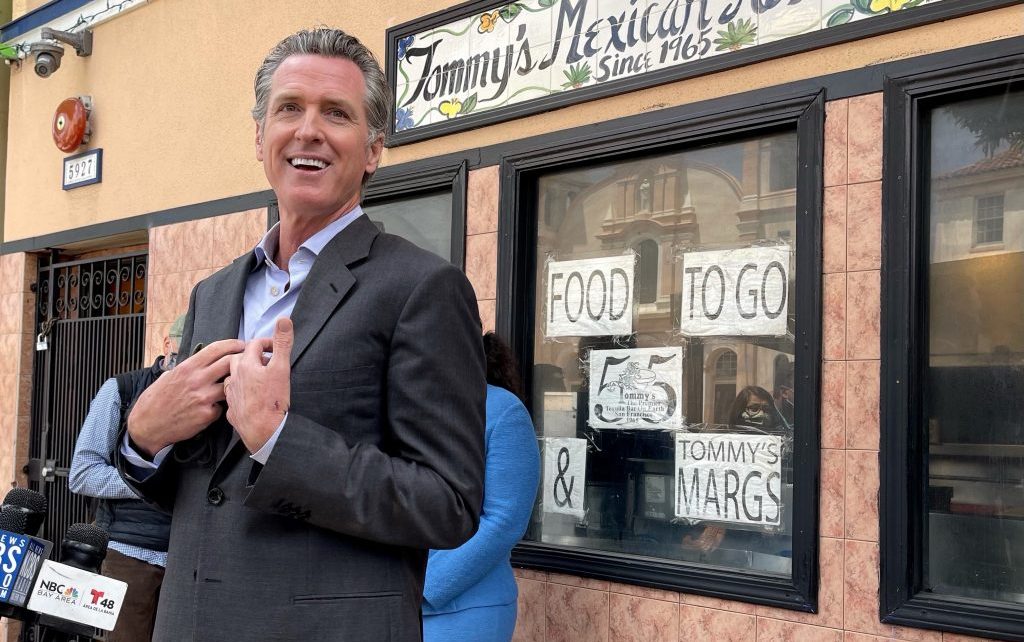
Governor Gavin Newsom in San Francisco on June 3, 2021 (Photo: Gov.CA.Gov)
California Shed Restaurant Jobs Under Gov. Newsom’s High Minimum Wage Policies
Gavin Newsom is touting that his sky-high minimum wage policies have allowed California to thrive
By Katy Grimes, September 3, 2026 3:19 pm
California Governor Gavin Newsom claims “California accounted for one in six new jobs in the nation,” through July 2026. The record-spending Governor brags that his sky-high minimum wage policies have allowed California to thrive, and the state has added jobs.
But quarterly data from the Bureau of Labor Statistics shows that the restaurant industry, which employs the majority of minimum wage earners, saw losses every year since 2023, when Newsom gave fast food workers a minimum wage increase to $20 per hour, shedding over 2.3 percent of its jobs – representing tens of thousands.
While the state has added jobs in other sectors, the increase during this period was driven by a beefed up public sector, which increased over 4%, and industries that don’t employ as many minimum wage workers, like management and health services.
Since September 2022 – while Newsom had the state on full lockdown – California lost a net 154,000 jobs in the private sector and gained 361,000 jobs in the public sector, according to California’s non-partisan Legislative Analyst’s Office.
The LAO noted that most private industries began shedding jobs in 2022, while comparable industries continued expanding nationally. A September 2025 LAO update confirmed that healthcare and government sectors continued to account for virtually all recent job creation.
“Newsom can continue to spin the story, but the fact remains: His minimum wage policies have left the restaurant industry worse off,” said Rebekah Paxton, research director at the Employment Policies Institute. Tens of thousands of workers are out of a job because of his hasty minimum wage laws. You can’t pretend to be a champion for workers while actively putting them out of work.”
Last week, Gov. Newsom claimed California is adding jobs while also having some of the highest state minimum wage mandates in the country.
“California isn’t just keeping pace — we’re driving the national economy,” Newsom crowed.
However, that’s not the same as outgrowing every other large state in every period. A more complete statement would recognize the big picture: Texas and Florida grew faster than California on an annual basis from 2020–2025, according to PPIC and BEA data. California also continues to post higher unemployment and poverty rates than the national average, and it has run annual structural budget gaps – spending growth outpacing ongoing revenue.
The PPIC noted that California’s real GDP grew more slowly than Texas or Florida in the early post-2020 years: California averaged 2.3% annually 2020–2023, versus 3.9% in Texas and 4.6% in Florida. Later BEA figures for 2025 show the three large states clustered closer together: Florida 3.1%, California and Texas both 2.5%, but the multi-year average still favored Texas or Florida.
California’s unemployment rate remains above the national average even while the state posts strong job-growth headlines. That combination is consistent with a labor market that is adding positions in some high-demand, often publicly funded or insurance-reimbursed sectors while shedding or slowing hiring in others that face the new wage rules most directly.
California has faced repeated multi-billion-dollar budget shortfalls since the post-pandemic revenue surge faded. The Legislative Analyst’s Office has documented structural gaps and projected annual deficits in the $15–35 billion range more recently, including for 2027, even after one-time fixes, accounting for the “structural budget gaps,” according to the LAO.
However, the overall employment numbers Newsom highlights tell us very little about how the state’s wage mandates are affecting the workers and industries most exposed to them, MinimumWage.com reports:
California’s Job Growth Leaves Restaurant Workers Behind
California may be adding jobs overall, but private-sector employment includes millions of workers in industries where minimum wage hikes have relatively little direct impact. Food service workers make up the majority (58%) of the workers earning minimum wage, making restaurants one of the industries most directly exposed to wage hikes. When you look at this directly-affected industry, the latest federal data shows employment is in free fall.
According to the latest Bureau of Labor Statistics quarterly data, which most directly reflects employer payrolls, California’s restaurant employment has declined for three consecutive years. Employment fell 0.67% from March 2023 to March 2024, another 1.58% from 2024 to 2025, and an additional 0.11% from 2025 to 2026. During that time, the state’s overall minimum wage requirement went from $15.50 to $16.90.

In April 2024, the state imposed a $20 minimum wage for fast food workers, raising the wage by 25% overnight. Recent research from UC Santa Cruz found that local restaurants reported responding to higher labor costs by cutting hours and overtime, reducing benefits, and increasing their use of automation. In fact, a July 2025 National Bureau of Economic Research paper found the law cut more than 18,000 fast food jobs.
Full-service restaurants across the state have also faced their fair share of struggles amid increasingly high wage requirements.
-
San Diego experienced a spike in restaurant closures earlier this year, with one owner claiming “high opening and operating costs combined with the economic realities of today” as a reason for shutting down his business.
-
San Francisco has become “among the toughest places to make restaurants work,” according to one restaurateur, as owners struggle to keep pace with the city’s increasingly expensive business environment.
-
Los Angeles saw more than 100 restaurants close their doors in 2025, according to the Los Angeles Times, with many owners citing rising labor costs among the pressures that forced them to close their doors.
Those struggles are unlikely to ease anytime soon. Newsom recently boasted that the state’s minimum wage is set to increase again, from $16.90 to $17.40 in the new year, keeping it among the highest in the country. But a higher minimum wage means less to workers if there are fewer jobs, fewer hours, or fewer opportunities available to earn it. As Newsom continues his high-wage victory lap, the impact these mandates are having on the workers most affected by them deserves a closer look.
Minimum Wage is a project of the Employment Policies Institute.


A California native and Navy mom, Katy lives in Sacramento, CA.
- California Voters: Howard Jarvis Taxpayers Association’s 2026 Voting Guide - October 23, 2026
- Newsom Gaslights Over California’s Bad Student Test Scores - October 22, 2026
- How the DMV Enabled Voter Fraud in California - October 21, 2026
RELATED ARTICLES
-

-
 December 7, 2019
 -

Gel, Smile, Spin.
That’s hus M.O.
Face facts, folks…
Newsom and his merry band of Democrat minions are literally killing the California economy, and LYING TO YOUR FACE in the process…
Try voting Republican this November or continue to watch your cost of living go up, up. up while your earnings stay the same or decline…
Democrats ain’t your friends, no matter how they lie to you….
Vote Hilton, Gates and Morgan if you want to save yourself….
I hope you know, Gavin, that you and the others who are responsible for this horrendous move that helped to plunge a butcher knife into the heart of California and its people will not be fondly remembered.
Does this clown read anything other than his own press releases? What news stations do these people passing these laws watch when they get to their homes or mansions?
I would like to know what it’s like to be totally and utterly clueless about what’s happening on the ground after passing these mandates and laws, because if I was in a position to change people’s lives like he is or they are, I would want to know if what I am doing is working.
Maybe they just don’t care. I answered my own question.
Cloward Pivin Strategy – They know EXACTLY what they’re doing folks.
VOTE VOTE VOTE – Especially for Election Integrity – or NOTHING ELSE WILL MATTER ! ! !
correct, and alex j is controlled opposition..a liar.
correct, and alex j is controlled opposition..a liar.
You forgot to include in the article the “Do Nothing Commission” that was created to report on the minimum wages for “Fast Food” workers.
You forgot to include in the article the “Do Nothing Commission” that was created to report on the minimum wages for “Fast Food” workers.
It was getting late at work, so I stopped in an an El Polo Loco that I had gone to occasionally in the past. They had replaced the counter people with computer order entry screens. The entry system was well designed and easy to use. They used to have five or six people working there. Now they only have two, a cook and an order entry/filler. These guys did not seem like minimum wage workers. They were highly skilled. The cook was cranking out food. The order entry/filler person had a headset and was working the drive through, the front counter, and the computer order system. It was like watching a well oiled machine in operation. I was very impressed.
Goodbye, minimum wage workers.
And it won’t be long before you will be able to “Kiss” that robot on the Cold Lips whom will be making that $17.00/ hour for his owner. Br careful what you are blessing and wishing for.
Stupid is as stupid does. Gavin Newscum is a vile, lying, crooked, cheating snake oil salesman and first class con man. Never believe a word that come out of that sob dirt bags mouth.
As Katy Grimes pointed out, most of the jobs being created in Newsom’s failed California are taxpayer funded state and local government jobs along with jobs at Democrat connected NGOs/nonprofits that primarily depend on taxpayer funding. How long can public sector jobs continue to grow if Newsom and his Marxist Democrat comrades continue to destroy private industry in California and the tax revenue that comes from it?