
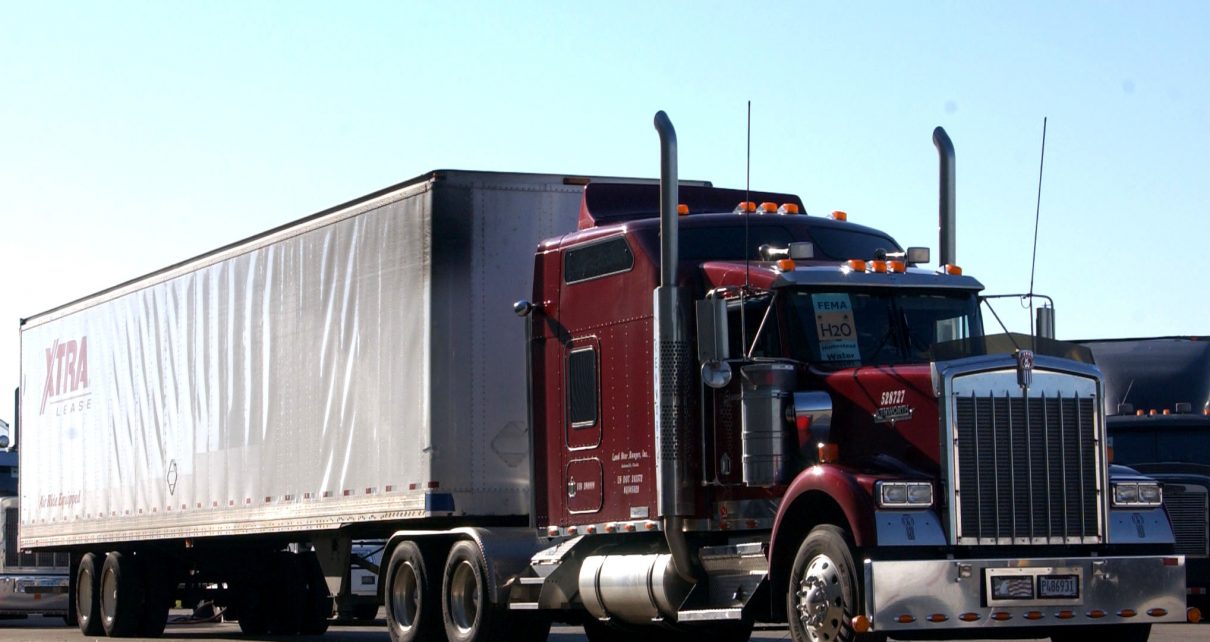
Semi tractor trailer (Photo: Public domain)
Checkmate at the Border, Stalemate in Sacramento
California’s Department of Motor Vehicles just handed me a case study I didn’t have to bill for
By Jay Rogers, September 5, 2026 12:00 pm
Eighty-five degrees in the shade, dust on the windshield, and an eighteen-wheeler rolling through Arizona’s Yuma Sector like any other Tuesday. Between August 10 and 14, federal agents pulled 95 truck drivers off that stretch of interstate. Every single one was in the country illegally. Every single one was carrying a valid, state-issued commercial driver’s license. 76 of those licenses came from California. 6 came from New York. CBP confirmed the numbers to Fox News earlier this month.
Call it Checkmate, because that is the name Customs and Border Protection gave a smaller sting this May. Over five days that month, agents arrested 52 people in the same sector. 36 were driving semi-trucks, and 29 of those 36 carried valid commercial licenses from California, New York, Washington, and Virginia. Most carried Employment Authorization Documents that had long since expired. August dwarfed it, according to CBP’s own account of that operation: 143 suspects from eighteen countries taken into custody, 2 human-smuggling rings dismantled, 74 pounds of methamphetamine and a 169 pounds of marijuana seized along the way. Call it what it is: a state government handing an eighty-thousand-pound weapon to people the federal government never had the chance to vet, then dressing the failure up as a paperwork glitch.
I have spent fifteen years testifying in courtrooms about fiduciary duty and the standard of care owed by people entrusted with someone else’s welfare. Judges pay me to explain, in plain English, what it looks like when a fiduciary cuts corners and calls it discretion. California’s Department of Motor Vehicles just handed me a case study I didn’t have to bill for. This is a fiduciary story before it’s an immigration story: a state owed a duty of care to everyone on the road and breached it.
Until this year, states could issue a “non-domiciled” CDL to almost any foreign national holding a work-authorization document, no particular visa required and precious little verification behind it. The Department of Transportation proposed closing that loophole with an interim rule in September 2025. A federal court in Washington paused that rule that November while litigation played out. The Federal Motor Carrier Safety Administration finalized the rule anyway on February 13, effective March 16, and narrowed eligibility to three visa categories: H-2A farm labor, H-2B seasonal labor, and E-2 treaty investors. A federal work permit alone no longer qualifies, which should have been the standard from day one.
California didn’t wait for the new rule to get caught. The agency’s nationwide audit found the state had issued CDLs with expiration dates stretching years beyond a driver’s lawful presence, granted licenses to applicants who never met eligibility requirements, and skipped the federal reporting system built to catch it. More than twenty thousand non-domiciled CDLs were flagged. When Sacramento missed its own deadline to cancel them, Washington withheld a hundred sixty million dollars in highway funding and started revoking licenses on its own authority. Seventeen thousand came off the road before a state court intervened in March, ordering the DMV to let drivers reapply on due-process grounds. California still is not issuing new non-domiciled CDLs. The lawsuits continue. Governor Newsom calls it a technicality. Secretary Duffy calls it a cover-up. I call it Tuesday in Sacramento.
None of this required a new criminal statute, and that’s worth understanding before social media turns it into a witch hunt. FMCSA’s ordinary toolkit is administrative, not criminal: find a state in substantial noncompliance, demand a corrective plan, withhold federal highway funds, and, in the worst case, strip the state’s authority to issue CDLs altogether. Criminal exposure attaches to individual officials, not “the state,” and only if prosecutors can prove someone knowingly falsified a CDLIS record or lied to federal auditors, not merely that a computer system was outdated or a policy was poorly drafted. That distinction matters, and it’s exactly the gap that let California stall for a year: no prosecutor is coming, so the only pressure is money and litigation, unless Congress decides accountability deserves sharper teeth.
California gets the headlines, but it’s not alone. Federal regulators have flagged the same pattern in Colorado, New York, Pennsylvania, and Minnesota, and given each of them thirty days to come into compliance or face the same funding hammer. This is a pattern among states that decided immigration enforcement was somebody else’s job, right up until it showed up in a truck qualification file.
Here is the part nobody wants to say in polite company: a commercial license is supposed to certify that the holder can read an American road sign, understand an officer’s instructions at a checkpoint, and safely operate a vehicle that outweighs your minivan by forty tons. Federal law requires English proficiency sufficient to do exactly that, and more than 26,000 drivers have been pulled off the road for failing it since enforcement resumed. In August 2025, that failure turned fatal. A driver was charged with three counts of vehicular homicide after an illegal U-turn on Florida’s Turnpike sent a minivan under his trailer, killing three people. He held CDLs from Washington and California; post-crash testing showed he answered only two of twelve English-proficiency questions correctly and identified one of four highway signs. He has been charged, not convicted yet, but the licensing trail isn’t in dispute: two states cleared him for an eighty-thousand-pound rig without confirming he could read the sign warning him not to make that turn. That wasn’t a one-off.
If you have watched five minutes of Narcos, you already understand how a smuggling network operates: find the weakest link and exploit it relentlessly. California and its fellow travelers built themselves into the weakest link in the country’s commercial licensing system, and the cartels noticed long before Sacramento did.
Not every driver caught in these sweeps is a cartel accomplice. Raman Dhillon, who runs the North American Punjabi Trucking Association, argues that the blame belongs with the schools and agencies that trained and licensed these men, not with drivers who trusted the paperwork they were handed. He has a point, and I will grant it without hesitation. But that argument cuts toward my thesis, not away from it. The individual driver is not the fiduciary in this relationship. The state is. When a trustee breaches a duty, you do not excuse the breach because the beneficiary happened to be sympathetic. You fix the trustee, and you fix it fast.
Chess assumes both players are trying to win the same game. California is playing a different one: run out the clock, litigate every deadline, and dare Washington to pull the trigger on decertification. Call that a stalling tactic dressed up as principle, and every family sharing the road with an unverified eighty-thousand-pound rig pays the price for the delay. Congress should stop treating this as an executive-branch squabble and write the verification standard into statute, with highway funding tied to compliance by formula, not negotiation. State officials who falsify CDLIS records or backdate lawful-presence documents should face the same personal exposure a fiduciary faces when a client’s records go missing. I built a career proving that duty of care is not a suggestion. Sacramento is about to learn the same lesson, one revoked license at a time.


- Sacramento Flunks Civics Again - October 19, 2026
- Class President by Appointment - October 14, 2026
- Fewer Kids, More Payroll: LAUSD’s Math Problem - October 11, 2026


” Raman Dhillon, who runs the North American Punjabi Trucking Association, argues that the blame belongs with the schools and agencies that trained and licensed these men, not with drivers who trusted the paperwork they were handed. ”
Oh, yeah. The drivers are all victims, who just happen to be scamming the system. Give me a break.
Here another illegal killing three people in California with his big rig.
https://www.youtube.com/watch?v=BsUDxkv3OfE
These people didn’t stand a chance.
Jashanpreet Singh, a 21-year-old Indian national and illegal immigrant, was arrested for causing a fatal semi-truck crash in Southern California that killed three people while he was under the influence of drugs.
Singh, who entered the U.S. illegally in 2022 and was released under the Biden administration’s “alternatives to detention” policy, allegedly drove his Freightliner tractor-trailer while impaired and failed to brake before slamming into slow-moving traffic on Interstate 10 in San Bernardino County on October 22, 2025. The resulting fiery chain-reaction crash destroyed multiple vehicles, injured four others, and led to Singh being charged with gross vehicular manslaughter while intoxicated and driving under the influence.
Thanks, Commiefornia.
Illegals first, citizens last.
They drive as well as they program. With the same results.
We always get the government we allow. Is it torches and ax handles time yet?
Well written and very factual. But here’s the risk we face: It makes sense for California to try to run out the clock because the next Administration might be comprised of people who want English-illiterate illegals on the road.
“Joe Biden” and Barack Obama are two of the worst Presidents in American history….
how many that have not been caught are rolling with contraband?
For all the “One for all and all for one” why are California trucking unions not making a peep? One upon a time Teamsters would have freaked out. Follow the money.