
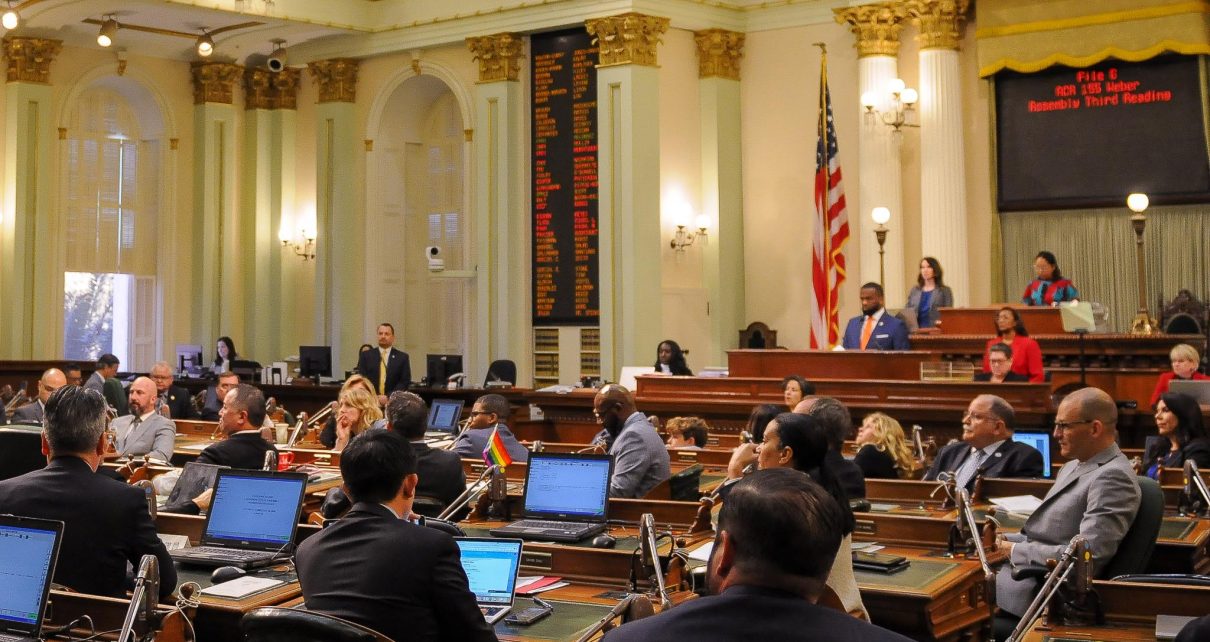
California State Assembly. (Photo: Kevin Sanders for California Globe)
Unique Aspects of California’s Legislative Process
Here are a few of those sections that I wanted to highlight
By Chris Micheli, September 16, 2026 2:00 pm
As I read through Articles IV and V of the California Constitution, I was drawn to several sections related to the legislative process and some unique aspects of several constitutional sections. Here are a few of those sections that I wanted to highlight:
SEC. 1.
The legislative power of this State is vested in the California Legislature which consists of the Senate and Assembly, but the people reserve to themselves the powers of initiative and referendum.
Note that the voters of California share the legislative process with the Legislature. No similar provision is found in Article V, Section 1 (executive branch) or Article VI, Section 1 (judicial branch).
SEC. 3.
(a) The Legislature shall convene in regular session at noon on the first Monday in December of each even-numbered year and each house shall immediately organize. Each session of the Legislature shall adjourn sine die by operation of the Constitution at midnight on November 30 of the following even-numbered year.
Note that this subdivision states that adjournment sine die (Latin for “without days”) is November 30 (and not August 31).
SEC. 6.
For the purpose of choosing members of the Legislature, the State shall be divided into 40 Senatorial and 80 Assembly districts to be called Senatorial and Assembly Districts. Each Senatorial district shall choose one Senator and each Assembly district shall choose one member of the Assembly.
Note that they are required to be called Senatorial Districts, rather than Senate Districts.
SEC. 7.
(b) Each house shall keep and publish a journal of its proceedings. The rollcall vote of the members on a question shall be taken and entered in the journal at the request of 3 members present.
Note that this subdivision only requires production of the Assembly and Senate Daily Journals, and not all the other legislative publications (e.g., Daily Files, Weekly Histories).
SEC. 7.
(c) (1) Except as provided in paragraph (3), the proceedings of each house and the committees thereof shall be open and public. The right to attend open and public proceedings includes the right of any person to record by audio or video means any and all parts of the proceedings and to broadcast or otherwise transmit them; provided that the Legislature may adopt reasonable rules pursuant to paragraph (5) regulating the placement and use of the equipment for recording or broadcasting the proceedings for the sole purpose of minimizing disruption of the proceedings. Any aggrieved party shall have standing to challenge said rules in an action for declaratory and injunctive relief, and the Legislature shall have the burden of demonstrating that the rule is reasonable.
Note that this subdivision contains some inartful drafting. Why? It says audio or visual, rather than using the conjunctive “and.” It could be interpreted to mean that a member of the public can do one or the other for legislative proceedings, but not both. Note, too, that the next subdivision instead uses the term audiovisual, so that is clearly applicable to both.
SEC. 8.
(a) At regular sessions no bill other than the budget bill may be heard or acted on by committee or either house until the 31st day after the bill is introduced unless the house dispenses with this requirement by rollcall vote entered in the journal, three fourths of the membership concurring.
Note that the 30-day in print rule applies to regular session bills, but not special sessions bills, and that the Budget Bill is exempt as well (but not bills related to the budget). Of course, this requirement can be waived by a ¾ vote.
SEC. 8.
(b) (2) No bill may be passed or ultimately become a statute unless the bill with any amendments has been printed, distributed to the members, and published on the Internet, in its final form, for at least 72 hours before the vote, except that this notice period may be waived if the Governor has submitted to the Legislature…
Note the requirement is applicable to passing a bill (i.e., voting on the bill on the Assembly and Senate Floors), but not to hearing the bill or voting on it in committee. Neither house of the Legislature considers a bill on their respective Floors until the expiration of the 72 hours.
Turning to Article V which concerns the executive branch of state government, there are two unique sections.
SEC. 3.
The Governor shall report to the Legislature each calendar year on the condition of the State and may make recommendations.
We know from pandemic times and thereafter that the annual “State of the State” address does not have to be an oral report (even though most were historically presented to a joint convention of the Assembly and Senate). Governor Newsom provided some SOTS by way of written report. Also, although historically delivered in January, it can also come at anytime.
SEC. 9.
The Lieutenant Governor shall have the same qualifications as the Governor. The Lieutenant Governor is President of the Senate but has only a casting vote.
Note that this means the Lt. Governor can only cast a vote when the Senate has a 20-20 tie. A “casting vote” is defined as when a legislative body is equally divided on a matter and the presiding officer casts a vote.


- Unique Aspects of California’s Legislative Process - September 16, 2026
- Employment Agencies and Counseling - September 16, 2026
- Digital Age Assurance Act - September 15, 2026
RELATED ARTICLES
-
 May 14, 2020
 -
 January 17, 2024
 -
 September 11, 2023