
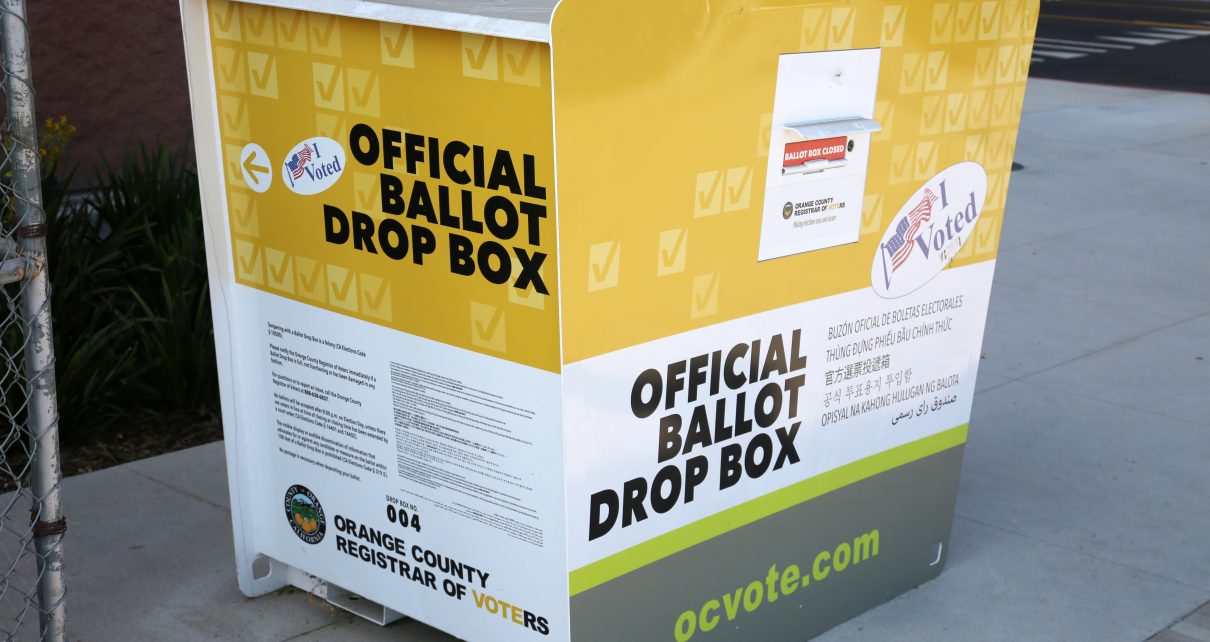
Official Ballot Drop Box placed ready to accept Voting Ballots for the upcoming election. Santa Ana, CA, Sept. 23, 2020. (Photo: mikeledray/Shutterstock)
Clinton-Appointed Judge Blocks DOJ Bid to Sequester Suspected Noncitizen Ballots; DOJ Appeals to Ninth Circuit
Judge Carter invokes Jim Crow history while rejecting effort to set aside ballots from likely noncitizens
By Megan Barth, October 29, 2026 10:56 am
A Clinton-appointed federal judge has rejected the Department of Justice’s emergency request to sequester mail ballots from more than 20,000 California registrants federal authorities flagged as likely noncitizens, even as early voting continues and ballots are already being processed ahead of the November 3 midterms.
In a late Wednesday ruling, U.S. District Judge David O. Carter of the Central District of California denied the temporary restraining order sought by First Assistant U.S. Attorney Bill Essayli’s office.
Carter wrote that the request “would wreak havoc and disrupt the election that is already underway, create a chilling effect on election workers and voters alike, and discount the votes of United States citizens.” He added that “a ballot segregated, in effect, would be a ballot removed” and that “if the Executive can discount votes and threaten an ongoing election due to unproven allegations, then our democracy is in danger.”
Carter further declared: “Never before in American history has the federal government, on the eve of an election, sought to coerce a state and local government to abandon their own Constitutional elections procedures and bend to the will of the Executive Branch. In bringing this lawsuit, the Executive would have this Court believe that it reigns as a sole sovereign. But California and its people are sovereign, too.” He cited “longstanding constitutional principles mandating that states have control over their elections” and questioned the reliability of the federal list.
Essayli responded on X that the denial leaves an “ongoing emergency” that “disenfranchises American citizens through dilution.” He said the Solicitor General authorized an immediate appeal, a Notice of Appeal has been filed, and the DOJ “will immediately seek an emergency order from the Ninth Circuit.”
The district court denied our emergency request to sequester ballots from 20,000 suspected noncitizens. Every day, more ballots are processed by election officials. This ongoing emergency disenfranchises American citizens through dilution. The Solicitor General authorized an… pic.twitter.com/4wz8GhxWXo
— F.A. United States Attorney Bill Essayli (@USAttyEssayli) October 29, 2026
This follows an earlier premature appeal that a Ninth Circuit panel dismissed 2-1 on jurisdictional grounds earlier in the week, with one Trump appointee dissenting.
The October 15 lawsuit stems from a federal list of more than 20,000 people the government says are likely noncitizens who received mail ballots. California officials, including Secretary of State Shirley Weber and Los Angeles County Registrar Dean Logan, refused a 48-hour demand to review the list and set aside any returned ballots until citizenship could be verified.
The DOJ has also charged 28 people in California—lawful permanent residents—with illegal voting or related election crimes, part of more than 150 voting-related charges nationwide since the start of the administration. As previously reported by the Globe, those cases involve false claims of U.S. citizenship to register or cast ballots.
Carter, confirmed in 1998, has repeatedly limited federal efforts on voter rolls and election integrity. In January 2026 he dismissed a separate DOJ lawsuit seeking California’s unredacted voter registration data, writing that the department could not use civil rights statutes for purposes Congress had not authorized.
He specifically noted that Title III of the Civil Rights Act of 1960 was passed in the Jim Crow era “in response to efforts to suppress Black Americans from voting,” and he called the government’s attempt to use it “contrived.” He further wrote that centralizing such information “would have a chilling effect on voter registration which would inevitably lead to decreasing voter turnout,” and that there cannot be “unbridled consolidation of all elections power in the Executive without action from Congress.”
Critics have pointed to this pattern as evidence of an activist approach that prioritizes expansive readings of voting access over verification requirements under federal law.
During Tuesday’s hearing, Carter expressed deep skepticism of the government’s evidence, suggested the DOJ “get busier” on indictments rather than seeking preemptive sequestration, and indicated he might appoint a special master to examine the data methodology—though his final order did not do so.
State officials argue the list is unreliable and that compliance would disrupt an election already underway, with millions of ballots cast or processed. The DOJ maintains that 18 U.S.C. § 611 prohibits noncitizen voting in federal elections and that California’s refusal to verify citizenship dilutes the votes of American citizens.
With the midterms days away and the appeal now pending before the Ninth Circuit, the case continues to test the limits of federal authority over state-administered elections and the practical ability to prevent illegal ballots from being counted.


- Clinton-Appointed Judge Blocks DOJ Bid to Sequester Suspected Noncitizen Ballots; DOJ Appeals to Ninth Circuit - October 29, 2026
- Sudanese and Afghan Nationals Charged with Illegal Voting in Nevada - October 28, 2026
- Arizona AG Kris Mayes Tees Off on Golf: ‘Too Many Courses’ in the Desert - October 28, 2026


“would wreak havoc and disrupt the election that is already underway, create a chilling effect on election workers and voters alike, and discount the votes of United States citizens.”
David Carter has not business being a judge. He can’t even formulate a logical argument.