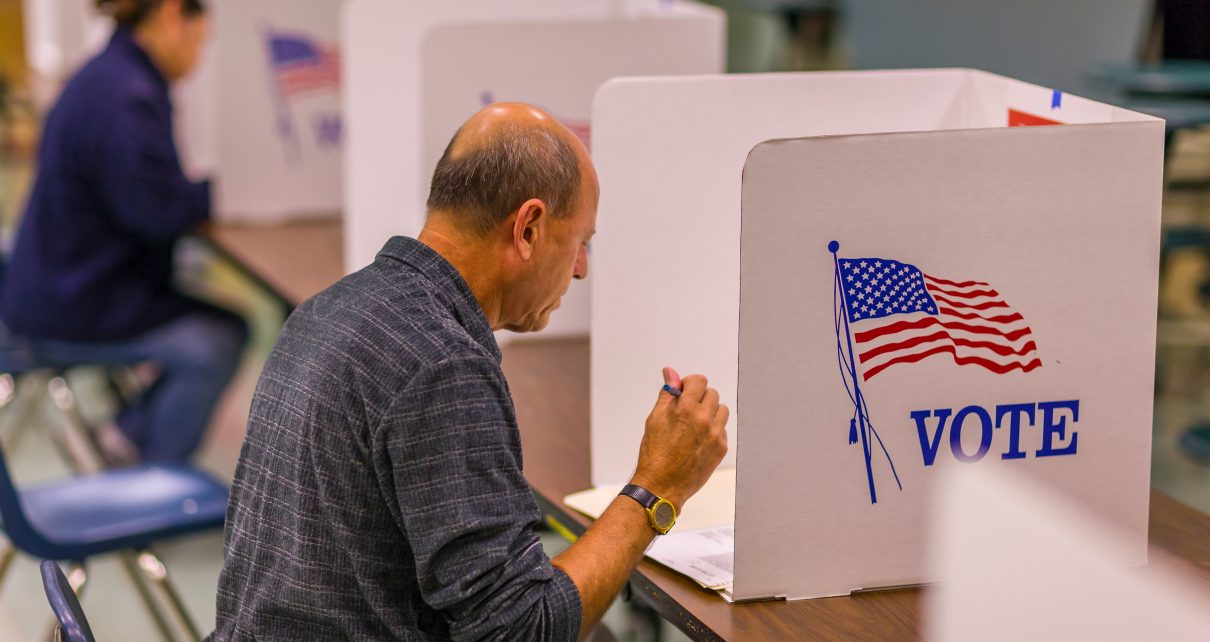
Voter at polls during presidential election, using paper ballots. (Photo: Rob Crandall/Shutterstock)
The Midterm Slot Machine
Why the polls can set the odds, but only voters can pull the lever
By John Feliz, November 2, 2026 11:12 am
The midterm elections have been the subject of disputed media polling numbers. The 2026 midterm races will be like a gigantic slot machine, with different combinations spinning nonstop. A handful of combinations let the Republicans thread the needle and pull off the upset.
A ton of critical races are still within the margin of error. If Republicans close strong and dominate the GOTV game, we could ABSOLUTELY win ’em all.
Most of the combinations give the Democrats control of the House. That’s more probable than improbable.
A smaller number of combinations also give the Dems control of the Senate. It’s certainly within striking distance.
And a minority of combinations show the Dems running the table: winning every close race from Texas through Michigan and delivering a real, undeniable Blue Wave. That’s not the most probable outcome, but it’s a very real possibility.
So I’ll make two predictions. The first is that Republicans lose the House. It won’t be a landslide, but the Dems will have a good night. Control of the Senate will be a nailbiter, with a sprinkling of GOP upsets and razor-thin finishes. Some high-profile Democrats will go down in flames. Donkey hearts will be broken.
But it’ll be an uphill battle for the GOP to hold onto the Senate. It could finish 49 Republicans, 51 Democrats.
Then all eyes will be on John Fetterman. Will he jump ship and join the GOP, or stay a Democrat? A post-election switch would reset the Senate to 50-50, handing Vice President JD Vance the tiebreaking vote, and President Trump has openly urged him to make the move.
Fetterman has promised that if the Senate flips, he’ll be “the 51st vote that I ran on.” But he has also drawn one red line: he’d leave if Democrats become “the anti-Israel party.”
It’ll probably depend on which Dems lose and which ones win. If Abdul El-Sayed wins Michigan, for example, the odds of Fetterman jumping go up. If El-Sayed is defeated and Chuck Schumer promises Fetterman a plum committee role, he’ll likely stay.
My second prediction: It doesn’t really matter what I write, what pollsters predict, or what the talking heads shout across the cable-news panels Tuesday night. A poll is a snapshot of the people who picked up the phone. It isn’t a verdict.
On the eve of the election, the numbers look rough for my side. Democrats lead the generic congressional ballot by about 9 points in Nate Silver’s average. Early voting has been strong for Democrats in places where it shouldn’t be. In Harris County, Texas, more than a million people voted early, more than twice the 2022 midterm number. In Florida, Republicans lead the early vote, but by less than their usual edge, and one GOP elder told Axios the party is “white-knuckled.”
But polls can miss in both directions. Pollster G. Elliott Morris found that his own surveys reach about half as many Trump voters in red ZIP codes as in blue ones, a gap that could inflate Democratic numbers. He also warns that polls may be missing less-engaged voters, which could cut the other way. Charlie Cook put it best: pollsters “can’t ascertain which disaffected Republicans will hold their noses and vote for their team, which will stay home,” or which will cross over. Many of those voters haven’t decided themselves.
And the early vote is a lead, not a final score. Republicans in the Trump era vote heavily on Election Day. Morris argues that the missing Republicans would have to show up Tuesday at “implausible rates” to close the gap. Maybe. But Democrats have their own turnout worries: young, Black and Hispanic voters have historically turned out at lower rates in midterms. Implausible is exactly what a GOTV operation is built for.
In a year when the biggest races are this close, the margin of error is the whole ballgame. In Texas, most surveys have shown James Talarico ahead of Ken Paxton by only a few points. In Michigan, El-Sayed’s lead over Mike Rogers runs anywhere from one point to nine, depending on the pollster. Those gaps get settled by one thing: who shows up.
That’s the real slot machine. Pollsters can tell you the odds on each reel, but they can’t pull the lever. Voters do. Every door knocked, every phone call, every neighbor driven to the polls, and every late-deciding independent is a pull on that lever.
So here’s the one prediction I’ll guarantee: the party that wants it more on Tuesday will beat its polls. If that’s the GOP, the experts will spend Wednesday explaining how they missed it again. If it’s the Democrats, the same experts will spend Wednesday explaining why it was inevitable all along.
Either way, the reels don’t stop spinning until the last ballot is counted. Here in California, that could take a while. Until then, nobody knows which combination comes up: not me, not CNN, and not the forecasters.


- The Midterm Slot Machine - November 2, 2026
- Polls as Psyops: What CNN’s Own Numbers Say When Nobody Edits Them - October 18, 2026
- California Is Already Holding the Democrats’ 2028 Primary - October 6, 2026
RELATED ARTICLES
-

-
 October 31, 2025
-