
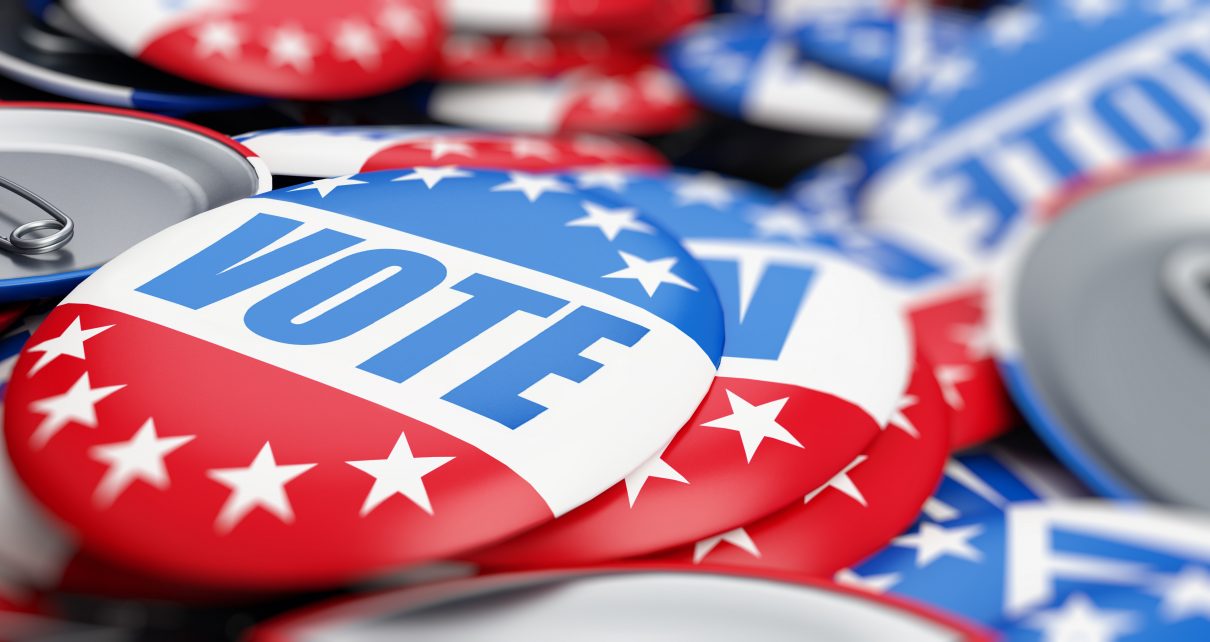
Vote buttons for election. (Photo: 3dfoto/Shutterstock)
California Is Already Holding the Democrats’ 2028 Primary
Prop. 40, the Los Angeles mayor’s race and three Bay Area presidential hopefuls show the party’s civil war is already on this November’s ballot
By John Feliz, October 6, 2026 4:37 pm
Washington pundits talk about the coming fight between the Democratic Party’s socialist insurgents and its establishment as if it were a 2028 event. Californians don’t have to wait. The fight is on our ballots right now, and early voting has already begun.
Start with the rest of the country. This year the left has had its best primary season in a generation. Abdul El-Sayed, a physician running on Medicare for All, won Michigan’s Democratic Senate nomination. Democratic socialist Melat Kiros ousted 15-term Rep. Diana DeGette in Denver. Three House candidates endorsed by New York Mayor Zohran Mamdani swept their primaries, knocking off two incumbents. The establishment has notched wins of its own. In Texas, party leaders’ preferred candidate, James Talarico, beat Rep. Jasmine Crockett. But the momentum has belonged to the insurgents.
Now look at California.
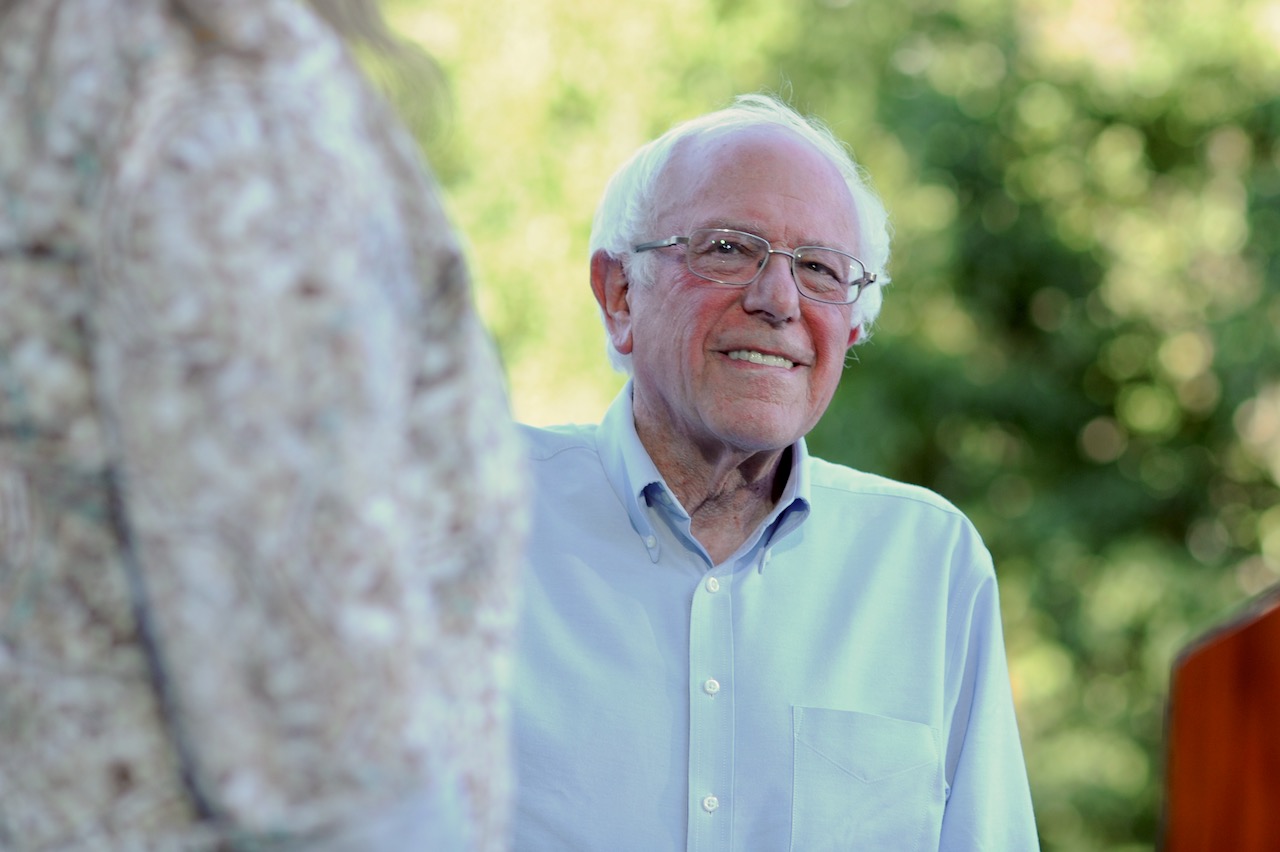
Proposition 40 would impose a promised one-time 5 percent tax on the wealth of Californians worth more than $1 billion, largely to backfill federal cuts to fraud riddled Medi-Cal. Gov. Gavin Newsom opposes Prop 40. So does Xavier Becerra, the Democratic nominee to succeed him. So do the California Teachers Association and the California Professional Firefighters. Yet in August the DSA dominated California Democratic Party endorsed it anyway, siding with its socialist base over its elected leaders. As early voting opened, Bernie Sanders came to California to campaign for Prop 40 alongside Rep. Ro Khanna, who calls himself Newsom’s “polar opposite” on the Prop 40 taxing question and has challenged the governor to a debate.
Consider the lineup. On one side are the liberal governor, the party’s nominee for governor, and a large share of organized labor. On the other are the left-learning Democratic state party, the SEIU health care workers’ union bankrolling the measure, and two of the left’s most prominent national figures. Opponents have raised more than $252 million, much of it from billionaires; Google co-founder Sergey Brin alone has put in $102 million. Supporters have raised about $32 million. And still the measure leads, 52 percent to 46 percent among likely voters in the latest liberal Public Policy Institute of California survey.
The same split runs through Los Angeles. Mayor Karen Bass, a pillar of the party’s progressive mainstream, trails socialist Councilmember Nithya Raman 39 percent to 28 percent in a UC Berkeley poll co-sponsored by the Los Angeles Times. In June, three of the six candidates backed by the Democratic Socialists of America for citywide office won outright, and the incumbent city attorney became the first in nearly a century to lose in a primary.
Hovering over all of it is 2028. Three of the Democrats most often mentioned for president, Newsom, former Vice President Kamala Harris and Khanna, come from the Bay Area. Khanna is building a Sanders-style populist campaign. Newsom has rolled out a “Project 2029” policy framework and says he would not run if Harris does. Prop. 40 has become their first proxy fight, and it is being waged with California’s budget.
Here is the uncomfortable truth for both wings of the party: Californians are not choosing between them out of affection for either one. They are choosing out of frustration.
Newsom’s job approval has fallen to 42 percent among registered voters, with 55 percent disapproving, in a recent Berkeley-Politico poll. Sixty-five percent of voters told PPIC that a candidate’s position on affordability is “very important” in choosing a governor. The left’s surge here is not mainly an ideological conversion. It is a verdict on results: on housing costs, gas prices, homelessness and a state government that has been entirely in Democratic hands since 2011. When the people who run everything cannot make the state affordable, voters start listening to people who promise to make someone else pay.
That is the Democrat establishment’s problem in a one party state. It owns the record. It cannot run against Sacramento because it is Sacramento. Becerra is likely to be the next governor. He leads Republican Steve Hilton in every public poll. But he would take office with his own party’s apparatus on record against him on the defining tax question of the year.
The left has a different problem: a target is not a plan. The liberal nonpartisan Legislative Analyst’s Office estimates Prop. 40 would raise “tens of billions of dollars” spread over several years. It also warns the measure could reduce state income tax revenue by “hundreds of millions of dollars or more” every year if billionaires leave. A one-time levy cannot permanently fund an ongoing obligation, and Medi-Cal is about as ongoing as obligations get. Even the governor, who says he supports taxing extreme wealth, argues it has to be done nationally, where the wealthy cannot simply move to Nevada or Texas.
There is a lesson here that reaches well beyond our borders. Nationally, the left’s insurgency has been strongest where Democrats are already dominant: New York City, Denver, the Bay Area, Los Angeles. Those are places where the establishment has governed long enough that voters hold it responsible for everything. Where Democrats are the challengers, as in Texas, the party’s less left wing still holds the upper hand. The real test of the left’s electability will come in Michigan, where DSA endorsed El-Sayed is narrowly ahead in a race that will show whether a “Medicare for All” candidate can win in an industrial Midwest swing state.
California, then, is not a preview of the national Democratic Party. It is a warning to it. A party that controls everything for long enough eventually ends up running against itself.
For the millions of Californians who are not Democrats, and for the many Democrats who are simply tired, the takeaway is straightforward. Do not mistake this fight for a debate about whether California’s problems get solved. It is largely a debate about who gets blamed for them. One faction of the failing Democrat party is defending a record it struggles to justify; the other socialist wing is promising a windfall that the Legislature’s own state analysts say will not last.
Whatever happens to Prop. 40 on Nov. 3, both wings of the Democratic Party owe Californians the same answer. Not who should pay more but why has so much money bought so little.

- Polls as Psyops: What CNN’s Own Numbers Say When Nobody Edits Them - October 18, 2026
- California Is Already Holding the Democrats’ 2028 Primary - October 6, 2026
- The Oldest Consultant Reads the Crosstabs - August 25, 2026
RELATED ARTICLES
-
 December 5, 2019
 -
 January 11, 2022
 -
 March 4, 2020
I am not sure why the dumb Californians still wish to disparage the top 1% when it is the bottom 1% that has more of an impact on their lives. Elon Musk is not going to crap on your sidewalk or leave used needles in the park where your kids play. Jeff Bezos is not going to step out from a dark alley and demand your wallet. But bums from the bottom 1% will and do all the time. The top 1% create things. The bottom 1% only take and create nothing of value. If you stop subsidizing them you can have your money and keep your top 1% as well.