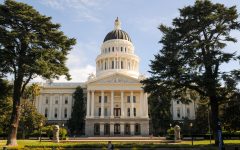
California State Capitol. (Photo: Katy Grimes for California Globe)
Canons of Statutory Construction Only Come into Play If Statutory Language is Ambiguous
If the language is clear and unambiguous on its face, the plain meaning governs
By Chris Micheli, November 3, 2026 7:34 am
Under California law, courts begin statutory interpretation by examining the plain and ordinary meaning of the statute’s words, and canons of construction are only deployed if the statutory language is found to be ambiguous or susceptible to more than one reasonable interpretation. In People v. Love (2020) 55 Cal.App.5th 273, 287, the court stated: “Where the statutory language is ambiguous, courts may also employ the ‘interpretative canons’ that can function as a sixth sense-type ‘guide’ in our inquiry into legislative intent.”
California courts always start by looking at the words of the statute and giving them their usual, ordinary meaning. If the language is clear and unambiguous on its face, the plain meaning governs. In that scenario, courts do not need to look at legislative history, extrinsic aids, or canons of construction.
If the language is ambiguous, which means that it is semantic, syntactic, or contextual in a way that allows two or more reasonable interpretations, then courts will turn to canons of construction and other tools (such as legislative intent, statutory structure, and public policy) to resolve the uncertainty.
Certain foundational rules, including presuming that every word is meant to have a purpose (i.e., avoiding surplusage) or reading words in their immediate textual context (like the noscitur a sociis canon), are often integrated into the very first step of reading the text to determine whether it is actually plain or clear.
Certain substantive or policy-driven canons (like the rule of lenity in criminal or penal statutes) are treated by California courts as strict “tie-breakers” that are only deployed after the court has already examined the text, context, and legislative history and found the provision remains genuinely ambiguous.
As a result, the canons of statutory construction generally only come into play if the statutory language at issue is ambiguous.


- Canons of Statutory Construction Only Come into Play If Statutory Language is Ambiguous - November 3, 2026
- Escheat of Decedent Property - November 3, 2026
- General Provisions of Capital Access Company Law - November 2, 2026
RELATED ARTICLES
-
 November 2, 2026
-
July 8, 2026
-