
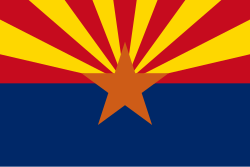
Arizona Flag. (Photo: public domain)
Hobbs Projected To Win Reelection As Democrats Lead Across Arizona State Government
Unofficial returns show Democrats leading for 20 Senate seats and 37 House seats, putting de facto single-party Democratic control within reach
By Matthew Holloway, November 4, 2026 4:16 pm
Arizona Republicans faced losses across state government Wednesday as Democratic Gov. Katie Hobbs is projected to secure a second term and unofficial returns showed Democrats leading for majorities in both legislative chambers.
The Associated Press called the governor’s race for Hobbs early Wednesday over Republican U.S. Rep. Andy Biggs. AP also projected victories for Attorney General Kris Mayes over Republican Senate President Warren Petersen and Secretary of State Adrian Fontes over Republican state Rep. Alexander Kolodin, according to FOX 10’s election roundup.
The state’s unofficial results reviewed Wednesday afternoon showed Hobbs and running mate John Giles with 1,195,524 votes, or 55.53%, compared with 919,282 votes, or 42.70%, for Biggs and running mate Sine Kerr. Hobbs’ lead stood at 276,242 votes.
Giles, the former Mesa mayor who changed his registration from Republican to independent, would become Arizona’s first lieutenant governor. Axios reported that the ticket sought support from centrist voters. Hobbs won her first gubernatorial election against Kari Lake in 2022 by approximately 17,000 votes.
Mayes led Petersen by 227,350 votes in the afternoon snapshot, receiving 1,178,020 votes, or 55.30%, to Petersen’s 950,670, or 44.63%. Her first election in 2022 was decided by 280 votes, according to KJZZ’s coverage.
Fontes held a 233,953-vote advantage over Kolodin, with 1,169,298 votes, or 54.75%, to Kolodin’s 935,345, or 43.80%, according to the state’s unofficial results.
Kolodin acknowledged his defeat in a Wednesday statement on X, attributing Republican losses to voter dissatisfaction with the national party and the country’s involvement in war. “Like many of you, I am heartbroken for Arizona. I understand why voters are angry,” he wrote.
Kolodin thanked campaign staff and volunteers and urged Republicans to rebuild institutions around individual rights and freedoms. He also predicted that unified Democratic control would bring changes to election laws and school choice. Control of both legislative chambers remained dependent on unresolved races in the unofficial results reviewed for this report.
Democrats also led the remaining statewide executive contests shown in the returns. Nick Mansour had 1,131,830 votes, or 53.61%, against Republican Elijah Norton’s 977,665, or 46.31%, for state treasurer. In the superintendent of public instruction race, Teresa Leyba Ruiz led Republican Kimberly Yee with 1,119,585 votes, or 52.95%, to 992,339, or 46.94%.
Democrat Brian Matlock led Republican Walter “Les” Presmyk for state mine inspector, receiving 1,096,319 votes, or 52.55%, to Presmyk’s 987,608, or 47.34%.
For the two Corporation Commission seats on the ballot, Democrats Clara Pratte and Jonathon Hill occupied the top two positions with 1,061,848 and 1,021,609 votes, respectively. Republicans Kevin Thompson and Ralph Heap followed with 918,185 and 859,795 votes. Those standings reflected reported votes and did not establish final outcomes.
The legislative returns placed Democrats in position to take control of both chambers.
A district-by-district review of the state’s unofficial results showed Democrats leading in 20 of 30 Senate contests and holding 37 of the 60 leading positions in House races, where voters elect two representatives per district. Republicans led for the remaining 10 Senate seats and 23 House seats.
Republicans entered the election with a 17–13 Senate majority and a 33–27 House majority. If the Democratic leads hold alongside Hobbs’ reelection, Arizona would have its first Democratic governing trifecta since 1966, according to KTAR’s legislative coverage.
If the current leads hold, Democrats would control the governorship and have enough votes to pass ordinary legislation and budgets without meaningful Republican support. Their projected 37 House seats and 20 Senate seats would also meet the numerical thresholds for impeachment and conviction under Arizona’s Constitution.
They would remain three House votes short of the two-thirds majority required for ordinary veto overrides and covered state tax increases, while amendments to voter-protected laws generally require three-fourths of each chamber and must further the measures’ purposes.
Several legislative contests remained close in the supplied returns. Democrat Elaine Aldrete led Republican T.J. Shope by 1,238 votes in Senate District 16. Democrat Stephanie Walsh led Republican Mylie Biggs by 2,416 votes in Senate District 14, while Republican Janae Shamp held a 2,270-vote advantage over Democrat Eric Stafford in Senate District 29.
The prospect of Democratic majorities would reshape the governing environment described by House Speaker Steve Montenegro in his pre-election interview with California Globe. Montenegro emphasized retaining Republican control and identified water, parental rights, taxes, and election security as priorities.
“We have Democrats looking to turn this state into New York with what you’re seeing Mamdani do to New York, with what you’re seeing happen in California, with what you’re seeing happen in Michigan,” Montenegro warned.
Montenegro remains in position to retain his House seat; however, Democrat Rep. Oscar De Los Santos could replace him as Speaker according to KJZZ. In District 29, Democrat Christine Marie Scianna led with 37,764 votes, followed by Montenegro with 37,158 and Republican James Taylor with 36,040. Montenegro’s advantage over Taylor for the second seat stood at 1,118 votes, according to the unofficial returns.
Arizona’s congressional results showed Democrats ahead in five districts and Republicans ahead in four.
Democrat Amish Shah led Republican Jay Feely in District 1 with 163,584 votes, or 52.54%, to 141,196, or 45.35%. In District 6, Democrat JoAnna Mendoza led Republican Rep. Juan Ciscomani with 157,496 votes, or 52.80%, to 134,306, or 45.03%, according to the state results.
Republican Rep. Eli Crane held a substantially narrower advantage in District 2. Crane had 138,582 votes to Democrat Jonathan Nez’s 137,616, a margin of 966 votes. Libertarian Curtis Goodwin had received 4,848 votes.
Republican Mark Lamb led Democrat Elizabeth Lee in District 5 by 6,014 votes, with 137,240 to Lee’s 131,226. Republican Rep. Abe Hamadeh led Democrat Bernadette Greene-Placentia in District 8 by 5,563 votes, receiving 127,063 to her 121,500.
Democrats Yassamin Ansari, Greg Stanton, and Adelita Grijalva held larger leads in Districts 3, 4, and 7, respectively. Ansari had 86.37% of the reported vote, Stanton had 62.25%, and Grijalva had 71.39%. Republican Rep. Paul Gosar led District 9 with 57.74%, according to the same returns.
The Republican setbacks came despite the party’s statewide registration advantage. The Secretary of State’s general-election registration report listed 1,522,925 active Republicans and 1,239,489 active Democrats, a Republican advantage of 283,436.
The report’s “Other” category contained 1,527,483 voters, exceeding either major party. In Maricopa County, the report listed 884,285 Republicans, 727,925 Democrats, and 925,670 voters in the “Other” category. Registration figures establish party affiliation; they do not establish turnout or candidate preferences.
Before Election Day, pollster Mike Noble had identified Republican difficulties among independent voters. In an October 27 interview reported by KTAR, Noble said his models favored Democrats winning the House, tying the Senate, and retaining the governor’s office.
“I’ve never seen Republicans losing independents so badly,” Noble said.
Voters also supported several ballot measures advanced by the Legislature. AP calls reported Wednesday morning showed approval of Proposition 316 restricting local grocery taxes, Proposition 317 designating drug cartels as terrorist organizations, Proposition 318 addressing girls’ sports and athletic facilities, and Proposition 319 restricting photo traffic enforcement. AP reported Proposition 142’s proposed restrictions on government DEI practices had failed.
The afternoon results reviewed for this report showed the following standings:
| Proposition | Yes | No |
| 141 — Vehicle mileage taxes | 50.73% | 49.27% |
| 142 — Government DEI restrictions | 40.10% | 59.90% |
| 144 — Election requirements | 46.83% | 53.17% |
| 316 — Local grocery taxes | 61.41% | 38.59% |
| 317 — Drug cartel designation | 57.06% | 42.94% |
| 318 — Girls’ sports and athletic facilities | 58.93% | 41.07% |
| 319 — Photo traffic enforcement | 61.07% | 38.93% |
| 320 — School district spending | 48.63% | 51.37% |
Proposition 141 held a 29,875-vote lead, while Propositions 144 and 320 trailed. Those three measures remained uncalled in the cited AP roundup.
The figures throughout this report reflect unofficial results reviewed Wednesday afternoon. All 15 counties had submitted results for the statewide contests, which does not mean every ballot had been processed. Final outcomes remain subject to completion of the count and the official canvass.


- Hobbs Projected To Win Reelection As Democrats Lead Across Arizona State Government - November 4, 2026
- Arizona Attorney General Kris Mayes Served on Board of Energy Nonprofit Operating in China - November 4, 2026
- Maricopa GOP Chair Reports Printer and Tabulator Issues on Election Day - November 3, 2026
RELATED ARTICLES
-

-
 September 29, 2026
-