
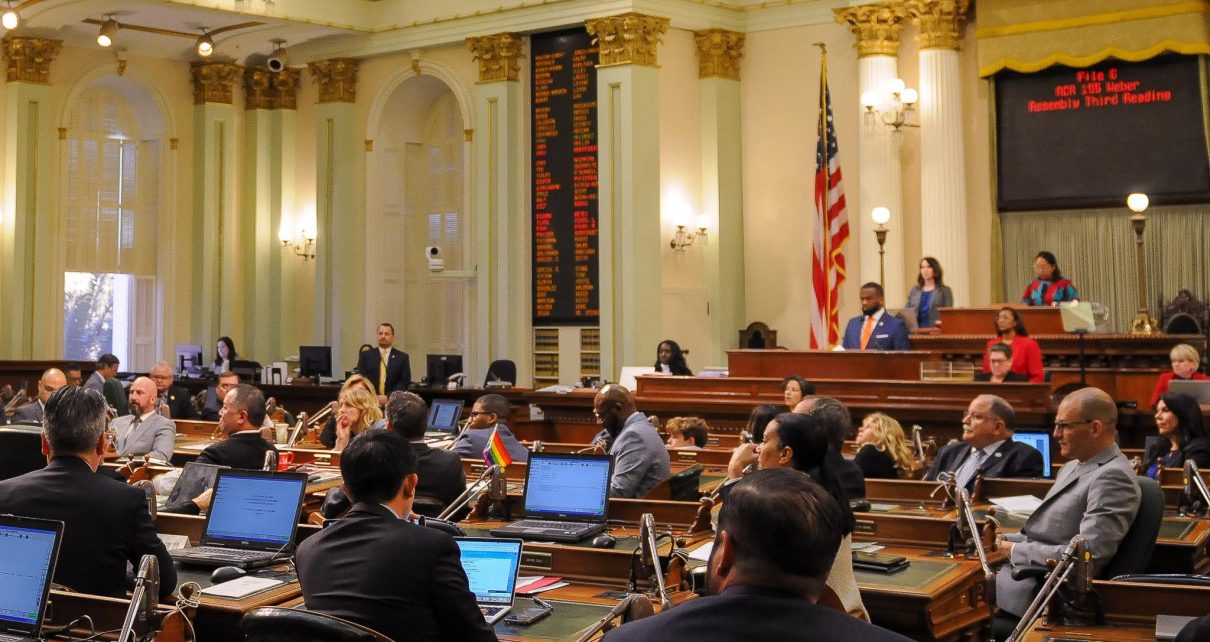
California State Assembly. (Photo: Kevin Sanders for California Globe)
Legislative Open Records Act Refresher
LORA is found in California Government Code Title 2
By Chris Micheli, November 10, 2026 9:56 am
Whether you work in the State Capitol, or you are a member of the Third House or the Fourth Estate, you should be familiar with LORA – the Legislative Open Records Act. The following is a refresher highlighting the key aspects of this important record retention and transparency law applicable to the legislative branch of California state government.
LORA is found in California Government Code Title 2 (Government of the State of California), Division 2 (Legislative Department), Part 1 (Legislature), Chapter 1.5 (General), Article 3.5. LORA was added to state law in 1975 by Chapter 1246.
Section 9073 explains that “legislative records” are open to inspection at all times during the normal office hours of the Legislature and any person has a right to inspect any legislative record, except as provided.
Moreover, any person is to be furnished reasonable opportunities for inspection of legislative records and reasonable facilities for making memoranda or abstracts. Also, any person may receive a copy of a legislative record if that record is of a nature permitting copying. The Legislature may establish a maximum fee of 10 cents per page for making copies.
Section 9074 states that all requests to inspect any legislative record has to be made to the appropriate Rules Committee of each house of the Legislature or the Joint Rules Committee. Committees are required to promptly inform any person whether any legislative record will be made available for inspection. The committees are directed that legislative records must be made available for inspection promptly and without unnecessary delay.
Whenever a legislative committee withholds any legislative record from inspection, within four working days (while the Legislature is in session) of the request to inspect the record, the committee is required to provide a written justification “by demonstrating that the record in question is exempt under the express provisions of this article or that on the facts of the particular case the public interest served by not making the record public clearly outweighs the public interest served by disclosure of the record.” When the Legislature is not in session, a committee has 10 working days of the request to provide that written justification.
Section 9075 specifies that the following items are not required to be disclosed:
(1) Preliminary drafts, notes, or legislative memoranda, except as provided in Section 9080.
(2) Records pertaining to pending litigation to which the Legislature is a party, or to claims made, until the litigation or claim has been finally adjudicated or otherwise settled.
(3) Personnel, medical, or similar files, the disclosure of which would constitute an unwarranted invasion of personal privacy.
(4) Records pertaining to the names and phone numbers of senders and recipients of telephone and telegraph communications.
(5) Records pertaining to the name and location of recipients of automotive fuel or lubricants expenditures.
(6) In the custody of or maintained by the Legislative Counsel, except those records in the public data base maintained by the Legislative Counsel.
(7) In the custody of or maintained by the majority and minority caucuses and majority and minority consultants of each house of the Legislature.
(8) Correspondence of and to individual Members of the Legislature and their staff, except as provided in Section 9080.
(9) Records the disclosure of which is exempted or prohibited pursuant to provisions of federal or state law, including provisions of the Evidence Code relating to privilege.
(10) Communications from private citizens to the Legislature, except as provided in Section 9080.
(11) Records of complaints to or investigations conducted by, or records of security procedures of, the Legislature.
Section 9080 begins with legislative findings and declarations that legislative records relating to bills, resolutions, or proposed constitutional amendments before the Legislature provide evidence of legislative intent that may be important in the subsequent interpretation of laws enacted in the Legislature.
Each legislative committee having custody of legislative records relating to a bill, resolution, or proposed constitutional amendment assigned to that committee is required to maintain the legislative records in an official committee file. The committee is required to preserve those records in its custody or arrange with the State Archives to maintain some or all of the records on the condition that the records be preserved.
The term “legislative records” means records contained in an official committee file, including all of the following:
(1) Committee staff analyses.
(2) Written testimony.
(3) Background material submitted to the committee.
(4) Press releases.
(5) Written commentary submitted to the committee on a bill, resolution, or proposed constitutional amendment. For purposes of this paragraph, “written commentary” does not include the following:
(A) Material not utilized by the staff of a fiscal committee in the preparation of any analysis for the members of that committee.
(B) Communications determined by the committee or its staff to be confidential.
(6) Versions of bills, resolutions, or proposed constitutional amendments assigned to the committee.
(7) Relevant interim hearing materials, studies, case materials, and articles.
Legislative records contained in an official committee file are required to be open to inspection and copying by the public, pursuant to Sections 9073 and 9074. Each committee must adopt and implement written procedures consistent with Sections 9073 and 9074 for the public’s access to official committee files maintained in the committee’s office.
The Rules Committee of each house of the Legislature or the Joint Rules Committee must provide for the storage of any official committee file that is not maintained in the office of the committee that created the file or with the State Archives.
However, nothing in this section requires making any legislative record available for inspection that relates to any unchaptered bill, resolution, or proposed constitutional amendment introduced in the current legislative session, except in accordance with the requirements and limitations specified in Sections 9073, 9074, and 9075.


- Legislative Open Records Act Refresher - November 10, 2026
- What Are Some Unique Aspects of the California Budget Process? - November 10, 2026
- Jeopardy Determinations - November 9, 2026
RELATED ARTICLES
-
 April 17, 2024
-
 February 5, 2020
-
 October 6, 2024