

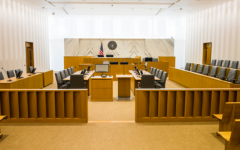
California State Capitol. (Photo: Katy Grimes for California Globe)
The Narrow Rule of Lenity in California
The state’s courts view the rule of lenity as a secondary, last-resort ‘tie-breaker’ canon rather than an automatic rule
By Chris Micheli, November 18, 2026 2:00 pm
The Rule of Lenity is viewed narrowly in California. The state’s courts view the rule of lenity as a secondary, last-resort “tie-breaker” canon rather than an automatic rule, requiring an egregious ambiguity that cannot be resolved through other tools of statutory interpretation.
As a result, California courts will only invoke the rule of lenity after exhausting all other traditional methods of statutory construction, including examining the text, statutory context, and legislative history. If the legislative intent is clear, lenity does not apply. Unlike jurisdictions where any minor confusion triggers lenity, California courts hold that “the existence of statutory ambiguity is not enough… there must be an egregious ambiguity and uncertainty to justify invoking the rule” (People v. Bamberg, quoting Witkin & Epstein).
In addition, there is a tension with statutory law in this state. California Penal Code Section 4 (enacted in 1872) explicitly states that the common law rule requiring penal statutes to be strictly construed does not apply, and that code provisions are to be construed according to the fair import of their terms to promote justice.
In Keeler v. Superior Court, the California Supreme Court affirmed that, while penal statutes should not be expanded by judicial enlargement or by inserting or deleting words to create offenses not clearly within their language, courts will not invoke lenity to override clear statutory intent.


- The Narrow Rule of Lenity in California - November 18, 2026
- Limitations on Catch-all Phrases - November 18, 2026
- Exploring Gut-and-Amend Bills in the California Legislature - November 18, 2026
RELATED ARTICLES
-
 October 2, 2026
-
November 5, 2024
-
 November 9, 2024