
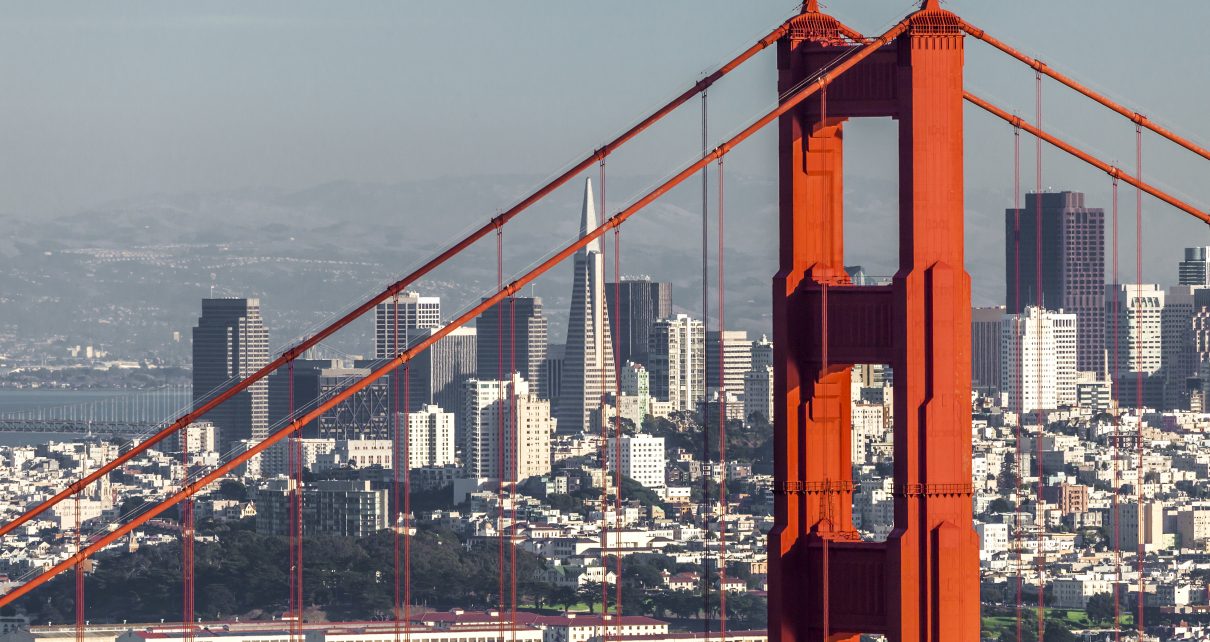
San Francisco from San Francisco Headlands and Golden Gate bridge, San Francisco, CA. (Photo: Kropic1/Shutterstock)
Pax Silica: America Drew the Line – China Throws a Fit
Economic security is national security
By Richie Greenberg, November 18, 2026 2:00 pm
Pax Silica is the United States finally treating the AI and semiconductor race like the strategic contest it actually is.
Launched December 2025 Pax Silica initiative is designed to lock down trusted supply chains on minerals, energy, chips, manufacturing, ports, and “Super Intelligence” – so America and its partners stop living under the constant threat of Chinese economic coercion.
Economic security is national security. The alternative? Handing Beijing permanent leverage over the technologies that will decide military edge and economic power for the next generation.
Last year, original Pax Silica signatories were the United States, Australia, Israel, Japan, South Korea, Singapore, and the United Kingdom. Israel’s early seat at the table was no accident – because when you are building a network of capable, non-coercive partners, you include the country that has already proven it can innovate under intense pressure.
Membership has since grown to roughly 26, including India, the Philippines, Qatar, the UAE, and a range of European and Latin American partners.
Pax Silica is not a binding treaty – it’s a clear signal to China that the free world intends to build with trusted partners instead of being held hostage to one regime’s mineral supply dominance.
On November 15, 2026, that signal got louder. At the Pax Silica Founders Retreat convened in San Francisco, the United States and nine partners signed the apply-named San Francisco Declaration on the Secure Foundations of Enduring Prosperity.
Today, the United States and nine Pax Silica economies signed the San Francisco Declaration on the Secure Foundations of Enduring Prosperity. It recognizes that economic security is national security, sets out a common understanding of the sensitive technologies and critical infrastructure that underpin Super Intelligence supply chains, and makes safeguarding them a shared endeavor. MORE: https://t.co/6WyMVhm999
— State Department Economic Affairs (@EconAtState) November 16, 2026
For obvious reasons, officials did not disclose the specific building, hotel or street address for the gathering. Photographs released by the State Department though show the ceremony held outdoors near the Golden Gate Bridge.
The Declaration defines the sensitive technologies and critical infrastructure (ports, logistics, energy systems) that must be protected – and sets up five working groups to turn their talk into action.
It never names China. It does not need to.
The Declaration’s language about excessive dependencies, coercive practices, and hostile actors is aimed squarely at Beijing’s playbook.
China’s reaction? It’s exactly what you would expect from a power that prefers the current arrangement – their arrangement.
A Chinese Foreign Ministry spokesperson whined about “ideological lines” and “exclusive cliques.” State media and Chinese analysts ultimately dismissed Pax Silica as doomed.
And then, Beijing answered with its own counter-initiative: Its own clique.
China’s unhappiness is useful information: if Pax Silica were just empty symbolism, the CCP would not be bothered one bit.
In the Philippines the opposition to Pax Silica has been louder still. Yes, they joined in April 2026- with plans for building a major AI and semiconductor hub. Officials there talk about tens of billions in investment and as many as 200,000 jobs.
And then, protesters there talked about displacement of communities, strain on water and power, and loss of sovereignty.
The protest-organizing core ran “Trump Out” actions, along with student groups. There were campus walkouts, long marches, clashes with police, hundreds of arrests and the obligatory burning of Trump effigies.
The protest’s scale and coordination, however, point beyond pure local grievance.
Fox News Digital reporting by Asra Nomani mapped a network of roughly 120 mostly U.S.-based communist, socialist, and “anti-imperialist” groups amplifying the campaign. Many also operate in the orbit of notorious tech millionaire Neville Roy Singham, whose funded nonprofits have a long track record of anti-American and pro-China messaging – and have also fought AI data-center projects inside the United States.
Framing every American-linked industrial project as “imperialist plunder” is a consistent ad nauseum pattern. The effect is to slow or stop efforts that would reduce Chinese dominance.
This is key. Control the AI, the semiconductor, and critical-minerals – and you will shape military capability, economic leverage, and national sovereignty for decades. China craves this.
If the United States and its crucial tech partners – including Israel – succeed in building diversified, trusted supply chains, they will shrink the risk of economic coercion from Beijing.
If activist networks and Chinese opposition succeed in stalling projects, the CCP’s existing advantages stay in place.
Pax Silica and the San Francisco Declaration are not some abstract geopolitical diplomacies. They are a live contest over who sets the rules of the next technological era.
China hates it. The professional activist class hates it. And that’s usually a reliable indicator that something worth doing is now underway.


- Pax Silica: America Drew the Line – China Throws a Fit - November 18, 2026
- Blue Wave, Red Flags: Why Newsom’s Midterm Backslapping Collides With California’s Record-Setting Mess - November 18, 2026
- Freshman Wiener Struts into DC: Reality Check Looms - November 14, 2026
RELATED ARTICLES
-

-
-
 February 26, 2023