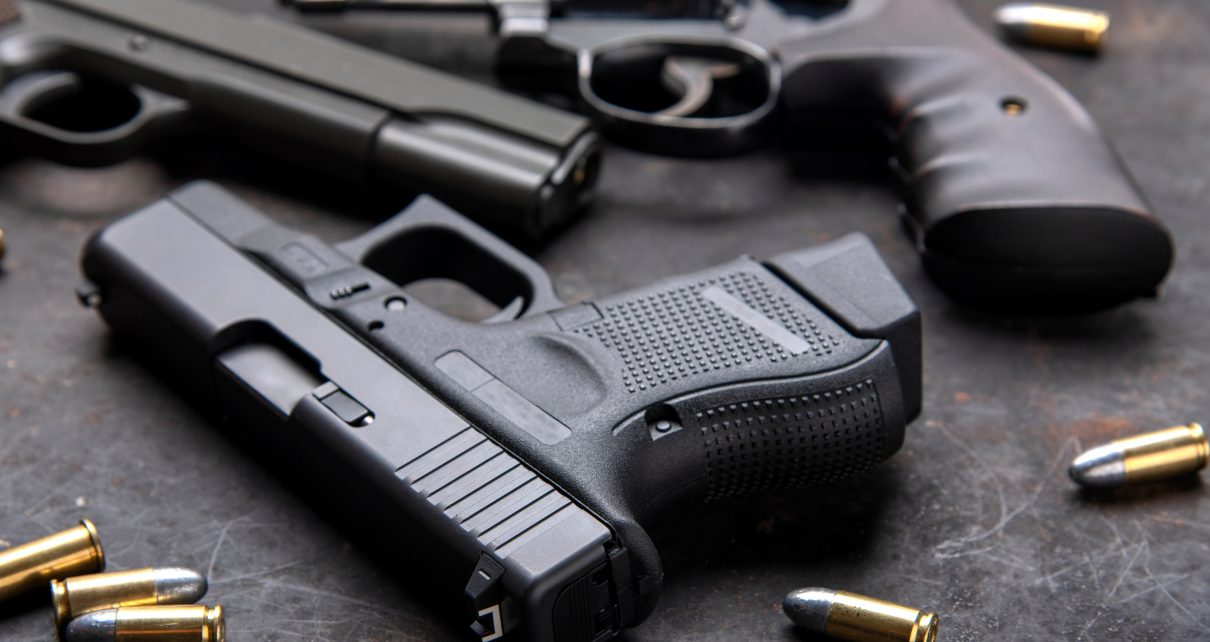
Guns and ammo. (Photo: Kiattipong/ShutterStock)
The Trace Doubles Down on Stupid: Still Misinterpreting ATF Gun-Tracing Statistics for Gun Control Advocacy
A newspaper can publish a flawed analysis, generate a political controversy, and then cite the controversy as proof that its reporting mattered
By Chuck Michel, November 19, 2026 10:00 am
The Trace, the nonprofit news organization sponsored by notoriously anti-gun billionaire Michael Bloomberg that is devoted to reporting on gun violence, has apparently decided that its misleading investigation of Turner’s Outdoorsman was such a triumph of journalism that it deserves another victory lap. And this time, it wants readers to contribute money to keep their gun control advocacy going. In a November fundraising email titled “Investigating the Drivers of Gun Violence,” Trace reporter Aaron Mendelson boasts about his organization’s investigation of California’s largest firearms retailer. According to Mendelson, The Trace uncovered evidence that firearms sold by Turner’s were disproportionately associated with crimes, prompting an elected official to demand an investigation and legislators to consider expanding public access to firearms tracing information. The message presents those political reactions as proof that The Trace’s reporting is helping make communities safer.
There is just one problem: None of those developments establish that Turner’s did anything wrong. Worse, The Trace has already been given a detailed explanation of why its interpretation of the data is misleading. Rather than grapple with those objections, it is now promoting the resulting political controversy as evidence of its own success.
The “Investigation” That Started It All
In May 2026, The Trace published an investigation claiming that Turner’s Outdoorsman, a California firearms retailer with more than 30 locations, accounted for a disproportionate share of firearms subsequently recovered by law enforcement. Its principal finding was that Turner’s sold approximately 20 percent of California’s firearms but accounted for approximately 25 percent of firearms appearing in a particular subset of ATF gun tracing records. The story also emphasized that nearly 8,000 firearms traced to Turner’s locations had subsequently been recovered by law enforcement. To the casual reader, the implication was unmistakable: Turner’s must be doing something irresponsible. But that conclusion does not follow from the data.
In September, attorneys Jason A. Davis, Anna M. Barvir, and I published a detailed examination of the reporting through the University of Wyoming’s Firearms Research Center, titled The Limits of Crime-Gun Trace Data. Our analysis examined the underlying California Department of Justice statistics, the limitations acknowledged by the agencies compiling them, and the distinction between firearms recovered during criminal investigations and evidence of improper conduct by the retailers that originally sold them. The central problem was straightforward: The Trace was asking ATF firearms tracing data to establish something those data cannot establish.
When police recover a firearm during an investigation, authorities may attempt to trace it through manufacturing, distribution, and retail records. That process can identify where a firearm originally entered the retail market and may provide valuable investigative leads. What it cannot establish, standing alone, is whether the original retailer violated the law. A firearm may be purchased lawfully, retained for years, stolen, transferred unlawfully, or eventually possessed by someone who becomes legally prohibited from possessing firearms. Any of those circumstances can result in a firearm appearing in law-enforcement records without any misconduct by the original dealer. The Bureau of Alcohol, Tobacco, Firearms and Explosives has repeatedly warned against treating tracing information as a representative measure of criminal firearm use or as proof of wrongdoing by a dealer. California’s own Department of Justice has likewise cautioned that the number of crime guns associated with a particular dealer must be interpreted carefully. A retailer selling more firearms may naturally appear more often in tracing records. That is not an excuse for unlawful sales. It is a recognition that investigators must establish what happened during an actual transaction before assigning responsibility.
An ATF Firearm Trace Doesn’t Always Mean a Gun Was Used in a Crime
There is another problem with the familiar claim that Turner’s accounted for a quarter of California’s crime guns. The relevant figure does not mean that one retailer supplied a quarter of all firearms recovered in connection with California crimes. It refers to a much narrower collection of firearms that could be matched to particular California retail transactions during the reporting period. The underlying DOJ data show that many firearms recovered by California law enforcement could not be matched to a specific California dealer transaction in the dataset. Moreover, California’s reporting system encompasses firearms recovered not just because they were used in crimes, suspected of involvement in crimes, or illegally possessed. Firearm traces are initiated for a variety of other reasons, including ownership determinations, found guns, guns left at the range, recovered stolen guns, estate processing, and checking antique provenance, none of which involve a retailer or gun buyer doing anything wrong. So the designation does not establish that the firearm was criminally misused, or used to injure anyone, much less that its original seller acted unlawfully.
This distinction matters enormously. A retailer’s share of a selected group of traced firearms is not the same thing as its share of all firearms used in crime. Nor does a statistical difference between retailers, without accounting for relevant variables, demonstrate improper sales practices. Geography, sales volume, product mix, customer demographics, local crime patterns, reporting practices, and the time between an original sale and later recovery can all influence tracing statistics. The Trace’s August follow-up acknowledged several of those variables, but its presentation continued to invite readers to inappropriately regard the association between Turner’s and later-recovered firearms as evidence of a broader problem with the retailer.
Even the Trace’s Fundraising Pitch Gets the Numbers Wrong
The November fundraising email makes a revealing mistake. Mendelson writes that Turner’s was the source of nearly 8,000 crime guns over a two-year period. But The Trace’s original May investigation examined firearms recovered from 2022 through 2024—three calendar years, not two. This is not some obscure discrepancy buried in an academic appendix. It concerns the basic reporting period for the statistic at the center of the investigation.
The same fundraising message declares that guns sold by Turner’s were connected to crimes at higher rates and appeared at crime scenes more quickly than those from other dealers. But differences in recovery rates and time-to-crime, even when accurately measured, are indicators for further investigation. They are not findings that the dealer made unlawful sales. A serious examination would attempt to determine why the differences exist before assigning blame. The Trace instead seems increasingly satisfied with the fact that its reporting has generated attention.
When Political Reaction Masquerades as Proof
The most striking part of the fundraising message is its celebration of what happened after publication. Mendelson notes that an elected official called for a government investigation of Turner’s business practices and that lawmakers considered legislation expanding access to crime-gun data. These developments, he suggests, demonstrate the value of The Trace’s journalism. But an elected official’s demand for an investigation proves only that an elected official demanded an investigation. It does not establish that the allegations prompting the demand were correct. In fact, since they were presented with the evidence and the scholarly article rebutting the Trace’s claims, the investigations have gone nowhere. Likewise, lawmakers’ consideration of legislation does not validate the statistical interpretation that inspired it.
A newspaper can publish a flawed analysis, generate a political controversy, and then cite the controversy as proof that its reporting mattered. That may be an effective fundraising strategy. It is not a substitute for evidence. The danger is that the process can become self-reinforcing: first, selectively presented statistics generate a headline suggesting misconduct; then advocacy organizations and elected officials demand action; finally, the resulting demands are cited as confirmation that the original reporting uncovered a serious problem. At no point in that sequence is anyone required to establish that the retailer actually violated the law.
The Investigation Found Turner’s Did Nothing Wrong
None of this means firearms dealers are immune from scrutiny. Retailers must comply with extensive federal and California requirements governing identification, background checks, transaction records, waiting periods, and prohibited sales. Evidence of a particular violation deserves investigation. But it also deserves to be evaluated fairly, including the outcome of the investigation.
The Trace’s August reporting pointed to inspection findings at Turner’s locations, including a suspected straw-purchase issue at one store. But after that store inspection investigation was completed, Turner’s was found not culpable and wasn’t sanctioned nor charged. That distinction is important. An inspector’s initial suspicion is not a final determination of wrongdoing, and the existence of an allegation does not justify treating a retailer as guilty after the matter has been resolved without such a finding. The final disposition deserves at least as much attention as the original allegation.
The Trace’s own reporting also acknowledged information that complicates its narrative. Federal inspectors previously described Turner’s recordkeeping as meticulous, and the retailer maintained certain sales practices more restrictive than the minimum required by law. The company has also publicly emphasized its record of regulatory compliance. Those facts do not establish that every transaction was flawless. But they are hardly consistent with treating the chain’s tracing statistics as self-evident proof of irresponsible sales practices.
Where there is evidence of a violation, identify it and investigate it. Where an investigation concludes without finding culpability, report that result. And where there is only a statistical association, stop pretending the accusation has already been proved.
Who Actually Decides Whether Someone Can Buy a Firearm?
California firearms dealers operate under one of the country’s most elaborate systems of purchase restrictions, mandatory background checks, transaction reporting, and waiting periods. The state establishes the legal disqualifications and administers the background-check process. Dealers must follow that process and independently comply with their own obligations not to make prohibited or otherwise unlawful sales. They cannot see into the future. They do not know whether a lawful purchaser will commit an offense years later, suffer a disqualifying conviction, lose the firearm through theft, or illegally transfer it to someone else.
A retailer is responsible for its own conduct at the time of sale. It is not automatically responsible for everything that subsequently happens to every product it has ever sold. If The Trace has evidence that Turner’s knowingly participated in unlawful transactions, ignored recognizable straw purchases, or otherwise violated applicable law, it should present that evidence. But it should not misuse gun tracing data, or use the later criminal possession or misuse of firearms as a substitute for proving actual misconduct by the retailer.
The Difference Between Objective Investigation and Biased Advocacy
The Trace describes itself as a newsroom dedicated to examining gun violence. Its reporting can raise legitimate questions, and firearms tracing data can help investigators identify potential trafficking patterns. But the organization’s latest fundraising appeal illustrates what happens when the desire to produce policy consequences overtakes the obligation to distinguish evidence from inference. A political reaction becomes a journalistic accomplishment. A demand for an investigation becomes implied confirmation of wrongdoing. Statistical associations become a narrative of irresponsible business practices. And the original methodological objections remain unanswered.
The Trace is constitutionally entitled to advocate for broader access to firearms data. It is entitled to argue that dealers should face additional regulation. It is even entitled to celebrate the political attention its stories receive. What it is not entitled to do, without challenge, is confuse those accomplishments with proof that the businesses it targets have behaved unlawfully. The distinction is especially important when the reporting names a particular business, calls its practices into question, and invites public officials to take action against it.
The Trace has doubled down on its accusations against Turner’s Outdoorsman. What it has not done is close the gap between its statistics and its conclusions. Until it does, the latest fundraising pitch demonstrates something other than rigorous investigative journalism: how easily a provocative statistical narrative can be converted into political pressure, reputational damage, and a request for donations. And that is a story worth investigating in its own right.


Mr. Michel has represented many of the most prominent shooting sports and self-defense civil rights associations in the world, including the National Rifle Association and the California Rifle & Pistol Association.
- The Trace Doubles Down on Stupid: Still Misinterpreting ATF Gun-Tracing Statistics for Gun Control Advocacy - November 19, 2026
- The Social Utility of Firearms, Revisited - November 3, 2026
- The Supreme Court’s AR-15 Cases Reveal What America Is Really Fighting About - October 30, 2026
RELATED ARTICLES
-
 December 17, 2022
-
-