
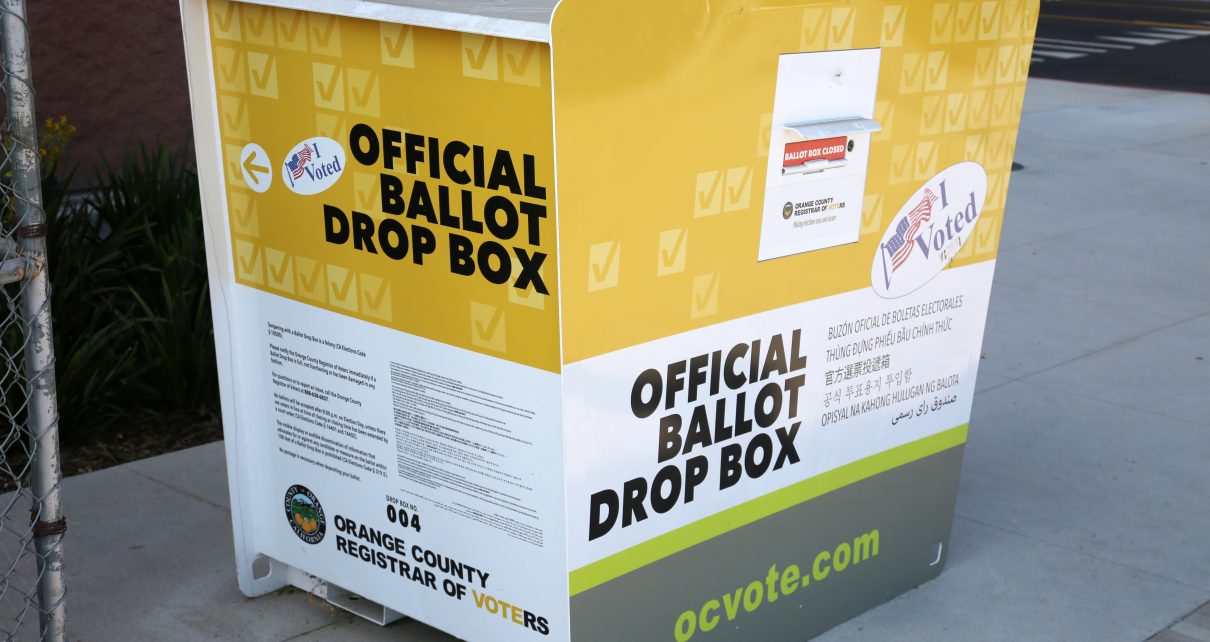
Official Ballot Drop Box placed ready to accept Voting Ballots for the upcoming election. Santa Ana, CA, Sept. 23, 2020. (Photo: mikeledray/Shutterstock)
Worldwide Technical Outages, System Failures, But US Electronic Voting Systems are Immune to Failures, Errors, or Manipulation?
‘The November 2026 midterms did not deliver clean results – they delivered a cascade of red flags that any honest observer must confront’
By Katy Grimes, November 19, 2026 9:00 am
Last Thursday, Microsoft said it experienced a worldwide outage affecting services like Outlook and Teams, impacting users, companies and government operations worldwide. The company said the outage was linked to a technical issue, not malicious or cyber activity, CBS News reported.
Then, the Federal Aviation Administration issued a nationwide ground stop on all departing U.S. flights for several hours, throwing the aviation industry into turmoil. Other recent outages that have since been resolved include disruptions to major banks like JPMorgan Chase, Bank of America and U.S. Bank, and issues with Apple’s services. On Tuesday, the National Security Agency‘s internal network used to store and share classified information went offline.
Secretary of State Marco Rubio, Director of National Intelligence Jay Clayton, and DHS Secretary Markwayne Mullin have all stated there is “zero evidence” the incidents are linked, coordinated, or caused by malicious actors, hackers, or nation-states. They say each has a distinct technical cause – maintenance, software bugs, updates, or hardware changes. Speculation has focused on AI-driven vulnerability discovery accelerating patching that then stressed legacy systems, but that remains unconfirmed as a unifying factor, CBS News reports.
So even with worldwide technical outages and system failures of some of the largest most technically sophisticated companies in the world, voters are supposed to believe that U.S. electronic voting systems are immune to failures, outages, errors, or manipulation?
Not everyone is buying that.
Setting aside obvious voter discontent, “the abrupt, overwhelming shift in one solidly conservative state after another is possible, but doesn’t seem highly probable.”
“This is the 2020 election, exactly like it, repeating identical statistical anomalies designed to engineer an artificial realignment,” Amil Imani reports. He explains that “unlike crude, visible errors, algorithmic weighting operates beneath standard audit thresholds. The software applies a mathematical multiplier — often referred to as fractional voting — assigning decimal values to individual ballots compounded by software update procedures executed in the weeks leading up to Election Day. Jurisdictions that applied ’emergency patches,’ logic upgrades, or firmware updates circumvented standard public certification timelines.”
“The November 2026 midterms did not deliver clean results. They delivered a cascade of red flags that any honest observer must confront,” Imani reports at American Thinker. “Federal data, documented cases, Election Day failures, mail-in anomalies, and viral evidence of irregularities form a pattern that cannot be dismissed as isolated human error. Federal agencies themselves documented the scale of the problem. The Department of Homeland Security reported more than 1,600 active voter fraud investigations, over 150 arrests, and roughly 300,000 suspicious records under review in the run-up to the election.”
“Mail-in voting supplied the most dramatic shifts. Across California and multiple swing states, candidates who led on Election Night watched their leads disappear as batch after batch of mail-in ballots arrived over subsequent days and nights. The so-called ‘blue shift’ is presented as a natural result of processing rules that delay the opening and scanning of mail ballots.”
Imani continues: “When an election produces outcomes that run completely counter to historical precedent, polling baselines, and raw mathematical probability, the dispute ceases to be a conventional political debate and transforms into an indictment of the process itself. The case asserting that this midterm was systematically subverted rests upon four primary pillars: statistical impossibility, software and algorithmic manipulation, unauthorized cyber penetration, and administrative chain-of-custody collapse.”
“The primary anomaly centers on contested battleground outcomes where one party captures 29 out of 30 coin-flip congressional races. In probability theory, independent coin-flip distributions do not resolve with a 96.7% success rate without external bias. When thirty high-friction districts spanning diverse demographic regions — from rural working-class enclaves to high-density suburban corridors — all break in an identical direction by margins often hovering within single fractions of a percentage point, the outcome defies standard standard-deviation boundaries.”
Imani concludes:
“Administrative friction is real. Printers jam. Programming updates fail. Mail processing stretches for days. Those are not imaginary problems. They are the exact points of vulnerability that allow errors – or worse – to affect outcomes. When the same friction repeatedly disadvantages one side’s preferred voting method, when federal agencies are investigating thousands of cases while offering cash rewards for tips, and when the public watches leads evaporate under late mail-in batches, the conclusion is unavoidable: the 2026 midterms were compromised.”
Here is a timeline and the details of the main outage incidents:
- Microsoft (starting ~November 11–12, 2026): Worldwide outage affecting Microsoft 365 services including Outlook, Teams, Copilot, and related tools. Caused by a latent bug present since July that was exposed when a network capacity upgrade and traffic rerouting overwhelmed servers. Microsoft stated it was a technical issue, not cyber-related or AI/agent-related. Services were restored over roughly a day; a separate phishing campaign later impersonated Microsoft service notices to exploit the disruption. One of the longer Microsoft outages in recent years.BloombergSecurityweekAl Jazeera
- FAA (November 13, 2026): Nationwide ground stop on departing U.S. flights lasting ~4–5 hours (the longest since 9/11). Triggered when a new router installed by contractor L3Harris Technologies (as part of a copper-to-fiber upgrade) at a radio facility in El Dorado, Arkansas (with a possible contribution from a radar site in Amarillo, Texas) flooded the FAA’s legacy telecommunications network with excessive data (~1,000 connection attempts every 4–5 seconds). This destabilized aircraft communications and radar feeds at many centers. Officials found no indication of a cyberattack or outside actor. It led to thousands of cancellations (around 12,000+ on the day) and ongoing delays. Root-cause investigation continued into the following days.CNBCFaa
- United Airlines (November 16, 2026): “Widespread system outage” / technology issue that delayed departing flights for about an hour. It affected company web-based applications used by pilots (including crew communications and aircraft weight/balance data). Flights already airborne and United Express were largely unaffected. United stated there was no indication it was cybersecurity-related and that it was unrelated to the FAA event. Hundreds of delays were reported that day (some residual from the earlier FAA disruption).Business InsiderIndia TodayReuters
- Apple (November 17, 2026): Hours-long outages affecting iCloud (sign-in and related), App Store, Apple Pay, Apple Music, Apple Support, some business/education tools, and retail store operations. Apple attributed it to an internal update/error and explicitly ruled out a cyberattack. Most services were restored by early evening (local time).TechrepublicThenextwebTalkandroid
- NSA (November 17, 2026): Temporary degradation of NSANet, the agency’s highly classified internal communications network used to store and share classified information. The NSA described it as occurring during scheduled routine maintenance; DNI Jay Clayton linked it to applying a software patch for critical PHP vulnerabilities discovered the prior month. Mission-critical capabilities remained operational. It led to staggered employee arrivals and some campus restrictions at Fort Meade (and impacts at other sites). No evidence of a cyberattack. Recovery was ongoing into November 18.CNN/CBS News
- Banking disruptions (around November 16): JPMorgan Chase software bug in on-premise systems affected online banking/transactions for some customers and caused ripple effects (including to other banks and Zelle). Chase stated it was not cyber-related.The Guardian
- Separate cyber incident (November 16): Supply-chain attack via a vulnerability in Optimizely, a website experimentation/personalization platform. Attackers injected malicious JavaScript into scripts loaded by websites, Securityweek reported.
No public reports indicate confirmed unauthorized data exfiltration or classic “breaches” at the NSA, United Airlines, Microsoft, or Apple tied to this cluster of outages. The incidents are being treated as reliability/maintenance issues (with ongoing investigations in some cases, especially the FAA). Public concern about possible coordination or cyber sabotage has been high, but official statements consistently reject that interpretation based on available evidence


A California native and Navy mom, Katy lives in Sacramento, CA.
- Worldwide Technical Outages, System Failures, But US Electronic Voting Systems are Immune to Failures, Errors, or Manipulation? - November 19, 2026
- A Geyser of Rotting Garbage in LA Defines California Today - November 18, 2026
- ‘Chronic Multiyear Deficits:’ California Legislative Analyst’s Office Releases 2027-28 Fiscal Outlook - November 18, 2026
RELATED ARTICLES
-
-
 May 11, 2023
-
 January 29, 2022