
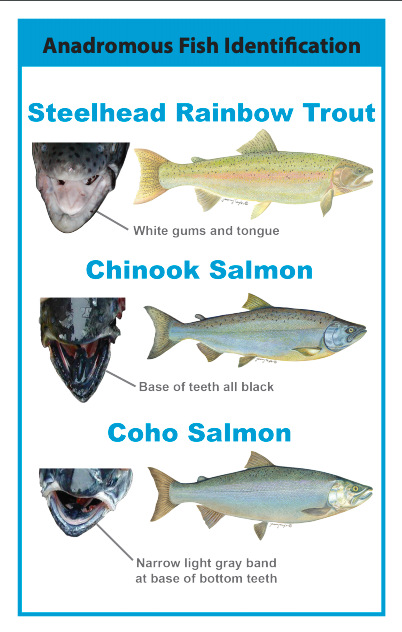
CA Sport Fishing Regulations. (Photo: nrm.dfg.ca.gov)
Fish and Wildlife Protection
Deals with fish and wildlife protection and conservation under the California Department of Fish and Wildlife
By Chris Micheli, March 23, 2026 4:42 pm
Division 2, Chapter 6 of the Fish and Game Code deals with fish and wildlife protection and conservation under the California Department of Fish and Wildlife.
Section 1600 contains legislative findings and declarations.
Section 1601 provides definitions for the following terms: “agreement,” “day,” “emergency,” and “entity.”
Section 1602 prohibits an entity from substantially diverting or obstructing the natural flow of, or substantially change or use any material from the bed, channel, or bank of, any river, stream, or lake, or deposit or dispose of debris, waste, or other material containing crumbled, flaked, or ground pavement where it may pass into any river, stream, or lake, unless all of the specified actions occur.
If an activity involves the routine maintenance and operation of water supply, drainage, flood control, or waste treatment and disposal facilities, notice to and agreement with the department cannot be required after the initial notification and agreement, unless the department determines either of two specified conditions are met.
Section 1603 requires the department to determine, after the notification is complete, whether the activity may substantially adversely affect an existing fish and wildlife resource. If the department determines that the activity may have that effect, the department must provide a draft agreement to the entity within 60 days after the notification is complete.
The draft agreement describes the fish and wildlife resources that the department has determined the activity may substantially adversely affect and include measures to protect those resources. The department’s description of the affected resources must be specific and detailed, and the department must make available, upon request, the information upon which its determination of substantial adverse effect is based.
Within 30 days of the date of receipt of the draft agreement, the entity is required to notify the department whether the measures to protect fish and wildlife resources in that draft agreement are acceptable. If the department’s measures are not acceptable, the entity must notify the department in writing and specify the measures that are not acceptable.
Upon written request, the department must meet with the entity within 14 days of the date the department receives the request for the purpose of resolving any disagreement regarding those measures. If the entity fails to respond, in writing, within 90 days of receiving the draft agreement, the department may withdraw that agreement, and require the entity to resubmit a notification to the department before commencing the activity.
Section 1604 provides that any party affected by a decision made by an arbitration panel pursuant to this chapter may petition a court of competent jurisdiction for confirmation, correction, or vacation of the decision.
Section 1605 prohibits the term of an agreement from exceeding five years. After the agreement expires, the entity must remain responsible for implementing any mitigation or other measures specified in the agreement to protect fish and wildlife resources. Any entity may request one extension of a previously-approved agreement, if the entity requests the extension prior to the expiration of its original term.
The department is required to grant the extension unless it determines that the agreement requires modification because the measures contained in the agreement no longer protect the fish and wildlife resources that the activity may substantially adversely affect. In the event the department makes that determination, the department must then propose measures intended to protect those resources.
Section 1606 prohibits the department from conditioning the issuance of an agreement on the receipt of another local, state, or federal permit.
Section 1607 provides that any time period prescribed in this chapter may be extended by mutual agreement.
Section 1608 requires the department to provide any entity that submits a notification with all seven specified items of information.
Section 1609 allows the department to establish a graduated schedule of fees to be charged to any entity subject to this chapter. The fees charged are to be established in an amount necessary to pay the total costs incurred by the department in administering and enforcing this chapter, including preparing and submitting agreements and conducting inspections. The department must annually adjust the fees.
Section 1610 specifies that this chapter does not apply to any of three specified circumstances. The entity performing the emergency work must notify the department of the work, in writing, within 14 days of beginning the work. Any work described in the emergency notification that does not meet the criteria for the emergency work is a violation of this chapter if the entity did not first notify the department in accordance with law.
Section 1611 states that an entity that submits a timber harvesting plan is deemed to have given the notification required by law, as long as the six specified items of information is included in the plan. The department is not required to determine whether the notification is complete or otherwise process the notification until the timber harvesting plan and the proper notification fee have both been received by the department.
Section 1612 authorizes the department to suspend or revoke an agreement at any time if it determines that an entity is not in compliance with the terms of the agreement or fails to provide timely status reports. The department has to adopt regulations establishing the procedure for suspension or revocation of an agreement.
Section 1613 provides that, if after receiving a notification, but before the department executes a final agreement, the department informs the entity, in writing, that the activity described in the notification, or any activity or conduct by the entity directly related thereto, violates any provision of this code or the regulations that implement the code, the department may suspend processing the notification. This section ceases to apply if any of the three conditions occur.
Section 1614 states that, if the entity is required to perform work subject to this chapter pursuant to a court or administrative order or notice, the entity must include the measures proposed by the department to protect fish and wildlife resources in the agreement. Those measures are not subject to arbitration.
Section 1615 provides that an entity that violates this chapter is subject to a civil penalty of not more than $25,000 for each violation. The civil penalty imposed is separate from, and in addition to, any other civil penalty imposed pursuant to this section or any other provision of the law.
In determining the amount of any civil penalty imposed pursuant to this section, the court is required to take into consideration all relevant circumstances, including the nature, circumstance, extent, and gravity of the violation. In making this determination, the court may consider specified items.
Every civil action brought under this section must be brought by the Attorney General upon complaint by the department, or by the district attorney or city attorney in the name of the people of the State of California, and any actions relating to the same violation may be joined or consolidated. In any civil action brought pursuant to this chapter in which a temporary restraining order, preliminary injunction, or permanent injunction is sought, it is not necessary to allege or prove at any stage of the proceeding any of the specified circumstances.
Section 1616 provides that any agreement or any memorandum of understanding executed by the department are governed by the provisions of this chapter that were in existence.
Section 1617 allows the department to adopt general agreements for the cultivation of cannabis. Any general agreement adopted by the department subsequent to adoption of regulations are in lieu of an individual agreement.


- Common Carriers of Persons - October 14, 2026
- Space Flight Liability - October 13, 2026
- Disposition of California Senate Bills - October 13, 2026
RELATED ARTICLES
-
 March 3, 2026
 -
-
September 4, 2020