
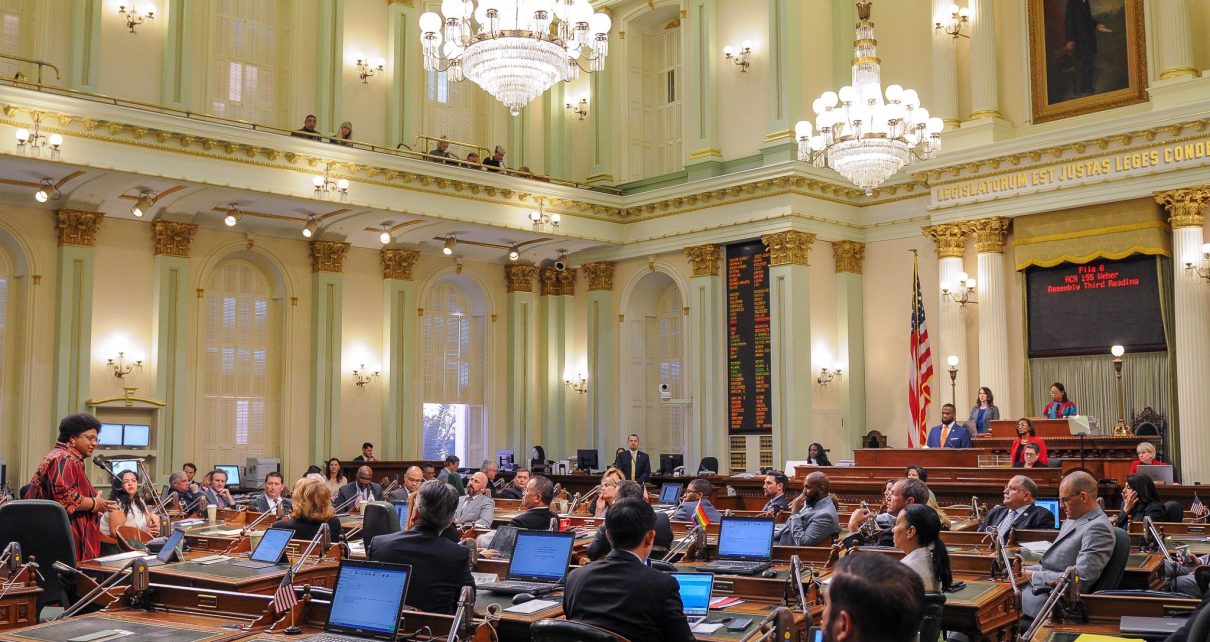
California State Assembly in Session. (Photo: Kevin Sanders for California Globe)
How California Statutes Are Made
There are essentially two paths to lawmaking in California
By Chris Micheli, June 20, 2026 2:00 pm
The California Legislature, like its federal counterpart, is bicameral (meaning it has two houses) with the Assembly (which has 80 members) and the Senate (which has 40 members) and the two houses meet in biennial sessions.
There are essentially two paths to lawmaking in California. The initiative is a power reserved to electors to propose statutes and amendments to the California Constitution. This requires submission of the measure to the Attorney General for title and summary, collection and certification of signatures, placement on the ballot, and ultimately passage by the statewide electorate. There are statutory initiatives and constitutional initiatives.
The other path is legislative wherein the Legislature passes bills and the Governor signs them to create statutes. A piece of legislation starts when a group, organization or legislator suggests legislation and either a Senator or Assembly Member agrees to author the bill. The bill idea is submitted to the attorneys at Legislative Counsel for drafting.
For those not fully acquainted with the California legislative process, new laws (called statutes) are enacted by the Legislature as bills (and signed by the Governor to become statutes). The Legislature can also amend or repeal existing statutes (also with the Governor’s action). Pursuant to Article IV, Section 8, “the Legislature may make no law except by statute, and enact no statute except by bill.”
Statutes Need Bills
Whether a statute is added, amended or repealed, that process must be done by a bill being passed by the Legislature and signed by the Governor (unless he or she allows it to become law without a signature). According to the California Legislature, “the process of government by which bills are considered and laws enacted is commonly referred to as the legislative process.”
About the Legislature and Process
A bill must be approved by both houses of the Legislature before it is sent to the Governor for final action. As a bicameral body, the Legislature is composed of the 80-member Assembly and the 40-member Senate. The Legislature meets in two-year sessions.
A bill is approved by a policy committee, and often a fiscal committee (about 80% of the bills), in both houses. Once adopted by both houses, the bill is sent to the Governor who may veto it or sign it into law. This process can take a few months, or an entire two-year Legislative Session, or sometimes longer.
Bills Ideas and Drafting Legislation
Policy committees (used to consider the policy impacts of proposed legislation) and fiscal committees (used to consider the fiscal impacts of proposed legislation) hear and consider and ultimately vote on legislation after gathering input from interested parties. These bills come from ideas that are put forth by constituents, interest groups, staff, and legislators themselves. Once a legislator decides to author a bill, he or she has the Office of the Legislative Counsel draft the bill for introduction. For a bill to be introduced or amended, it must be in “Leg Counsel” form.
Bill Introduction and Referral
Thereafter, the legislator introduces the bill in the Assembly (if an Assembly Member) or in the Senate (if a Senator). It is assigned a bill number and read publicly for the first time. This is the first of three required readings. Once the bill is printed, there is no action for 30 days after introduction until the 31st day in print.
The respective Rules Committee will assign the bill to a standing committee(s) for their consideration. The proper committee referral is based upon the subject matter of the bill and the jurisdiction of the committee(s), as well as prior precedent of similar bills. Many bills are assigned to a fiscal committee if the bill has a fiscal impact on the State or requires an expenditure of state funds (which is 75 – 80% of all bills).
Policy Committee
Once the Rules Committee has assigned the introduced bill to a policy committee, then the bill is heard in that assigned policy committee and possibly the fiscal committee if there are local or state fiscal implications of the measure. At this committee hearing, the author presents his or her bill and the proponents and opponents are permitted to speak briefly at the hearing. A vote is taken whether to pass, amend and pass, or defeat a bill.
The following are the main activities undertaken by the committees of the Assembly and Senate:
- Bill received by a committee
- Set for hearing by Committee and Author
- Hearing date published in the Senate or Assembly Daily File
- Bill analyzed
- Hearing held and bill voted on
- Votes recorded
- Votes reported to the Assembly or Senate Desk
- Appropriate systems and organizations receive information about the bill
At a bill hearing, the author presents his or her measure, followed by witnesses speaking for and against the bill, and then the author makes closing remarks. Thereafter, Committee actions can include:
- Amendments: Author’s or Committee
- Vote on the Bill with a recommendation:
- Do pass
- Do pass as amended
- Fail passage
- Grant reconsideration
- Hold the bill in committee
- Report action as a recommendation to the Floor of either the Senate or Assembly
Fiscal Committee
The vast majority of bills are referred to both a policy and fiscal committee. Once the committee(s) consider the measure, then the bill goes to the floor of the Assembly or Senate and, once passed, must complete the same process in the other house. Throughout this process, there are several opportunities prior to and during these committee hearings for interested parties to express their views on pending legislation.
Floor Activity
After passage from the policy committee, as well as the fiscal committee, if necessary, the Floor process for legislation includes:
- Second Reading — Bills passed by committees are read a second time on the
floor in the house of origin and assigned to third reading for final consideration. - Third Reading — After the bill is read a third time, it is explained by the author, discussed by Members, and voted on by all the members of the house.
If the bill is approved in its house of origin, then the bill is transmitted to the second house. If the bill is defeated, the Member may seek reconsideration and another vote. Most bills require a majority vote in both houses (21 votes in the Senate and 41 votes in the Assembly).
However, there are some measures that require a 2/3 majority vote (27 votes in the Senate and 54 votes in the Assembly), such as those with an urgency clause, bond acts, some appropriations bills, constitutional amendments, and bills that amend certain initiatives (e.g., Political Reform Act, Prop. 103).
If a measure is approved on the floor, then the bill goes to the other (or second) house and the process repeats itself. When a bill is approved by the second house, or the house of origin on concurrence, the bill goes to the Governor.
Making Your Voice Heard
The committee’s staff prepare an analysis of the bill and its impact on existing law. It is important to express your viewpoints on legislation prior to a committee hearing so that your views can be considered before legislators vote on the bill. They want to hear from constituents and interest groups regarding pending legislation. As bills make their way through the legislative process, they may be amended either substantively or technically.
Tracking Legislative Activity
Interested parties can track legislation through the process and determine whether amendments are favorable or unfavorable to one’s position. Those amendments ultimately need to be agreed to by the house of origin before the bill reaches the Governor’s Desk.
Concurrence
The same process occurs in the second houses (i.e., policy committee, fiscal committee, Floor debate and vote). If there were any amendments made in the second house, then the bill must return to its house of origin for a final vote to either accept or reject those amendments. If they are rejected, then a two-house conference committee is convened to resolve the differences. If they are accepted, then the measure goes to the Governor’s Desk.
Gubernatorial Action
The Governor generally has 12 days upon which to act on a measure (roughly 200-300 bills each year are subject to this period of time), except for the large volume of bills that are send to his or her desk at the end of the Session. With those bills, usually numbering at least 750 measures, he or she has 30 days to sign or veto them. The Governor also has the option to allow a bill to become law without his signature.
This deadline is extended to 30 days at the end of session to consider the hundreds of bills approved by the two houses in the last few weeks of the legislative session. Thereafter, the Secretary of State, in coordination with the Governor’s Office, assigns a chapter number to the bill and it becomes effective on January 1 of the following year, although urgency and budget bills, along with three other types of bills, take effect immediately.


- General Provisions for Common Interest Developments - October 21, 2026
- What Are Some Unique Aspects of Statutory Interpretation in California? - October 21, 2026
- Corporate Net Income - October 21, 2026
RELATED ARTICLES
-
 September 9, 2022
 -
 March 6, 2022
 -
 October 20, 2024