
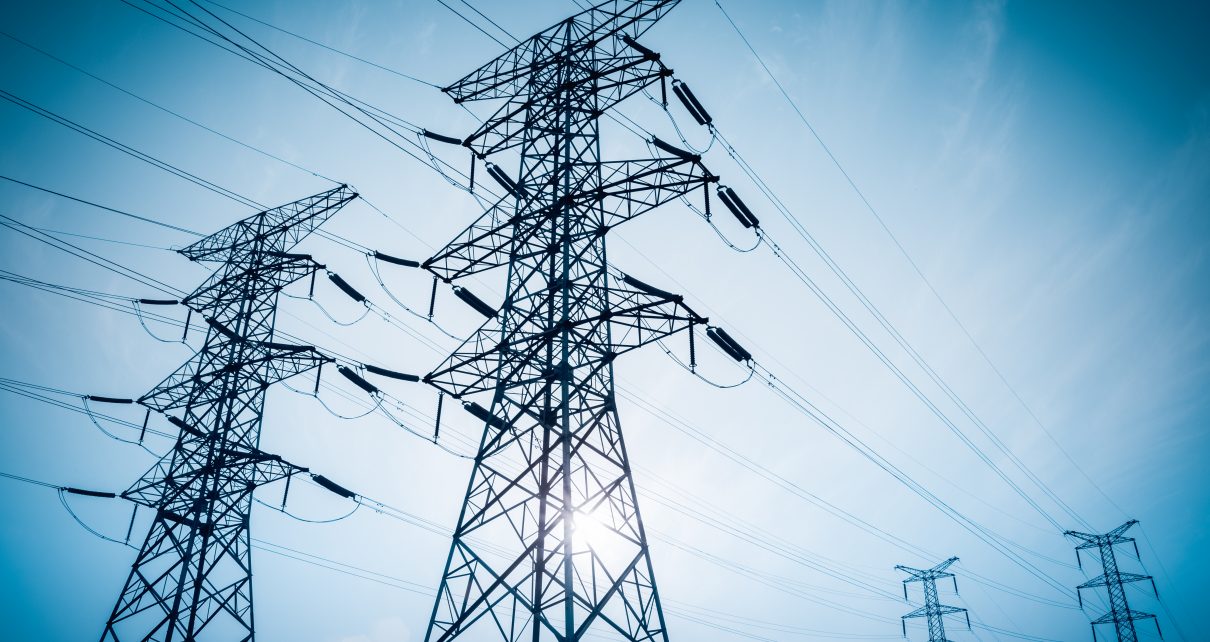
Electricity Transmission Pylon at Dusk. (Photo: chuyuss/Shutterstock)
California’s Absurd ‘Gay Certification’ Process for Utility Contracts
California’s experiment in sexual-orientation credentialing for contracts is a textbook example of identity politics run amok
By J. Mitchell Sances, June 20, 2026 12:00 pm
Recent reporting has pulled back the curtain on yet another California scheme that prioritizes identity over merit in the distribution of public resources.
Through the California Public Utilities Commission’s Supplier Diversity Program under General Order 156, large investor-owned utilities face escalating procurement “goals” for state-certified LGBT Business Enterprises (LGBTBEs).
These targets reached 1.5 percent in 2024 and beyond, channeling hundreds-of-millions of dollars (figures cited in recent analyses approach $633 million annually across related categories) toward businesses whose owners must prove their sexual orientation or transgender identity to government-approved certifiers.
This is not neutral supplier outreach. It is preferential treatment baked into the contracting process for entities ultimately funded by ratepayers.And the mechanism for accessing those preferences is a bureaucratic checklist so intrusive and subjective that it would be laughable–if it were not backed by the force of state policy and the threat of penalties for misrepresentation.
To qualify as an LGBTBE, a business must demonstrate that 51 percent is owned and managed by individuals who identify as lesbian, gay, bisexual, or transgender.
Verification falls to the Supplier Clearinghouse, which maintains an explicit list of acceptable proofs.
Among them:
- Three letters from personal contacts written on company letterhead or personal stationery attesting that the owner is LGBT (with the writer having known the individual for over a year); a letter from a recognized LGBT organization signed by its leader or board member; proof of media coverage explicitly identifying the owner as LGBT..
- Joint living arrangement documents naming a same-sex partner (leases, utility bills, wills, insurance policies, retirement plans).
- Evidence of parenting or family-building efforts with same-sex partners, including surrogacy or adoption records.
- Domestic partnership or marriage certificates; and, for transgender applicants, physician letters regarding gender reassignment or legal name/gender change petitions.
The National LGBTQ+ Chamber of Commerce offers its own parallel certification path, accepting one document from a primary list or two from a secondary list. These include attestations from personal references, joint financial or property documents, media articles, social media profiles (with caveats), awards from LGBT groups, or even evidence of past discriminatory actions documented in police or HR records.
Falsely representing a business as LGBTBE can carry criminal penalties under state law, including up to a year in county jail for corporate officials involved in the misrepresentation.
One struggles to imagine a more direct assault on the principle that government contracting should be blind to irrelevant personal characteristics.The Equal Protection Clause of the Fourteenth Amendment demands that similarly situated persons receive equal treatment under the law.
When the state erects a system that awards advantages in bidding and procurement based on an owner’s claimed sexual orientation or gender identity, complete with a state-sanctioned process for documenting private sexual behavior and relationships, it classifies businesses according to a protected characteristic and tilts the playing field accordingly.
The U.S. Supreme Court’s 2023 decision in Students for Fair Admissions v. Harvard dismantled race-based preferences in education on equal protection grounds, rejecting the notion that the government may engage in such classifications without satisfying strict scrutiny.
The logic extends forcefully here.
Sexual orientation and sex-based distinctions in government programs trigger comparable constitutional concerns. There is no compelling governmental interest in carving out identity-based set-asides for utility contracts, nor is an intrusive certification regime narrowly tailored to any legitimate end. Ratepayers deserve suppliers chosen for competence, price, and reliability, not for how convincingly their owners can assemble letters from friends or produce joint utility bills.
This program did not emerge from organic market demand. It traces to legislative and regulatory expansion of earlier minority- and women-owned business initiatives, with LGBT inclusion added amid activist pressure.
The result is a system that requires individuals to publicly document and affirm the most intimate aspects of their lives to access taxpayer-adjacent opportunities. It invites fraud, encourages performative identity claims, and divides economic actors into favored and disfavored categories based on characteristics that have nothing to do with the quality of goods or services provided.
Recent federal scrutiny underscores the vulnerability of the scheme. The Department of Justice has communicated concerns to the CPUC regarding these procurement goals, highlighting their tension with anti-discrimination principles and the heavy evidentiary burdens imposed on applicants.
With only a few hundred certified LGBTBEs participating amid broader supplier diversity spending, the program’s practical impact remains limited while its constitutional and policy defects loom large.
California’s experiment in sexual-orientation credentialing for contracts is a textbook example of identity politics run amok.It substitutes bureaucratic gatekeeping for open competition and demands that citizens prove their membership in a favored group to the satisfaction of state-aligned certifiers.
Equal protection requires better.
Contracting decisions should rest on objective criteria without regard to the sexual orientation, gender identity, race, or sex of business owners.
The state would do well to abandon this apparatus entirely.
Anything less perpetuates a regime that treats equal protection as optional when identity politics demands otherwise.


- Netflix’s ‘14th’ Filmmakers Urge Americans to ‘Fight’ While Lecturing on Autocracy - October 19, 2026
- Private Initiative Steps Up While Sacramento and City Hall Stall: Caruso, Skydance, and the Bay Theater’s Return to the Palisades - October 15, 2026
- Newsom’s Latest Medical Laws: California Defies Other States and Medical Realities - October 13, 2026
RELATED ARTICLES
-
 January 30, 2024
 -
 September 11, 2023
 -
 September 16, 2021
So we are supposed to pay more for our electricity so that contracts are only given to gay people.
The Democrats never stop screwing over the residents.
Yes.
When people complain about electric rates, they don’t understand 2 things:
1. The public utilities cannot buy a roll of toilet paper without the approval of the PUC.
2. If they think the electric company is making so much money, they can buy stock it.
The Republic of California- a wholly subsidized idiocracy.
It wouldn’t too farfetched for the loons in sacramento to require electrical linemen to wear pink nomex overalls with a rainbow bunny tail, that’s how ridiculous things are now.
The CPUC commissioners oversee the Utility Supplier Diversity Program under General Order 156 and all five current commissioners are leftist Democrat stooges who were appointed by Democrat Gov. Gavin Newsom.
John Reynolds: Appointed November 2021 and designated President in February 2026.
Christine Harada: Appointed February 2026; previously Undersecretary of the California Government Operations Agency.
Matthew Baker: Appointed February 2024.
Darcie L. Houck: Appointed February 2021.
Karen Douglas: Appointed in 2023 (previously served 2011–2017).
The Democrat party has a dark and evil history of horrific discrimination being the party of slavery, KKK, Jim Crow laws, World War II internment camps, segregation, affirmative action, and DEI.
You forgot the Democrats love of NAKED MEN IN THE GIRL’S LOCKER ROOM.
SCOTUS Chief Justice said it best, “The best way to stop discriminating is to stop descriminating.” General Order 156 is slam dunk unconstitutional under any common sense reading.
When I was a child, in the midwest, I don’t remember the power ever going out. Not through thunderstorms. Not through feet and feet of snow.
Here in Cali, I cannot remember a year going by without loss of power.
The state is a shambles in regards to everything. Power. Water. Fires. Traffic. At least you can’t blame the straight white guys….unless Gavin is straight.
I’ve worked in the midwest as a line hand and the power does fail from time to time for many of the same reasons it does in California. Meanwhile, midwesterners are used to tornados but are terrified of earthquakes and fires. Californians are used to earthquakes and are wary of fire yet would pee themselves in the vicinity of a tornado. Other than that, California wasn’t the third world scheit hole it is now when I was a child. You can thank one party rule for that.