
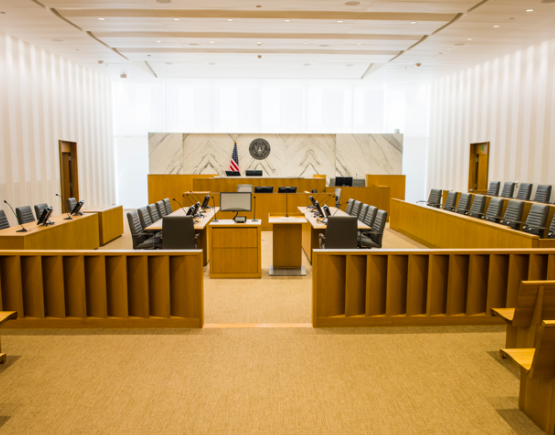
Central District of California in Los Angeles courtroom. (Photo: uscourts.gov)
Jurisdiction under the Uniform Child Custody Act
A court of this state has temporary emergency jurisdiction if the child is present in this state and the child has been abandoned
By Chris Micheli, December 3, 2025 2:30 am
California’s Family Code, in Division 8, Part 3, Chapter 2, deals with jurisdiction under the Uniform Child Custody Jurisdiction and Enforcement Act
Section 3421 provides that a court of this state has jurisdiction to make an initial child custody determination only if any of the four specified conditions are true. This is the exclusive jurisdictional basis for making a child custody determination by a court of this state.
In addition, physical presence of, or personal jurisdiction over, a party or a child is not necessary or sufficient to make a child custody determination. The presence of a child in this state for the purpose of obtaining gender-affirming health care or gender-affirming mental health care is sufficient to meet the requirements of state law.
Section 3422 states that a court of this state that has made a child custody determination has exclusive, continuing jurisdiction over the determination until either of the two actions occur. A court of this state that has made a child custody determination and does not have exclusive, continuing jurisdiction under this section may modify that determination only if it has jurisdiction to make an initial determination.
Section 3423 provides that a court of this state may not modify a child custody determination made by a court of another state unless a court of this state has jurisdiction to make an initial determination and either of the two determinations is made.
Section 3424 provides that a court of this state has temporary emergency jurisdiction if the child is present in this state and the child has been abandoned or it is necessary in an emergency to protect the child because the child, or a sibling or parent of the child, is subjected to, or threatened with, mistreatment or abuse, or because the child has been unable to obtain gender-affirming health care or gender-affirming mental health care.
A court of this state that has been asked to make a child custody determination under this section, upon being informed that a child custody proceeding has been commenced in, or a child custody determination has been made by, a court of a state having jurisdiction is required to immediately communicate with the other court.
A court of this state which is exercising jurisdiction upon being informed that a child custody proceeding has been commenced in, or a child custody determination has been made by, a court of another state under a statute similar to this section is required to immediately communicate with the court of that state to resolve the emergency, protect the safety of the parties and the child, and determine a period for the duration of the temporary order.
Section 3425 states that, before a child custody determination is made under this part, notice and an opportunity to be heard must be given to all persons entitled to notice under the law of this state as in child custody proceedings between residents of this state, any parent whose parental rights have not been previously terminated, and any person having physical custody of the child.
Section 3426 specifies that a court of this state may not exercise its jurisdiction under this chapter if, at the time of the commencement of the proceeding, a proceeding concerning the custody of the child has been commenced in a court of another state having jurisdiction substantially in conformity with this part, unless the proceeding has been terminated or is stayed by the court of the other state because a court of this state is a more convenient forum under Section 3427.
In a proceeding to modify a child custody determination, a court of this state is required to determine whether a proceeding to enforce the determination has been commenced in another state. If a proceeding to enforce a child custody determination has been commenced in another state, the court may do any of three specified items.
Section 3427 makes clear that a court of this state that has jurisdiction under this part to make a child custody determination may decline to exercise its jurisdiction at any time if it determines that it is an inconvenient forum under the circumstances and that a court of another state is a more appropriate forum. The issue of inconvenient forum may be raised upon motion of a party, the court’s own motion, or request of another court.
If a court of this state determines that it is an inconvenient forum and that a court of another state is a more appropriate forum, it must stay the proceedings upon condition that a child custody proceeding be promptly commenced in another designated state and may impose any other condition the court considers just and proper. A court of this state may decline to exercise its jurisdiction under this part if a child custody determination is incidental to an action for dissolution of marriage or another proceeding while still retaining jurisdiction over the dissolution of marriage or other proceeding.
Section 3428 provides that, if a court of this state has jurisdiction under this part because a person seeking to invoke its jurisdiction has engaged in unjustifiable conduct, the court is required to decline to exercise its jurisdiction unless one of three specified conditions are true.
The court may fashion an appropriate remedy to ensure the safety of the child and prevent a repetition of the unjustifiable conduct, including staying the proceeding until a child custody proceeding is commenced in a court having jurisdiction.
Section 3429 states that, in a child custody proceeding, each party, in its first pleading or in an attached affidavit, is required to give information, if reasonably ascertainable, under oath as to the child’s present address or whereabouts, the places where the child has lived during the last five years, and the names and present addresses of the persons with whom the child has lived during that period.
However, where there are allegations of domestic violence or child abuse, any addresses of the party alleging violence or abuse and of the child which are unknown to the other party are confidential and may not be disclosed in the pleading or affidavit. The pleading or affidavit must state whether the party has engaged in any of three specified forms of conduct.
Section 3430 allows the court, in a child custody proceeding in this state, to order a party to the proceeding who is in this state to appear before the court in person with or without the child. The court may order any person who is in this state and who has physical custody or control of the child to appear in person with the child.
If a party to a child custody proceeding whose presence is desired by the court is outside this state, the court may order that a notice given includes a statement directing the party to appear in person with or without the child and informing the party that failure to appear may result in a decision adverse to the party. The court may enter any orders necessary to ensure the safety of the child and of any person ordered to appear under this section.


- Validating Proceedings in California - March 7, 2026
- Manner of Sale of Real and Personal Property - March 7, 2026
- Bankruptcy Reorganizations - March 6, 2026
RELATED ARTICLES
-
 November 18, 2025
 -
 December 1, 2025
 -
 October 17, 2025