

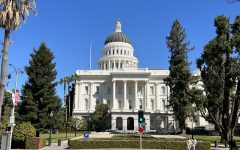
Downtown Sacramento from the Capitol building. (Photo: Norcal_kt, Shutterstock)
Nonprofit Mutual Benefit Corporations
Names this part the Nonprofit Mutual Benefit Corporation Law
By Chris Micheli, April 14, 2026 2:00 pm
Corporations Code Title 1, Division 2, Part 3 deals with nonprofit mutual benefit corporations in this state. Chapter 1 concerns organization and bylaws. Article 1 deals with title and purposes. Section 7110 names this part the Nonprofit Mutual Benefit Corporation Law.
Section 7111 provides that, subject to any other provision of law of this state applying to the particular class of corporation or line of activity, a corporation may be formed under this part for any lawful purpose.
Title 2 deals with formation. Section 7120 provides that one or more persons may form a corporation under this part by executing and filing articles of incorporation.
Section 7121 provides that, in the case of an existing unincorporated association, the association may change its status to that of a corporation upon a proper authorization for such by the association in accordance with its rules and procedures.
Section 7122 prohibits the Secretary of State from filing articles setting forth a name in which “bank,” “trust,” “trustee,” or related words appear, unless the certificate of approval of the Commissioner of Financial Protection and Innovation is attached.
Section 7122.3 prohibits the Secretary of State from filing articles for a corporation the name of which would fall within the prohibitions of law.
Article 3 of Chapter 1 of Part 3 of Division 2 of Title 1 in the Corporations Code deals with articles of incorporation for nonprofit mutual benefit corporations.
Section 7130 requires the articles of incorporation of a corporation formed under this part to set forth five specified items.
Section 7131 allows the articles of incorporation to set forth a further statement limiting the purposes or powers of the corporation.
Section 7132 allows the articles of incorporation to set forth any or all of the four specified provisions, which are not effective unless expressly provided in the articles. The articles of incorporation may set forth any or all six specified provisions.
Section 7133 states that, for all purposes other than an action in the nature of quo warranto, a copy of the articles of a corporation duly certified by the Secretary of State is conclusive evidence of the formation of the corporation and prima facie evidence of its corporate existence.
Section 7134 specifies that, if initial directors have not been named in the articles, the incorporator or incorporators, until the directors are elected, may do whatever is necessary and proper to perfect the organization of the corporation, including the adoption and amendment of bylaws of the corporation and the election of directors and officers.
Section 7135 explains that nothing in any provision of the articles of a mutual benefit corporation is to be construed to limit the equitable power of a court to impress a charitable trust upon any or all of the assets of a mutual benefit corporation or otherwise treat it as a public benefit corporation.
Title 1, Division 2, Part 3 deals with nonprofit mutual benefit corporations. Chapter 1 deals with organization and bylaws. Article 4 specified the powers.
Section 7140 provides that a corporation, in carrying out its activities, has all of the powers of a natural person, including the power to do thirteen specified tasks.
Section 7141 states that no limitation upon the activities, purposes, or powers of the corporation or upon the powers of the members, officers, or directors, or the manner of exercise of powers, must be asserted as between the corporation or member, officer or director and any third person, except in specified proceedings.
Section 7142 provides that, in the case of a corporation holding assets in charitable trust, any of the five specified individuals may bring an action to enjoin, correct, obtain damages for or to otherwise remedy a breach of the charitable trust. In an action under this section, the court may not rescind or enjoin the performance of a contract unless one or more of three specified conditions exist.
Corporations Code Title 1, Division 2, Part 3 deals with nonprofit mutual benefit corporations. Chapter 2 deals with directors and management. Article 1 contains general provisions.
Section 7210 requires each corporation to have a board of directors. Subject to the provisions of this part and any limitations in the articles or bylaws relating to action required to be approved by the members, or by a majority of all members, the activities and affairs of a corporation must be conducted and all corporate powers be exercised by or under the direction of the board.
Section 7211 requires all of the eight specified requirements apply to entities. An action required or permitted to be taken by the board may be taken without a meeting if all directors individually or collectively consent in writing to that action and the number of directors then in office constitutes a quorum.
Section 7212 allows the board, by resolution adopted by a majority of the number of directors then in office, provided that a quorum is present, create one or more committees, each consisting of two or more directors, to serve at the pleasure of the board. Appointments to the committees are by a majority vote of the directors then in office, unless the articles or bylaws require a majority vote of the number of directors.
Section 7213 requires a corporation to have a chair of the board, who may be given the title chair, chairperson, chair of the board, or chairperson of the board, or a president or both, a secretary, a treasurer or a chief financial officer or both, and any other officers with any titles and duties as shall be stated in the bylaws or determined by the board and as may be necessary to enable it to sign instruments.
Section 7214 says that any note, mortgage, evidence of indebtedness, contract, conveyance or other instrument in writing, and any assignment or endorsement, executed or entered into between any corporation and any other person, is not invalidated as to the corporation by any lack of authority of the signing officers in the absence of actual knowledge on the part of the other person that the signing officers had no authority to execute the same.
Section 7215 states that the original or a copy in writing or in any other form capable of being converted into clearly legible tangible form of the bylaws or of the minutes of any incorporators’, members’, directors’, committee or other meeting or of any resolution adopted by the board or a committee, or members, is prima facie evidence of the adoption of bylaws or resolution or of the due holding of such meeting and of the matters stated.


- Common Latin Terms in Statutory Construction - October 23, 2026
- Frogs in California - October 23, 2026
- Commencement of Estate Proceedings - October 22, 2026
RELATED ARTICLES
-
 February 12, 2026
 -
 March 24, 2026
 -
 March 26, 2022