

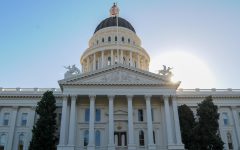
California State Capitol. (Photo: Katy Grimes for California Globe)
Office of Administrative Hearings Procedures – Part 5
The petitioner or respondent may object for cause to the use of a particular individual as an advisor
By Chris Micheli, August 28, 2026 2:42 am
Section 1332 states that, if prior to the arbitrator selection a dispute arises regarding acceptance of the work, the OAH must, upon request of one or more of the parties, cause a special arbitrator to be appointed for the sole purpose of resolving that dispute.
The special arbitrator selected is required to provide a written decision on only the issue of the timeliness of the filing of the complaint. If the special arbitrator decides that the requirements have been met, the OAH causes a new arbitrator to be selected to handle the arbitration on the merits. If the special arbitrator decides that the requirements have not been met, the OAH dismisses the complaint in arbitration without prejudice to the filing of a timely complaint.
Section 1333 authorizes the arbitrator, with consent of the parties, to select expert or technical advisors. These services must be provided by a contract between the OAH and the advisor. The contract must be on terms and conditions which are consistent with the State’s laws, policies, and procedures.
The petitioner or respondent may object for cause to the use of a particular individual as an advisor. If an objection is not timely made, it is deemed waived. An expert technical advisor is prohibited from being in communication with the arbitrator on the merits of a contested matter except in specified circumstances.
Section 1334 grants the arbitrator discretion to dismiss any complaint where the petitioner or cross-complainant fails to prosecute the matter by failing to perform discovery or otherwise fails to take any significant action to move the case to hearing for a period of 18 consecutive months, measured from the filing of the complaint or the last significant action.
The arbitrator is required to dismiss any complaint where the petitioner cross-complainant fails to prosecute the matter by failing to perform discovery or otherwise fails to take any significant action to move the case to hearing for a period of 36 consecutive months, measured from the filing of the complaint or the last significant action.
The term “significant action” is defined. The arbitrator is required to dismiss a complaint if the hearing has not commenced within five years after the filing of the compliant. If an arbitrator has not been selected or is absent due to resignation, death or disability, the OAH has authority to dismiss the complaint as specified.
Section 1340 states that the simplified claims procedure provided for in this article is available by election of either petitioner or respondent on claims which in the aggregate do not exceed $50,000 in one complaint and a final written decision or ruling has been issued by the public agency.
Section 1341 authorizes the petitioner or respondent to elect to have its claims resolved with use of the simplified claims procedure by indicating its election with or in the filing of its first pleading in arbitration and by attaching thereto a copy of the written decision or ruling of the department or agency.
In the complaint or answer, the party electing the simplified claims procedure is required to state all facts and conclusions at issue. The arbitrator may consider a request for the simplified claims procedure after the filing of the first pleading except a request must be granted only for mistake, inadvertence, surprise or excusable neglect.
Section 1342 provides that the petitioner and respondent may select an arbitrator by agreement. If the petitioner and respondent do not agree upon an arbitrator, the OAH promptly prepares a list of twenty potential arbitrators selected at random from those who have indicated a willingness to serve as an arbitrator in the location for the hearing.
Within 10 days from the mailing, the petitioner and respondent each may cross off the names of not more than 10 to which it objects, numbering the remaining names in the order of preference and return the list to the OAH with a copy to the other.
Thereafter, the OAH appoints the arbitrator from among the persons whose names remain in accordance with the designated order of mutual preference. The disclosure and challenge procedure in Section 1323 shall apply. If for any reason the appointment cannot be made from the submitted list, the OAH repeats the process until an arbitrator is selected.
Section 1343 provides that not more than 25 days and not less than 10 days prior to a hearing, the arbitrator, on written request of a party, may direct the parties to take three specified actions.
Section 1344 explains that no verbatim record of the proceedings is required. The claim file and written record produced at the highest agency level of review, including all written materials submitted by the petitioner or respondent and reviewed by the public agency, are forwarded to the arbitrator by the public agency with or prior to filing of an answer constitutes the initial record before the arbitrator.
In addition, the parties may submit and file in advance of the hearing any additional written, photographic or demonstrative evidence or may object to materials submitted by other -parties. Based upon the initial record and any additional evidence and written arguments submitted in advance of the hearing, the arbitrator establishes the issues to be tried.
Section 1345 provides that no decision made by a public agency is conclusive on any issue in the arbitration and each party has the burden of proving its affirmative allegations by a preponderance of the evidence as in ordinary civil actions.
Affidavits of witnesses are admissible if the witness is competent and the statements are relevant to the issues established by the arbitrator and provided they are filed at least 15 days in advance of the hearing. If within at least 5 days in advance of the hearing a party files a written objection to the proffered testimony, the party is entitled to cross-examine any such witness.
The award must be in writing affirming, disaffirming or modifying the written decision of the public agency and be made setting forth the reasons with findings of fact and conclusions of law, unless waived by the parties. The decision must be in accordance with the law of this state, supported by substantial evidence.
Section 1346 requires the provisions of Chapter 4, “Public Works Contract Arbitrations,” to be applicable to the simplified claims procedure.
Section 1350 states that an arbitration is commenced by filing with the OAH in Sacramento a complaint in arbitration within 90 days from receipt of the final written decision by the public agency on the claim or, if no final written decision has been issued, at any time subsequent to 240 days after acceptance of the contract work. The petitioner is required to serve copies of the complaint on the respondent and any other named party.
Section 1351 limits a complaint by a contractor to the claim or claims presented to the public agency as required by the contract. A complaint by a contractor has to be verified in accordance with the provisions of CCP Section 446 and must contain seven specified items of information. In addition, a complaint by a public agency must contain four specified items of information.
Section 1352 states that a petitioner or respondent may name an interested party in a complaint or cross-complaint as a party whose joinder in the arbitration is demanded in two specified circumstances. At any time prior to a hearing on the merits, an interested party may be permitted to join in and be bound by the arbitration proceedings if required by the terms of the interested party’s contract or by the agreement of the parties.
Section 1353 allows the petitioner to amend the complaint prior to the filing of an answer to the complaint by filing the amendment with the OAH of the answer to the complaint or of the complaint subsequent to the filing of the answer to the complaint shall be made only for good cause shown. Objections to the amendments may be made orally and are to be noted in the record.
Section 1354 provides that, not later than 30 days after service of the complaint, the respondent is required to file an answer to the complaint. The answer or objection will not be filed unless the respondent submits a non-refundable filing fee, established by and payable to the OAH, and proof of service required in section 1305.
Section 1355 requires the answer to the complaint to be in writing and set forth in ordinary and concise language a direct statement of respondent’s defenses to each claim asserted in the complaint together with any affirmative defenses or cross-complaint to be asserted. Any allegation of the complaint which is not denied in the answer is to be tried as uncontested and evidence is inadmissible to controvert any allegation.
Section 1356 provides that, no later than 30 days after service of the complaint a respondent, in lieu of filing an answer, may file an objection to the complaint. There are five specified possible objections that may be raised.
Section 1357 specifies that cross-complaints may be filed and served as specified in two circumstances. The provisions of Sections 1350-1356 relating to complaints also apply to cross-complaints.
Section 1360 requires the parties to have four specified obligations with respect to discovery in arbitrations under this subchapter. Discovery by agreement of the parties is encouraged. Inspection and production of discoverable documents and records is the preferred initial means of discovery.
On request of any party made not less than 30 days prior to the hearing on the merits, each party is required to notify the other parties in writing of the identity and current address of each expert witness to be presented as a witness at the hearing and a brief narrative statement of the qualifications of the witnesses and the general substance of the testimony which the witness is expected to give.
Section 1361 requires that all motions by the parties are to be in writing, unless made on the record during hearing, and clearly state the action requested and the grounds relied upon. The original written motion, together with evidence of service of true copies on all other parties and the arbitrator, must be filed in the OAH. The arbitrator is required to conduct the proceedings and make the orders as deemed necessary to dispose of the issues raised by the motion.
Section 1370 states that the failure of any party to file an answer or objection to a complaint or cross-complaint pursuant to this subchapter is cause for holding the party to be in default.
Section 1371 specifies that the failure or refusal of any party to comply, after due notice, with any lawful order of the arbitrator is cause for holding the party to be in default.
Section 1372 sets forth that the failure or refusal of a party of record to timely appear at a hearing on the merits after due notice, or comply with any lawful order of the arbitrator, at the hearing, is cause for holding the party to be in default.
Section 1373 states that, when the matter is tried as uncontested, the party not in default has the burden of proof of affirmative allegations, and affirmative findings must be based only on the express admissions of the defaulted party, judicially noticeable facts, or on evidence which would support findings of fact in an uncontested civil trial, or any combination thereof.
Also, in proceedings conducted under this section, a party in default has no right to cross-examine witnesses, or present any evidence to controvert the allegations of the complaint or the answer, or otherwise present any evidence.
Section 1374 specifies that the entry in the record of the default of any party for cause is to be by order of the arbitrator either upon written motion and proceedings, or upon stipulation of the Parties.
Section 1375 states that, upon a finding by the arbitrator on the record that a party is in default, the arbitration must proceed in accordance with Section 1373 with respect to that party.
Section 1380 requires, unless the petitioner, respondent and arbitrator otherwise agree, the arbitrator to order a prehearing conference. At the conference, the arbitrator may consider any of the eight specified items.
In addition, the parties may be ordered to exchange, at some time in advance of the hearing, all exhibits each party intends to offer at the hearing (other than exhibits exclusively used for impeachment or rebuttal); and may be ordered to index, offer and file some or all of the exhibits in advance of the hearing.
Section 1381 requires the arbitrator, in coordination with the parties and the OAH, to set the date and time for all hearings conducted under these rules and serve written notice on all parties no later than 15 days prior to the date of hearing, provided, however, that no less than 30 days’ notice is to be given for the hearing on the merits of the arbitration.
Section 1382 authorizes the arbitrator to require the parties before, during or following a hearing to submit arguments or briefs on some or all of the issues. The arbitrator, prior to taking the issues under submission for decision, may require the parties to submit proposed findings of fact and conclusions of law on some or all of the issues. When a proposed finding of fact is required to be submitted on an issue, the failure of a party to propose a finding may be treated by the arbitrator as a waiver of that party’s contentions.
Section 1383 requires the arbitration hearings to be open to the public unless the attendance of individuals or groups of individuals would disrupt or delay the orderly conduct or timely completion of the proceedings. A Party to the arbitration cannot be excluded under this section.
Section 1384 authorizes the arbitrator to order separate determination of issues in any proceeding which is the subject of this subchapter.
Section 1385 states that continuances or extensions of time may be permitted for good cause or on stipulation of all relevant parties. A showing of good cause for any continuance or the basis of the stipulation must be set forth in the record.
Section 1386 says that, by stipulation, any matter or issue pending before the arbitrator may be submitted on an agreed statement of facts. The arbitrator may permit arguments and render an award based on the agreed statements submitted and such arguments.
Section 1387 requires oral evidence to be taken only on oath or affirmation. Each party has these rights: to present evidence relevant to the issues; to cross-examine opposing witnesses on any matter relevant to the issues even though that matter was not covered in the direct examination; to impeach any witness regardless of which party first called the witness to testify; and to rebut the evidence against the party. Any party may be called and examined as if under cross-examination by any adverse party.
In addition, the hearing need not be conducted according to technical rules relating to evidence and witnesses. Any relevant evidence, including hearsay, is to be admitted if it is the sort of evidence on which responsible persons are accustomed to rely in the conduct of serious affairs, regardless of the existence of any common law or statutory rule which might make improper the admission of such evidence over objection in civil actions, provided, however, hearsay evidence even though not objected to is not sufficient in itself to support a finding unless it would be admissible over objection in civil actions.
Section 1388 allows the arbitrator to take notice in reaching a decision any fact which may be judicially noticed by the courts of this State, provided that the judicially noticed fact is set forth in the record.
Section 1389 requires the proceedings at the hearing to be reported by a phonographic reporter or, with agreement of the parties and consent of the OAH, otherwise perpetuated by mechanical, electronic, or other means capable of reproduction or transcription.
Section 1390 requires a written decision on the merits to be filed with the OAH and contain a summary of the evidence, reasons underlying the decision and, unless the parties otherwise agree, findings of fact and conclusions of law. A copy of the decision must be served by the OAH on each of the parties.
Thereafter, objections to findings and conclusions may be filed by any party within 15 days of receipt of the written decision. Any response to objections must be filed within 15 days of receipt of the objections to findings and conclusions. The arbitrator is to consider the objections and may notice a hearing.
Section 1391 states that, if the parties settle any claim, in whole or part, during the course of the arbitration proceedings, the terms of the agreed settlement must be incorporated in a decision, if requested by the parties, and a final award to be issued by the arbitrator.
Section 1392 requires the cost of conducting the arbitration to be borne equally by the parties and in no case awarded to the prevailing party. These costs include four specified items. Other costs, other than attorney’s fees, may be awarded to the prevailing party in the arbitrator’s discretion on the same basis as is allowed in civil actions. These costs are taxed as in civil actions.
Reasonable attorney’s fees may be awarded and a petition for interest, costs and attorney’s fees must be filed by any party within 15 days of receipt of the decision on any objections filed. If there is no objection, the filing must occur within 30 days of receipt of the decision on the merits. Any petition for interest, costs or attorney’s fees is to be promptly determined and assessed by the arbitrator in a separate hearing.
Section 1393 provides that any decision on costs, together with the decision on the Merits, is required to be reflected in a final award issued by the arbitrator.
Section 1395 requires arbitrators to have substantial experience in or directly related to public works construction projects, particularly large-scale complex projects with or on behalf of federal, state or local government agencies, as well as experience as an arbitrator or adjudicator of disputes arising out of these types of projects is necessary, as well as, knowledge of California construction law. This experience may be met by a combination of factors, which include any one or more of the three specified factors.
Section 1398 requires arbitrators certified to the panel to apply for recertification every seven years to remain on the panel. Arbitrators are to be evaluated for recertification on the basis of the current standards and qualifications.


- Hiring in General - October 13, 2026
- Considering Legislative Statements with Unambiguous Statutes - October 12, 2026
- Disposition of California Assembly Bills - October 12, 2026
RELATED ARTICLES
-
 July 23, 2020
 -
 November 10, 2024
 -
 October 24, 2024