
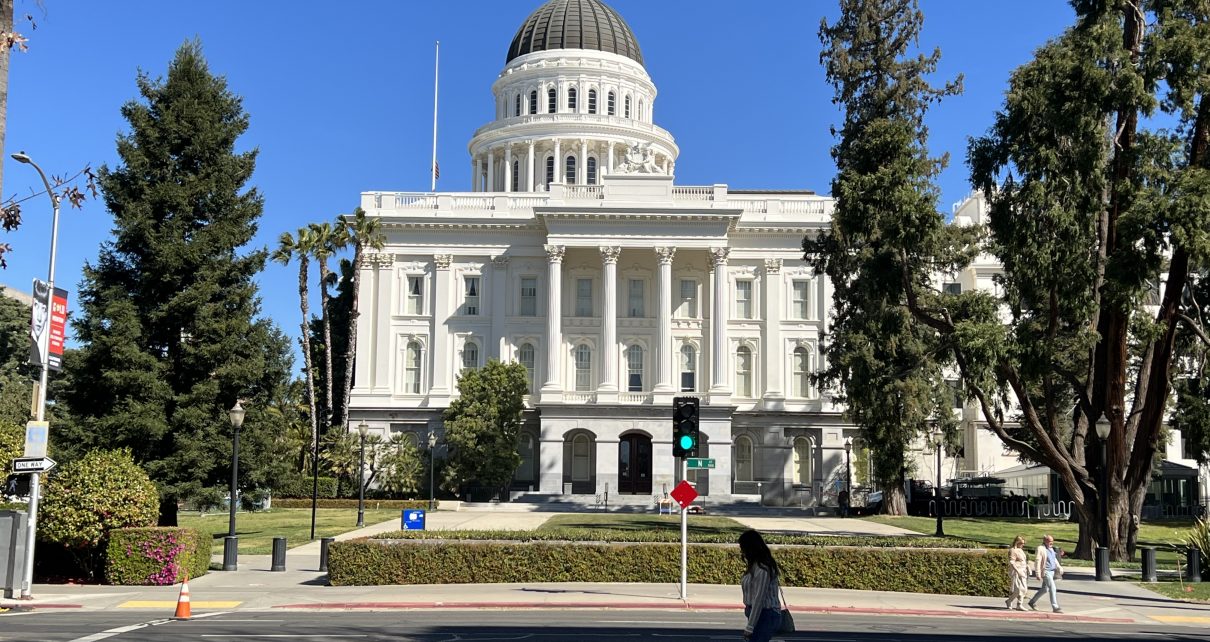
California State Capitol on March 11, 2022. (Photo: Kevin Sanders for California Globe).
Permissive Joinders in California
Judgment may be given for one or more of the plaintiffs according to their respective right to relief
By Chris Micheli, January 14, 2026 2:30 am
Chapter 5 of Title 3 of Part 2 of the Code of Civil Procedure deals with permissive joinders in California civil actions.
Section 378 authorizes all persons to join in one action as plaintiffs if two specified requirements are met. Also, it is not necessary that each plaintiff be interested as to every cause of action or as to all relief prayed for. Judgment may be given for one or more of the plaintiffs according to their respective right to relief.
Section 379 allows all persons to be joined in one action as defendants if there is asserted against them either of two specified circumstances. It is not necessary that each defendant be interested as to every cause of action or as to all relief prayed for. Judgment may be given against one or more defendants according to their respective liabilities.
Section 379.5 provides that, when parties have been joined, the court may make orders as may appear just to prevent any party from being embarrassed, delayed, or put to undue expense, and may order separate trials or make such other order as the interests of justice may require.
Section 382 states that, if the consent of any one who should have been joined as plaintiff cannot be obtained, he may be made a defendant.
Section 382.4 provides that, if a proposed settlement in a class action, including a consent judgment, decree, or settlement agreement, provides for the distribution of money or any other thing of value to a person or entity that is not a party to the action, an attorney for a party to the action must notify, in connection with the hearing for preliminary approval, the court if the attorney has a connection to or a relationship with a nonparty recipient of the distribution that could reasonably create the appearance of impropriety as between the selection of the recipient of the money or thing of value and the interests of the class.
Section 384 expresses the policy of the State of California to ensure that the unpaid cash residue and unclaimed or abandoned funds in class action litigation are distributed, to the fullest extent possible, in a manner designed either to further the purposes of the underlying class action or causes of action, or to promote justice for all Californians.
Before the entry of a judgment in a class action that provides for the payment of money to members of the class, the court is required to determine the total amount that will be payable to all class members if all class members are paid the amount to which they are entitled pursuant to the judgment. The court must also set a date when the parties shall report to the court the total amount that was actually paid to the class members.
This section does not apply to any class action brought against any public entity, or against any public employee. However, this section is not to be construed to abrogate any equitable cy pres remedy that may be available in any class action with regard to all or part of the cash residue or unclaimed or abandoned class member funds.
Section 384.5 provides that, if a judgment in a class action, including a consent judgment, decree, or settlement agreement that has been approved by a court, provides for a distribution of money or any other thing of value to a person or entity that is not a party to the action, the court is required to transmit a copy of the order, judgment, or decree to the Judicial Council.


- Nonprofit Mergers - March 24, 2026
- Commodities Crimes - March 24, 2026
- Fish and Wildlife Protection - March 23, 2026
RELATED ARTICLES
-
 November 3, 2024
 -
 July 12, 2022
 -
 January 8, 2026