

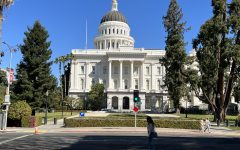
California State Capitol. (Photo: Kevin Sanders for California Globe)
Registration and Enforcement of Protective Orders
Required each county to develop a procedure, using existing systems, for the electronic transmission of data to the Department of Justice
By Chris Micheli, October 12, 2025 2:30 am
California’s Family Code, in Division 10, Part 4, Chapter 3 deals with the registration and enforcement of protective orders and other domestic violence prevention orders.
Section 6380 required each county to develop a procedure, using existing systems, for the electronic transmission of data to the Department of Justice. The data is electronically transmitted through the California Law Enforcement Telecommunications System (CLETS) of the Department of Justice by law enforcement personnel, or with the approval of the Department of Justice, court personnel, or another appropriate agency capable of maintaining and preserving the integrity of both the CLETS and the California Restraining and Protective Order System.
All data filed with the court on the required Judicial Council forms with respect to protective orders is required to be transmitted by the court or its designee within one business day to law enforcement personnel by either one of the two specified methods. Upon the issuance of any specified orders issued pursuant to a dissolution, legal separation, nullity, or paternity proceeding the Department of Justice is required to be immediately notified of the contents of the order and the eight specified items of information.
Within one business day of service, a law enforcement officer who served a protective order shall submit the proof of service directly into the Department of Justice California Restraining and Protective Order System, including the officer’s name and law enforcement agency, and must transmit the original proof of service form to the issuing court.
The Department of Justice maintains a California Restraining and Protective Order System and makes available to court clerks and law enforcement personnel, through computer access, all information regarding the protective and restraining orders and injunctions, whether or not served upon the respondent.
Section 6381 specifies that an order issued under this part is enforceable in any place in this state. An order issued under this part is not enforceable by a law enforcement agency of a political subdivision unless that law enforcement agency has received a copy of the order, or the officer enforcing the order has been shown a copy of the order or has obtained information, through the California Restraining and Protective Order System.
Section 6382 requires each appropriate law enforcement agency to make available to any law enforcement officer responding to the scene of reported domestic violence, through an existing system for verification, information as to the existence, terms, and current status of an order issued under this part.
Section 6383 provides that a temporary restraining order, emergency protective order, or an order issued after hearing pursuant to this part must be served, on request of the petitioner, on the respondent, whether or not the respondent has been taken into custody, either by a law enforcement officer, who is present at the scene of reported domestic violence involving the parties to the proceeding or who receives a request from the petitioner to provide service of the order.
Upon receiving information at the scene of a domestic violence incident that a protective order has been issued under this part, or that a person who has been taken into custody is the respondent to that order, if the protected person cannot produce an endorsed copy of the order, a law enforcement officer must immediately inquire of the California Restraining and Protective Order System to verify the existence of the order.
If the law enforcement officer determines that a protective order has been issued but not served, the officer immediately notifies the respondent of the terms of the order and where a written copy of the order can be obtained, and the officer at that time also enforces the order. The law enforcement officer’s verbal notice of the terms of the order constitutes service of the order and is sufficient notice.
There shall be no civil liability on the part of, and no cause of action for false arrest or false imprisonment against, a peace officer who makes an arrest pursuant to a protective or restraining order that is regular upon its face, if the peace officer, in making the arrest, acts in good faith and has reasonable cause to believe that the person against whom the order is issued has notice of the order and has committed an act in violation of the order.
Section 6384 states that, if a respondent named in an order issued under this part after a hearing has not been served personally with the order but has received actual notice of the existence and substance of the order through personal appearance in court to hear the terms of the order from the court, no additional proof of service is required for enforcement of the order. The Judicial Council forms for orders issued under this part contain a statement in substantially the specified form.
Section 6385 specifies that proof of service of the protective order is not required if the order indicates on its face that both parties were personally present at the hearing at which the order was issued and that no proof of service is required, or if the order was served by a law enforcement officer.
There is no civil liability on the part of, and no cause of action arises against, an employee of a local law enforcement agency, a court, or the Department of Justice, acting within the scope of employment, if a person unlawfully purchases or receives or attempts to purchase or receive a firearm and a person is injured by that firearm or a person who is otherwise entitled to receive a firearm is denied a firearm and either wrongful action is due to a failure of a court to provide the notification provided for in this chapter.
Section 6386 authorizes a court to appoint counsel to represent the petitioner in a proceeding to enforce the terms of a protective order. In a proceeding in which private counsel was appointed by the court, the court may order the respondent to pay reasonable attorney’s fees and costs incurred by the petitioner.
Section 6387 requires the court to order the clerk of the court to provide to a petitioner, without cost, up to three certified, stamped, and endorsed copies of any order issued under this part, and of an extension, modification, or termination of the order.
Section 6388 provides that a willful and knowing violation of a protective order is a crime punishable as provided by the Penal Code.
Section 6389 states that a person subject to a protective order cannot own, possess, purchase, or receive a firearm or ammunition while that protective order is in effect. A person who owns, possesses, purchases, or receives, or attempts to purchase or receive, a firearm or ammunition while the protective order is in effect is punishable specified in the Penal Code.
Upon issuance of a protective order, the court must order the respondent to relinquish any firearm or ammunition in the respondent’s immediate possession or control or subject to the respondent’s immediate possession or control. That person must immediately surrender the firearm or ammunition in a safe manner, upon request of a law enforcement officer, to the control of the officer, after being served with the protective order.
A court holding a hearing on this matter must review the file to determine whether the receipt has been filed and inquire of the respondent whether they have complied with the requirement. Violations of the firearms prohibition of any restraining order under this section are required to be reported to the prosecuting attorney in the jurisdiction where the order has been issued within two business days of the court hearing.
Section 6389 prohibits specified persons who are subject to a protective order from owning, possessing, purchasing, or receiving a firearm or ammunition while that protective order is in effect. A person who owns, possesses, purchases, or receives, or attempts to purchase or receive, a firearm or ammunition while the protective order is in effect is punishable pursuant to the Penal Code.


- Aquatic Invasive Species - October 9, 2026
- Bills in California Special Sessions - October 9, 2026
- Bills by Vote Requirement in California - October 9, 2026
RELATED ARTICLES
-
 July 12, 2025
 -
 August 24, 2025
 -
 June 13, 2025