

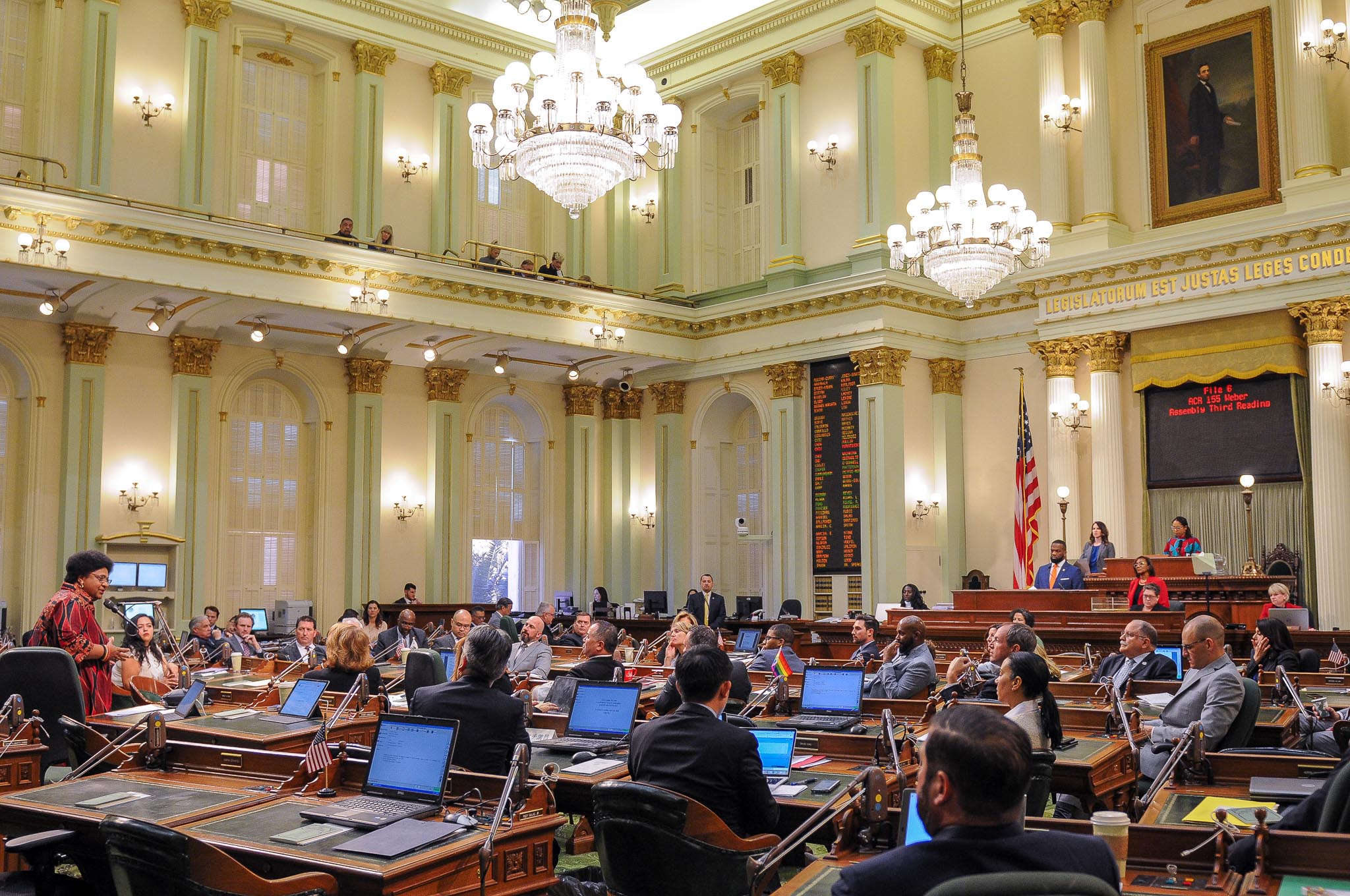
California State Capitol. (Photo: Katy Grimes for California Globe)
Rules of Probate Practice
Deals with rules of practice under the Probate Code
By Chris Micheli, July 20, 2026 2:30 am
Division 3, Part 1, Chapter 1 deals with rules of practice under the Probate Code. Section 1000 provides that the rules of practice applicable to civil actions, including discovery proceedings and proceedings, apply to, and constitute the rules of practice in, proceedings under this code. All issues of fact joined in probate proceedings must be tried in conformity with the rules of practice in civil actions.
Section 1001 allows the Judicial Council to may provide by rule for the practice and procedure under this code. Unless disapproved by the Judicial Council, a court may provide by local rule for the practice and procedure under this code. Judicial Council and local court rules shall be consistent with the applicable statutes.
Section 1002 states that either the superior court or the court on appeal may order costs to be paid by any party to the proceedings, or out of the assets of the estate, as justice may require.
Section 1003 provides that the court may, on its own motion or on request of a personal representative, guardian, conservator, trustee, or other interested person, appoint a guardian ad litem at any stage of a proceeding under this code to represent the interest of any of the six specified persons, if the court determines that representation of the interest otherwise would be inadequate. If not precluded by a conflict of interest, a guardian ad litem may be appointed to represent several persons or interests.
Section 1003.5 prohibits the public guardian from being appointed as a guardian ad litem unless the court, after reasonable notice and inquiry, finds that no other qualified person is willing to act as a guardian ad litem.
Section 1004 states that, if a proceeding under this code affects the title to or the right of possession of real property, notice of the pendency of the proceeding may be filed.
Chapter 2 deals with petitions and other papers. Section 1020 requires a petition, objection, response, report, or account filed pursuant to this code to be in writing, signed by all of the petitioners, objectors, or respondents or by all of the persons making the report or account, and filed with the court clerk. Verification of a document constitutes signature of that document, unless expressly provided to the contrary.
Section 1021 requires two documents to be verified. The verification must be made as set forth in this section.
Section 1022 requires an affidavit or verified petition to be received as evidence when offered in an uncontested proceeding under this code.
Section 1023states that, if a petitioner, objector, or respondent is absent from the county or for some other cause is unable to sign or verify a petition, objection, or response filed pursuant to this code, the person’s attorney may sign or verify the petition, objection, or response unless the person is a fiduciary appointed in the proceeding.
Chapter 3 deals with hearings and orders. Section 1040 provides that this chapter governs the hearing of all matters under this code, except where the statute that provides for the hearing of the matter prescribes a different procedure.
Section 1041 states that, when a petition, report, account, or other matter that requires a hearing is filed with the court clerk, the clerk is required to set the matter for hearing.
Section 1042 requires a hearing under this code to be on notice unless the statute that provides for the hearing dispenses with notice.
Section 1043 allows an interested person to appear and make a response or objection in writing at or before the hearing. An interested person may appear and make a response or objection orally at the hearing.
Section 1044 explains that the petitioner or other party affirming is the plaintiff and the party objecting or responding is the defendant.
Section 1045 allows the court to continue or postpone any hearing, from time to time, in the interest of justice.
Section 1046 requires the court to hear and determine any matter at issue and any response or objection presented, consider evidence presented, and make appropriate orders.
Section 1047 states that an order made in a proceeding under this code need not recite the existence of facts, or the performance of acts, upon which jurisdiction depends, but need only contain the matters ordered.
Section 1048 requires orders to be either entered at length in the minute book of the court or signed by the judge and filed.
Section 1049 allows an order to be enforced as provided in law.
Section 1050 states that the judgment roll in a proceeding under this code consists of the specified papers, where applicable.
Section 1051 states that, in the absence of a stipulation to the contrary between parties who have filed pleadings in a proceeding under this code, there is no ex parte communications between any party, or attorney for the party, and the court concerning a subject raised in those pleadings, except as permitted or required by law.
Chapter 4 deals with probate accounts. Section 1060 provides that this chapter governs all accounts to be filed with the court.
Section 1061 requires all accounts to state the period covered by the account and contain a summary showing all of the specified information, to the extent applicable. The summary must be in a format substantially the same as that which is set forth in this section, except that inapplicable categories need not be shown. The terms “net income” and “net loss” are defined.
Section 1062 requires the summary to be supported by detailed schedules showing the six specified items.
Section 1063 states that, in all accounts, there is an additional schedule showing the estimated market value of the assets on hand as of the end of the accounting period, and a schedule of the estimated market value of the assets on hand as of the beginning of the accounting period for all accounts subsequent to the initial account. The requirement of an estimated value of real estate, a closely held business, or other assets without a ready market, may be satisfied by a good faith estimate by the fiduciary.
Section 1064 requires the petition for approval of the account or a report accompanying the petition must contain five specified items of information. The filing of an account is to be deemed to include a petition requesting its approval, and may include additional petitions for authorization, instruction or confirmation authorized by the code, including, but not limited to, a request for an order for compensation of the fiduciary and the attorney for the fiduciary. The term “family” is defined.


- Aquatic Invasive Species - October 9, 2026
- Bills in California Special Sessions - October 9, 2026
- Bills by Vote Requirement in California - October 9, 2026
RELATED ARTICLES
-
 April 12, 2025
 -
 June 29, 2026
 -
 February 25, 2026