

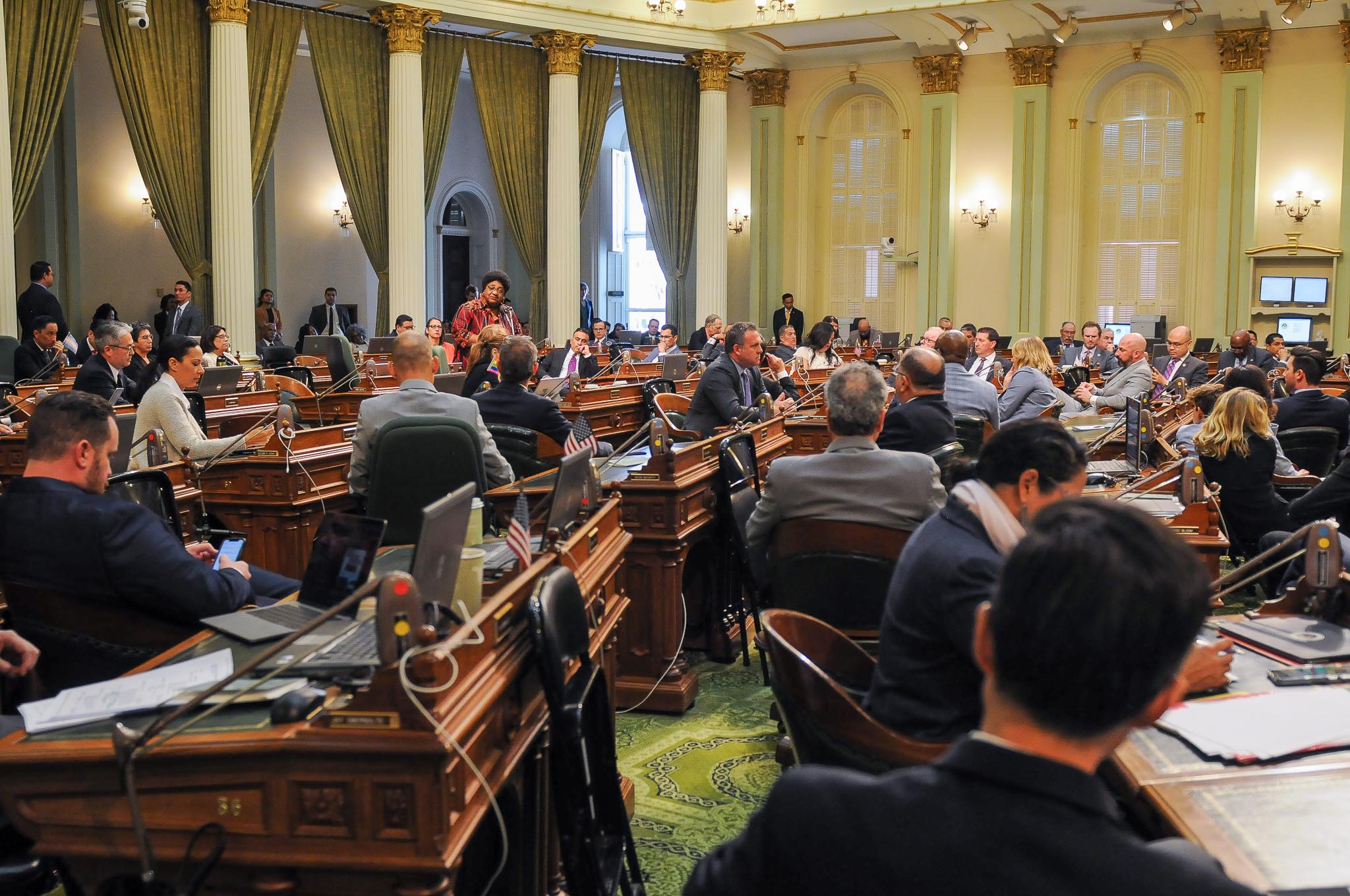
California Assembly. (Photo: Katy Grimes for California Globe)
What Is in the 2026 Claims Bill?
AB 2597 would appropriate $7,391,650.83 from the General Fund to the Attorney General to pay claims, settlements, or judgments against the state
By Chris Micheli, July 9, 2026 2:30 am
Each year, the California Legislature must author a “claims bill,” which appropriates funds to pay legal judgments or settlements owed by the State of California. So, what are the amounts being paid in this year’s AB 2597 and the reasons for those amounts?
The Title of AB 2597 is “an act relating to the payment of claims against the state, making an appropriation therefor, and declaring the urgency thereof, to take effect immediately.”
The Legislative Counsel’s Digest explains that, under existing law, if sufficient appropriations are not available for the payment of certain claims, settlements, or judgments, the Attorney General is required to report the claims, settlements, and judgments to the chairperson of either the Senate Committee on Appropriations or the Assembly Committee on Appropriations, who is then required to cause introduction of legislation appropriating the funds necessary for payment.
AB 2597 would appropriate $7,391,650.83 from the General Fund to the Attorney General to pay the payment of claims, settlements, or judgments against the state arising from 8 specified actions. This bill would declare that it is to take effect immediately as an urgency statute.
The text of the bill follows, along with an explanation of the amounts being paid:
SECTION 1.
(a) The sum of seven million three hundred ninety-one thousand six hundred fifty dollars and eighty-three cents ($7,391,650.83) is hereby appropriated from the General Fund to the Attorney General to be allocated in accordance with the following schedule:
(1) The sum of one hundred sixty-five thousand eight hundred fifty dollars ($165,000) for the payment of claims, settlements, or judgments against the state arising from Hoffman, et al. v. Bonta (United States District Court, Southern District of California, Case No. 3:24-cv-00664-CAB-MMP).
The case of Hoffman v. Bonta is a federal Second Amendment lawsuit challenging California’s statutory requirement that applicants for standard two-year Concealed Carry Weapons (CCW) licenses be state residents.
(2) The sum of one hundred twenty-eight thousand two hundred six dollars and fifty cents ($128,206.50) for the payment of claims, settlements, or judgments against the state arising from California Rifle and Pistol Association, et al. v. Bonta (United States District Court, Central District of California, Case No. 2:23-cv-10169-SPG-ADS).
In California Rifle & Pistol Association, Incorporated, et al. v. Los Angeles County Sheriff’s Department, et al. (Case No. 2:23-cv-10169-SPG-ADS), gun rights organizations challenged California’s concealed carry weapon (CCW) licensing framework. A preliminary injunction bars enforcing the state’s total ban on issuing CCWs to non-residents and certain burdensome local fee/psychological testing requirements.
(3) The sum of two million seven hundred seventy-five thousand dollars ($2,775,000) for the payment of claims, settlements, or judgments against the state arising from California Chamber of Commerce v. Bonta (United States District Court, Eastern District of California, Case No. 2:19-cv-02019-DJC-JDP).
In California Chamber of Commerce v. Bonta (Case No. 2:19-cv-02019-DJC-JDP), the U.S. District Court for the Eastern District of California ruled that Proposition 65 warning requirements for dietary acrylamide are unconstitutional.
(4) The sum of five hundred fifty-three thousand one hundred fifty-nine dollars and twenty-three cents ($553,159.23) for the payment of claims, settlements, or judgments against the state arising from California Chaparral Institute, et al. v. Board of Forestry and Fire Protection (San Diego County Superior Court, Case No. 37-2020-00005203-CU-TT-CTL, Fourth District Court of Appeal, Case No. D083484).
The appellate court ruled in California Chaparral Institute v. Board of DForestry and Fire Protection that the Board violated CEQA because there was no substantial evidence supporting the claim that the clearing program would avoid the adverse effects of type conversion. It explicitly declared that the state must evaluate how converting native ecosystems into flammable annual grasslands increases overall wildfire danger.
(5) The sum of eight hundred eighty-seven thousand six hundred eighty-five dollars and thirty-eight cents ($887,685.38), with five hundred ninety-five thousand nine hundred fifty-four dollars and three cents ($595,954.03) available to the Catholic Medical Mission Board, and two hundred ninety-one thousand seven hundred thirty-one dollars and thirty-five cents ($291,731.35) available to Food for the Poor, Inc., for the payment of claims, settlements, or judgments against the state arising from Catholic Medical Mission Board, Inc. v. The Attorney General of the State of California; Registrar of the Registry of Charitable Trusts (Los Angeles County Superior Court, Case No. 20STCP01520) and Food for the Poor, Inc. v. The Attorney General of the State of California; Registrar of the Registry of Charitable Trusts (Los Angeles County Superior Court, Case No. 20STCP01626).
In Catholic Medical Mission Board, Inc. v. The Attorney General (Los Angeles County Superior Court, Case No. 20STCP01520 / Appellate Case No. B315409), the California appellate court affirmed that, while the Attorney General holds constitutional authority to prevent false or misleading statements in charitable solicitations, the trial court’s permanent injunctions and statutory reformations were legally flawed and remanded the case for further proceedings.
(6) The sum of four hundred eighty-one thousand seven hundred forty-nine dollars and seventy-two cents ($481,749.72) for the payment of claims, settlements, or judgments against the state arising from Safari Club International, et al. v. Bonta (United States District Court, Eastern District of California, Case No. 2:22-cv-01395-DAD-JDP).
The case of Safari Club International v. Bonta ended in March 2026 when U.S. District Judge Dale A. Drozd signed a stipulated final judgment and permanent injunction, preventing California from enforcing the state law that restricted firearm and ammunition marketing to minors.
(7) The sum of nine hundred thousand dollars ($900,000), with three hundred fifty thousand dollars ($350,000) available to the Law Offices of Donald Kilmer, and five hundred fifty thousand dollars ($550,000) available to Michel and Associates, P.C., for the payment of claims, settlements, or judgments against the state arising from Junior Sports Magazines Inc., et al. v. Bonta (United States District Court, Central District of California, Case No. 2:22-cv-04663-CAS-AYP).
In Junior Sports Magazines Inc., et al. v. Bonta (U.S. District Court, Central District of California, Case No. 2:22-cv-04663-CAS-AYP), the court entered a final judgment and permanent injunction on March 17, 2026. The ruling found in favor of the plaintiffs, permanently enjoining the state from enforcing California Business and Professions Code Cection 22949.80, which had prohibited the firearms industry from marketing or advertising firearm-related products to minors.
(8) The sum of one million five hundred thousand dollars ($1,500,000) for the payment of claims, settlements, or judgments against the state arising from The Personal Care Products Council v. Bonta (United States District Court, Eastern District of California, Case No. 2:23-cv-01006-TLN-JDP).
In The Personal Care Products Council v. Bonta (Case No. 2:23-cv-01006-TLN-JDP), a federal district court ruled that enforcing Proposition 65 cancer warnings for respirable, unbound titanium dioxide in cosmetics and personal care products violates First Amendment rights regarding compelled commercial speech.


- S Corporation Tax Treatment - October 6, 2026
- Bills Containing an Appropriation in California - October 6, 2026
- Does California’s Prop. 45 Apply to Data Centers? - October 6, 2026
RELATED ARTICLES
-
-
 February 2, 2023
 -
 February 19, 2025