
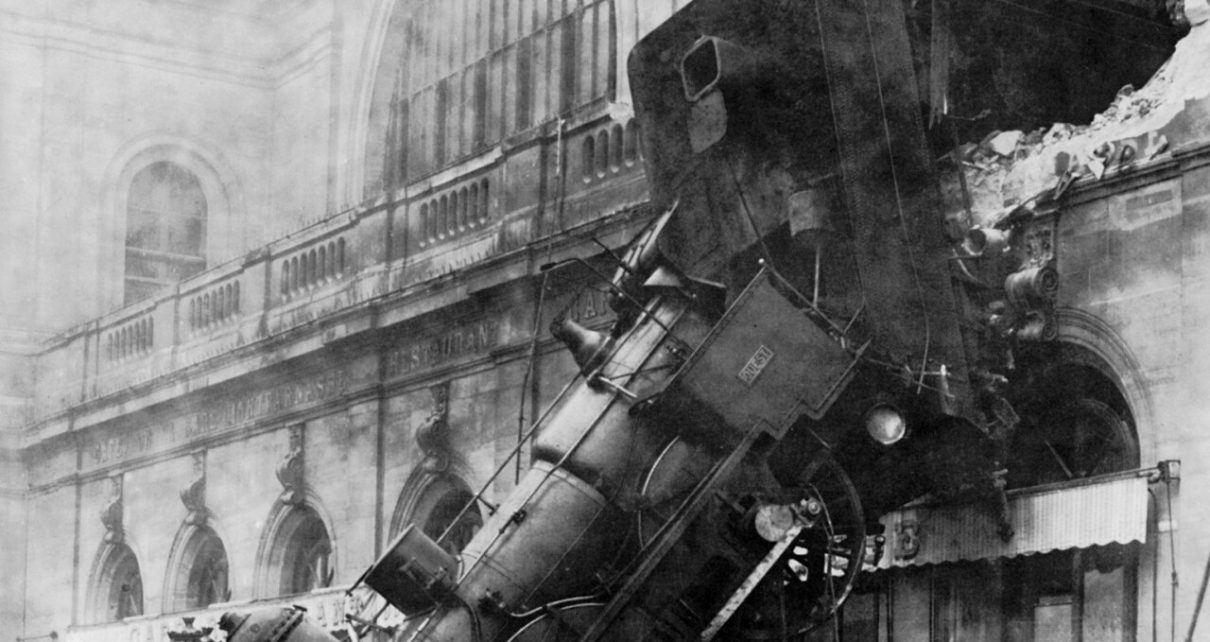
Gavin’s High Speed Rail Disaster
The federal government pulled its money because the project violated terms and conditions of federal funding
By Katy Grimes, August 14, 2026 11:40 am
California’s high-speed rail project has no operational trains and no high-speed track laid on the actual alignment, as of August 2026.
Gov. Gavin Newsom has blown $18 billion on California High Speed Rail and the project is about to run out of money.
California’s High-Speed Rail boondoggle is now estimated to cost taxpayers $231 billion, up from its original $33.5 billion price tag in 2008 when voters passed Proposition 1A.
It is 2026, and still there are NO trains running.
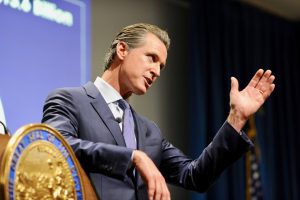
In Gov. Newsom’s first State of the State address in 2019, he announced the high speed rail project, as planned to go from Sacramento to San Diego, “would cost too much and take too long. There’s been too little oversight and not enough transparency,” Newsom said. However, rather than scrapping the entire project, he doubled down on stupid, and keeping a segment from Bakersfield to Merced in the Central Valley.
The very next day, President Donald Trump demanded the California Governor return the $3.5 billion it received from the federal government for the “disaster” high-speed rail project. “California has been forced to cancel the massive bullet train project after having spent and wasted many billions of dollars,” Trump tweeted. “They owe the Federal Government three and a half billion dollars. We want that money back now. Whole project is a ‘green’ disaster!”
The 2018 High Speed Rail planning options did not include a Merced to Bakersfield route, but did have a Fresno to Bakersfield option at a cost of approximately $2.55 billion. “We’ll connect the revitalized Central Valley to other parts of the state, and continue to push for more federal funding and private dollars,”” Newsom said. “But let’s just get something done.”
“For those who want to walk away from this whole endeavor, I offer you this: Abandoning high-speed rail entirely means we will have wasted billions of dollars with nothing but broken promises and lawsuits to show for it,” he added. “And by the way, I am not interested in sending $3.5 billion in federal funding that was allocated to this project back to Donald Trump.”
California’s High Speed Rail Scheme
“If it is built, California’s High-Speed Rail would be the largest public works project in state history. That fact alone appears to be intoxicating to state officials, in a perpetual quest to have California be the first state to do anything,” I reported in 2011. That’s how long California’s High Speed Rail has served only as a jobs program and a really bad joke on California voters and taxpayers.
“Even though high-speed rail has become nothing more than a pipeline project for grabbing big money and a big lie, Gov. Jerry Brown signed the rail bill Wednesday, sealing California’s economic fate. Because of the illegitimacy of the project’s intent, California taxpayers will be left holding the bill.”
I wrote that in 2012. Since then, the only thing that has changed is California Governor Gavin Newsom is now responsible for this High Speed Swindle.
The bill Brown signed in 2012 authorized $5.8 billion to start construction of only one high-speed rail line in the Central Valley, and included $2.6 billion in state rail bond funds, along with $3.2 billion in federal funds.
“But California will have to borrow every dime of that state money to build the high-speed boondoggle.”
“Voters were deceived by the original ballot summary and language in Proposition 1A from 2008, but the state’s lawmakers seem to find that fact inconvenient. And, the entire project is lacking in private, public and debt funding to complete even the most minor operating segment.”
While Newsom inherited an already troubled project, he has continued and defended it, secured additional state commitments, and publicly attributed federal funding cuts to political factors.
It is a major infrastructure failure with billions in cost overruns, delays that look like gold bricking, scope changes, and absurd optimistic early assumptions.
As I explained in 2012, the governor, legislators and the High Speed Rail Authority were (and still are) violating the law:
Prop. 1A states, “The high-speed train system shall be planned and constructed in a manner that minimizes urban sprawl and impacts on the natural environment.” But the impact of the rail system may actually create suburban communities around train stations within reasonable distances from urban areas and higher employment areas.
The train system will dissect both urban and rural communities which will be problematic, as well as a serious violation of the “natural environment.” The trains will travel through densely populated cities, but also through sensitive agricultural and natural areas in the state.
The train system will dissect both urban and rural communities which will be problematic, as well as a serious violation of the “natural environment.” The trains will travel through densely populated cities, but also through sensitive agricultural and natural areas in the state.
Other areas of the high-speed rail law are being violated as well:
* The California High-Speed Rail Authority must have all of the the funding ahead of time, before any construction starts on a new segment.
* The high-speed train system must operate on its own entirely, and in the black. That means operating profitably, and includes caveats of no government subsidy. The plan relies heavily on a projection of 100 million users by 2030, a notion that was created with manipulated data, and is absurd.
* Prop. 1A stipulates 11 requirements that must be met before funds can be released for the construction of a “corridor” or “usable segment.” Specifically, some of these requirements include actual high-speed train service, ridership, revenue projections and planned passenger service.
* The success of any legitimate transportation system must be based on connectivity. “For each corridor described in subdivision (b), passengers shall have the capability of traveling from any station on that corridor to any other station on that corridor without being required to change trains,” the law states. “Stations shall be located in areas with good access to local mass transit or other modes of transportation.” This means that, unless there are extensive connecting rail systems already in place in the high-speed rail destinations, cab companies, limo services and car rental companies should be lining up to rent space in the train stations. Commuters will not have the necessary train and bus systems to transfer to with the existing plan.
The law also calls for certified EIR’s for each segment of the system. Instead of dealing with the environmental issues, Brown tried to suspend the California Environmental Quality Act guidelines for the project. But that move brought about several lawsuits, which have held up important parts of the entire project.
In “California’s Electric High Speed Rail: No Power, No Money, No ‘High Speed,’” we speculated if the high-speed trains will be powered by windmills, solar panels, cooking oil and algae since California’s electricity grid can’t even power the state on a hot day reliably without asking electric car owners to please refrain from plugging in.
In May, Assemblyman Carl DeMaio (R-San Diego) spoke in the California Assembly about the High Speed Rail “FRAUD COVERUP” in Assembly Bill 1608 by Assemblywoman Lori Wilson (D-Suisun City):
FRAUD COVERUP: Instead of stopping the massive fraud happening in state programs at your expense, CA Democrats are covering it all up by passing AB 1608 to allow the High Speed Rail project to hide evidence of fraud from the public! I confronted them on the Assembly Floor with the receipts!
“The only legislation that should be coming to this floor regarding the High Speed Rail Boondoggle Project is a law that would cancel the project as quickly as possible and try to mitigate the massive financial losses that taxpayers have suffered,” DeMaio said.
What Voters Approved in 2008
California voters approved Proposition 1A in 2008, the “Safe, Reliable High-Speed Passenger Train Bond Act for the 21st Century.” Here are some details:
* $33.5 billion cost. They approved a total cost of $33.5 billion for a high-speed rail system. The $33.5 billion was to be made up of a combination of 1/3 federal funds, 1/3 state funds and 1/3 private funds. Importantly, the investment from California taxpayers was limited to a $9.95 billion bond.
* S.F. to L.A. Voters approved a system connecting San Francisco to Los Angeles, with a trip time of two hours and 40 minutes, at a cost of $55 per ticket. But the plan has veered sharply inland from San Francisco to Los Angeles, over to the Central Valley, with a leg from Fresno to Bakersfield. And the cost of the trip jumped to $105.
* Ridership: 95 million. Even ridership numbers have been toyed with. Voters were told that there would be a ridership of 95 million passengers by 2030. Ridership estimates have decreased nearly three times since 2008, and they are still absurdly inflated. In the new report, they’re estimated to be as high as 36 million passengers by 2060 (page 5-17). That’s about a third of the Prop. 1A promise.
* Bond repayment. Repaying high-speed rail bonds will cost the state’s General Fund $647 million per year for 30 years, or approximately $20 billion for the $9.95 billion bond.
So California has spent $18 billion on the High-Speed Rail project with no operational high-speed service, costs have massively exceeded original projections, and the project faces a near-term cash crunch.
It’s well past the time to pull the plug.

A California native and Navy mom, Katy lives in Sacramento, CA.
- US DOJ Gives California 48-Hours to Review/Address List of Noncitizens Who Received Ballots - October 14, 2026
- Gov. Newsom Finds Sneaky Backdoor Way to Advance Reparations - October 14, 2026
- Xavier Becerra Backs Out of Another Debate with Steve Hilton - October 13, 2026

If Democrats say they are going to build something, just say NO! They are completely incompetent and corrupt. You are just throwing money away.
At this stage, the State should cut its losses and hand over the project to the San Joaquin Regional Rail Commission and Brightline West to lay track and run fast trains along the right-of-way.
But look on the bright side…
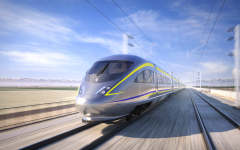
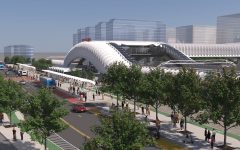
We got some bitchin’ artist renderings of sleek looking trains in futuristic looking stations or streaking across verdant California landscapes…
And Gavin and Jennifer Newsom got a second beautiful 9 million dollar mansion in Marin….
I wonder how many politicians, contractors and sub contractors became independently wealthy because of this high speed rail boondoggle. 231 Billion dollars is a staggering amount of money. It’s an incredible Amount of money. These politicians and everyone else that was involved in this thing stole it ALL. But this is California, no one goes to jail. Not politicians, not their friends, not their wives…NONE of them. Gavin Newsom, this guy wants to be president? This is one of the best that the Democrats have? AOC? Bernie? They are scrapping the bottom of the barrel and DONT even know it. Vote Republican because if you don’t, this is the kind of crap you will continue to get.
Dear Friends, I agree with Ms. Grimes’ analysis, but the conclusion of the saga ought to be one that will carry a benefit on to future generations, not leave California scared with Stonehenge-California, or Lenin’s Tomb-California Monument to Socialist Transit. Instead, a private-sector solution, which is what we voted for on Prop. 1A, could build profitable transport. Put the CAHSRA in Ch. 9 Bankruptcy, do a liquidating plan of reorganization, trade the Class Ones (UP & BNSF) the partially-completed infrastructure for their restoration of intermodal service from all the ag-shipping Counties, e.g., Salinas Valley where we used to have a TOFC ramp, and have the Trustee seek to clawback fraudulent transfers. He gets an extra two years on the Statute of Limitations on those complaints thanks to the Bankruptcy Code. Liquidate everything else. As was the case with the land grant railroads, it may take decades, but in the end you’ll have a profitable business. The Class Ones gain extra added freight revenue moving all the additional TOFC & COFC traffic sufficient to offset their loses moving passengers. We’d have less traffic congestion on I-5, Hwy. 99, etc., and fewer big rig accidents, injuries & deaths. Shippers get 40% on average lower freight rates with intermodal service compared with OTR trucking, and at competitive 3-day Coast-to-Coast service as UPS “Ground” gets from our Class Ones today. Back when we ran the Salad Bowl Express that service was 7th morning arrival in NYC. And we also get cleaner air because of the coefficient of friction steel-on-steel compared with rubber over concrete or asphalt. Joe Thompson, Past-Chair, Legislation Committee, Transportation Lawyers Assn.
Anyone who thinks this boondoggle was anything more than Jerry Brown’s shot at a legacy(his daddy has a canal…) and an appeasement to organized labor for all they have done for the Democrats has rocks in their heads…
Unfortunately, the taxpayers end up holding the $231B bag.