

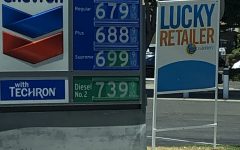
Gas, diesel prices, Sacramento CA, 9/11/2026. (Photo: Katy Grimes for California Globe)
Why Gas Prices Are So High in California
‘When tensions flare in the Middle East, Californians feel it first and worst’
By Katy Grimes, September 12, 2026 10:29 am
While national crude prices set the floor, California’s taxes, climate rules, unique fuel special blend, and diminished refining system raise the price per gallon.
California gas is expensive for two overlapping reasons: it is structurally more costly than in most other states even in normal times, and the 2026 global oil shock has hit the state harder than the rest of the country.
As of mid-September 2026, regular gasoline in California averages about $5.89 to $5.97 a gallon versus a U.S. average around $4.27 to $4.31.
Diesel costs are even more extreme, with statewide averages over $8.00 per gallon, even topping $9.00 per gallon in some counties.

Oil is priced globally, and while the U.S. is “energy independent,” it does not mean the U.S. sets its own gasoline price or that domestic crude automatically stays cheap at the pump.
Oil trades as a global commodity, so U.S. gasoline prices follow international crude benchmarks, even when the country produces more oil than anyone else and is a net exporter of petroleum products.
The U.S. is the world’s largest oil producer and a net exporter of petroleum products.
Global market, not a closed U.S. market
Crude oil trades as one interconnected commodity.
A barrel of similar quality from Texas, the North Sea, or the Middle East is valued against the same worldwide supply-demand balance and the same set of risks. Refiners then pay that price or lose supply to exports.
U.S. consumption of petroleum products is still far larger than domestic crude output – approximately 20 million barrels per day of products vs. roughly 13.5–13.8 million bpd of crude in 2026. The country remains a net importer of crude oil even while exporting refined products.

Forbes explains the two extra facts that sharpen the picture:
- U.S. production is mostly light, sweet crude. Many U.S. refineries were built for heavier, sour grades, so the country simultaneously exports light barrels and imports heavier ones. That two-way trade further locks domestic prices to the global market.
- Quality, location, and transport still create modest differentials (a few dollars a barrel, occasionally more). They do not break the overall linkage.
The result is a structural swap: the U.S. exports most of its light crude and imports heavy crude mostly from Canada, so refineries can run efficiently. Those imported barrels are bought at world prices. Retrofitting plants is expensive and slow.
What you actually pay at the pump
The U.S. Energy Information Administration standard four-part breakdown of U.S. retail regular gasoline prices treats crude oil as the largest component, and longer-run averages sit right in the 50–52% range.
The EIA explains:
Gasoline types
Gasoline is sold based on octane levels in three primary grades of gasoline:
- Regular
- Midgrade
- Premium
“The octane level indicates gasoline’s resistance to combustion. Gasoline with a higher octane is less prone to pre-ignition and detonation, also known as engine knocking. Refiners charge more for higher-octane fuel, and premium-grade gasoline is the most expensive. From 1995 through 2006, the price difference among grades of gasoline was typically about 10 cents per gallon. Since 2006, the price difference among gasoline grades has generally increased. In 2025, the national annual average price of midgrade gasoline was about 57 cents per gallon more than regular-grade gasoline, and the average price for premium-grade gasoline was about 93 cents per gallon more than regular-grade gasoline.”

From an average low of $1.25 per gallon in 1990 under President George H.W. Bush, to an average high of $4.93 per gallon of gas in 2022 under President Joe Biden, the upward trajectory is interesting.
Gasoline retail prices
The retail price of gasoline includes:
- The cost of crude oil
- Taxes
- Refining costs and profits
- Distribution and marketing
Those shares move inversely with crude: when oil prices rise, crude’s percentage of the pump price grows; when oil falls, taxes and logistics become larger shares of a cheaper gallon.
Limited spare refining capacity and regional rules, California’s special blends and high taxes, add extra volatility.
Why California is always more expensive
Even before the Iran war, California’s highest-in-the-nation gas prices were already up 80 cents per gallon prior to the war with Iran, while the rest of the country was enjoying some of the lowest priced gas in years, the Globe reported in March.

The EIA reports annual averages were about $2.14 in 2016, $2.17 in 2020, $3.95 in 2022, $3.30 in 2024, and $3.10 in 2025; the latest months of 2026 are back above $4.00.
Robert Rapier of Shale Magazine, a chemical engineer in the energy industry, the Chief Energy Analyst for Energy Network Media Group and Editor-in-Chief of Shale Magazine, published USC Professor Michael Mische‘s 2025 report, A Study of California Gasoline Prices, which clearly explains why California’s fuel costs are so high—and why they’re likely to remain that way:
Seven Reasons Your California Gas Tank Costs More to Fill
1. Special Blends, Special Costs
California’s mandated CARBOB gasoline blend might be cleaner, but it comes with a hefty price tag. Between this specialty formula, seasonal reformulations, and Cap-and-Trade compliance, we’re talking an extra $0.47 to $1.15 tacked onto every gallon before it even leaves the refinery.
I’ve talked with refinery operators who describe the compliance process as “jumping through flaming hoops while carrying water buckets.” The engineering challenges alone are massive.
2. The Tax Man Cometh… and Cometh Again
While politicians point fingers at oil companies, Sacramento quietly collects about $1.64 per gallon in taxes and fees – by far the highest in America. Next time you wince at a $100 fill-up, remember that roughly $30 went straight to government coffers.
The irony? Those refiners being vilified often make mere pennies per gallon in profit during normal operations. One industry veteran told me, “Some quarters we actually lose money on each gallon of California gas we produce.”
3. Dependency by Design
Remember when California was an oil powerhouse? Those days are fading fast. The state now produces just 23% of its crude needs, importing over 60% from places like Ecuador, Saudi Arabia, and Iraq.
Every tanker that docks in Long Beach represents both transportation costs and vulnerability to global markets. When tensions flare in the Middle East, Californians feel it first and worst.
4. Refinery Exodus
You can’t sell what you can’t make. California’s refining capacity has been shrinking for years, with Phillips 66 and others closing facilities. Another 8.6% of capacity is expected to disappear soon.
(Valero’s Benicia refinery closed April 2026).
As one refiner manager told me: “We’re constantly weighing whether the investment to keep this place running is worth it, given the regulatory landscape.”
5. Pipeline? What Pipeline?
Unlike states east of the Rockies, California has no crude oil pipelines crossing its borders. We’re essentially an energy island, forced to rely on ships and limited rail capacity to bring in fuel.
This isolation isn’t just expensive – it’s precarious. When a refinery goes offline for maintenance (or worse, an unplanned outage), there’s no quick way to bring in replacement fuel from neighboring states.
6. Business Climate Colder Than San Francisco Fog
Since 2018, over 360 energy-related companies have packed up and left California. That exodus takes with it jobs, tax revenue, and critically – investment in energy infrastructure.
One former California oil executive who relocated his company to Texas told me, “It wasn’t just the regulations themselves – it was the constant moving of goalposts and the openly hostile rhetoric from officials. Eventually, you go where you’re welcome.”
7. The 2035 ICE Ban Shadow
“Finally, the state’s aggressive push to ban the sale of internal combustion engine vehicles by 2035 creates a chilling effect on long-term investment in fuel infrastructure. Why would companies invest billions in refining, storage, and distribution assets in a state that has openly stated its goal of making those assets obsolete?”
Shale Magazine says “the Bottom Line is that California’s painful gas prices aren’t accidents or the result of corporate villainy – they’re the predictable outcome of policy choices made over decades. Multiple investigations by federal and state agencies have repeatedly found no evidence of price gouging, which has been Gov. Gavin Newsom’s accusation.
“What they have found is a perfect storm of regulations, taxes, import dependency, and shrinking infrastructure that guarantees Californians will continue paying premium prices for their mobility.”


A California native and Navy mom, Katy lives in Sacramento, CA.
- Newsom Gaslights Over California’s Bad Student Test Scores - October 22, 2026
- How the DMV Enabled Voter Fraud in California - October 21, 2026
- Newsom Doth Protest Over DOJ Voter Fraud Allegations and 20,000 Noncitizens Receiving Ballots - October 20, 2026
Gasoline still isn’t as high as when Biden was in office, yet somehow Democrats were fine with that then. Phonies and hypocrites.
These high gas prices in California are all part of the plan to destroy the middle class in this state. Democrats see the middle class as an impediment to their Socialist authoritarian government ambitions.
Katy, can you please fix your website, and stop censoring comments with the word “So****st”?
We/I are not censoring comments. It’s baked in to the Word Press website. But thank you for the reminder. I pulled about 10 comments out of the trash today.
I quite often have relevant comments that are rejected by the s**m f*l*tr.
It usually picks on me for a few days, lays off for a few days, then hits me again.
No apparent, consistent reason for it.
Gasoline still isn’t as high as when Biden was in office, yet somehow Democrats were fine with that then. Phonies and hypocrites.
These high gas prices in California are all part of the plan to destroy the middle class in this state. Democrats see the middle class as an impediment to their So*****st authoritarian government ambitions.
“In August 2026, a $5 billion joint venture was finalized between Phillips 66, Kinder Morgan, and HF Sinclair to proceed with this 1,300-mile refined products pipeline system.” The pipeline will delivery 200,000 bbls/day of gasoline, diesel, and jet from OK and TX to Colton, CA. Estimated startup is 2029. Let’s hope the regulators, environmentalists, and their lawyers stay out of the way.
Thank you Katy Grimes and California Globe for reminding us that California has the highest gas prices in the country because of the failed energy policies of Gov. Gavin Newsom and the evil Democrat cabal that controls the state. They imposed punitively high gas taxes, goofy climate rules, a unique fuel special blend, and drove out oil and gas refiners out of California reducing the state’s refining capacity. Most Californians did not ask for this insanity.
Most Californians may not have asked for this insanity but a majority of politically ignorant Californians voted for it.
I have lived in Calif since 1967. The state is 43% registered Republican but has only 6 Congressional seats out of 52. WE DID NOT VOTE FOR THIS $#!t!!! Voter fraud is baked into elections and fully supported by corrupt Democrat politicians at the city, county, state level and corrupt leftist judges as well!! The only thing that will change things is if every Democrat in the state suddenly disappeared from the face of the earth.
“Multiple investigations by federal and state agencies have repeatedly found no evidence of price gouging,”,
The investigators were looking at the oil company’s. They should have just drove to the state capitol here in Sacramento. The thieves in that big white building are the ones doing the price gouging.
Let’s face it…California politicians have been hijacked by the environmental whackjobs and /or the CCP, whose EV’s await the most receptive market in the United States.
The Democrat party has adopted a “No ICE” stance in policies in all its forms…
Time to fight back once and for all by turning out massively in favor of Steve Hilton for Governor, Michael Gates for Attorney General and Herb Morgan for Controller!!!
Doing so would effectively consolidate SANITY in the State’s Executive, Legal and Financial sectors!!!
Vote like your life depends on it, because it does…
Amen
MUST VOTE STEVE HILTON IN NOVEMBER. If every Republican voted in this state he would crush Becerra, who if he wins will be more of the same BS.
I just checked gas prices at Costco in Clovis, the best bang for our fuel buck, and then I checked the price in the city in Tennessee I’m moving to the beginning of October. There is a $2.01 difference!! $5.59 in Clovis, and $3.58 in Tennessee. Most stations don’t charge more for a credit purchase either. And btw, the roads are MUCH better there than here, as I’ve noticed everywhere I’ve traveled in the US. Add to that car licenses are $29!!!