
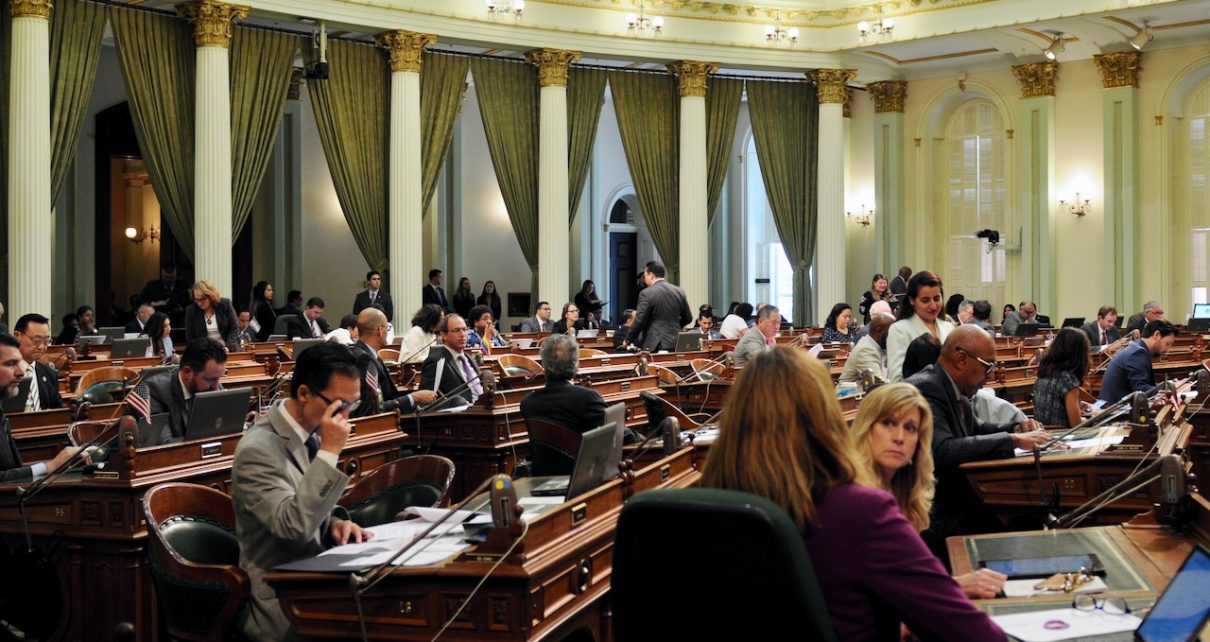
California State Assembly Chamber. (Photo: Kevin Sanders for California Globe)
An Introduction to the California Legislature and the Legislative Process
Gaining this understanding begins with the concept of Federalism – the sharing of power between the federal and state governments
By Chris Micheli, November 2, 2025 2:00 pm
This general overview of the California legislative process is intended to acquaint those new to the State Capitol with basic information to appreciate different aspects of the process and some of the players in the legislative process. The website of the Office of Legislative Counsel provides valuable information on past and pending legislation, a glossary of terms, and more detailed explanations of the legislative process.
There is also helpful guidance contained on the websites of the Assembly and Senate, and the Governor. And be sure to check out the materials provided on the website of the Assembly Chief Clerk and Senate Secretary.
Having a basic understanding of California’s legislative process is important for those operating in state government. Gaining this understanding begins with the concept of Federalism, which is the sharing of power between the federal and state governments. The United States Constitution gives the federal government certain powers and reserves other powers to the states.
Legal observers describe the federal constitution as a grant of power to Congress. In turn, state legislatures perform similar duties for state government as Congress does for the federal government. Legal observers also describe the California Constitution as a limit on powers to the Legislature. In other words, this theory provides that the Legislature has all powers except those denied to it.
California legislators, like many state legislatures, have term limits, while Members of Congress do not. State legislatures ratify amendments to the U.S. Constitution proposed by Congress. Congress may not require a state to enact and enforce a federal regulatory program, but Congress may encourage the states to cooperate by attaching conditions to the receipt of federal funds, such as when the federal government required states to make 21 the legal age for consumption of alcohol in exchange for receiving federal highway funding.
The California Legislature, like its federal counterpart, is bicameral (meaning it has two houses) with the Assembly (which has 80 members) and the Senate (which has 40 members) and the two houses meet in biennial sessions. Legislators must be at least 18 years of age and a U.S. citizen in order to serve in either house.
Pursuant to Proposition 28 approved by the voters in June 2012, legislators may serve a maximum of 12 years in state office, and they can serve all 12 of those years in one house or in combination of both houses. Assembly Members are elected every two years and senators are elected every four years.
Legislators have personal and committee staff to assist them in performing the duties of their office, and the Legislature is served by professional staff including the Legislative Data Center, Legislative Counsel Bureau, Legislative Analyst, and Bureau of State Audits.
There are essentially two paths to lawmaking in California. The initiative is a power reserved to electors to propose statutes and amendments to the California Constitution. This requires submission of the measure to the Attorney General for title and summary, collection and certification of signatures, placement on the ballot, and ultimately passage by the statewide electorate. There are statutory initiatives and constitutional initiatives.
The other path is legislative wherein the Legislature passes bills and the Governor signs them to create statutes. A piece of legislation starts when a group, organization or legislator suggests legislation and either a Senator or Assembly Member agrees to author the bill. The bill idea is submitted to the attorneys at Legislative Counsel for drafting.
Thereafter, the bill is printed and there is no action for 30 days after introduction until the 31st day in print. Upon introduction, a bill gets it first of 3 readings. Then the Rules Committee assigns the bill to one or more committees for a hearing.
Bills are assigned to policy committees according to their subject area and may be assigned to a fiscal committee if the bill has a fiscal impact on the State or requires an expenditure of state funds (which is 75 – 80% of all bills). The committee process includes:
- Bill received by a committee
- Set for hearing by Committee and Author
- Hearing date published in the Senate or Assembly Daily File
- Bill analyzed
- Hearing held and bill voted on
- Votes recorded
- Votes reported to the Assembly or Senate Desk
- Appropriate systems and organizations receive information about the bill
At a bill hearing, the author presents his or her measure, followed by witnesses speaking for and against the bill, and then the author makes closing remarks. Thereafter, Committee actions can include:
- Amendments: Author’s or Committee
- Vote on the Bill with a recommendation:
- Do pass
- Do pass as amended
- Fail passage
- Grant reconsideration
- Hold the bill in committee
- Report action as a recommendation to the Floor of either the Senate or Assembly
After passage from the policy committee, as well as the fiscal committee, if necessary, the Floor process for legislation includes:
- Second Reading — Bills passed by committees are read a second time on the
floor in the house of origin and assigned to third reading for final consideration. - Third Reading — After the bill is read a third time, it is explained by the author, discussed by Members, and voted on by all the members of the house.
If the bill is approved in its house of origin, then the bill is transmitted to the second house. If the bill is defeated, the Member may seek reconsideration and another vote. Most bills require a majority vote in both houses (21 votes in the Senate and 41 votes in the Assembly).
However, there are some measures that require a 2/3 majority vote (27 votes in the Senate and 54 votes in the Assembly), such as those with an urgency clause, bond acts, some appropriations bills, constitutional amendments, and bills that amend certain initiatives (e.g., Political Reform Act, Prop. 103).
If a measure is approved on the floor, then the bill goes to the other (or second) house and the process repeats itself. When a bill is approved by the second house, or the house of origin on concurrence, the bill goes to the Governor. The Governor generally has 12 days to act on a measure and can either sign the bill, veto the bill, or allow the bill to become law without his or her signature.
This deadline is extended to 30 days at the end of session to consider the hundreds of bills approved by the two houses in the last few weeks of the legislative session. Thereafter, the Secretary of State, in coordination with the Governor’s Office, assigns a chapter number to the bill and it becomes effective on January 1 of the following year, although urgency and budget bills, along with three other types of bills, take effect immediately.
Keep in mind that California’s over 200 state agencies, departments, boards, and commissions implement these statutes passed by the Legislature through their interpretation, implementation and enforcement. These agencies and departments generally have rulemaking authority which allows them to adopt regulations to implement the statutes they are charged with administering.
Legislators are also regulated in their official conduct. For example, they may not accept honoraria, meaning they may not accept any payment for giving speeches, making appearances, or writing articles. They are bound by conflict of interest laws such that legislators may not introduce or vote upon non-general legislation or make, participate in making, or use their official position to influence specific state governmental decisions in which they know or have reason to know that they have a financial interest in the decision.
In addition, they must file annually a Statement of Economic Interests (Form 700) when assuming or leaving office and annually when in office. Legislators are also bound by “revolving door” restrictions which generally prohibit them from lobbying for compensation the Legislature or any committee, subcommittee, member, officer, or employee of the Legislature on behalf of any other person for a period of one year after leaving office.


- Some Suggestions for Those New to the California Executive Branch - October 19, 2026
- Support Services and the Sales Tax - October 19, 2026
- Employee Notices - October 18, 2026
RELATED ARTICLES
-
 May 14, 2020
 -
 August 19, 2025
 -
 September 11, 2024
It’s hard to see what process there is with all the gut and amend along wirh all the other shell games and unbelievable gaslighting coupled with legendary prevarication.
Now please do a deep dive into “gut & amend” or “How the Democrats lie, cheat and steal” 101….
Vote NO on Prop 50 if you want to live in California and actually be able to save a little money… vote Yes, and the Democrats will spend us all into the poorhouse, or out of state, whichever …..