
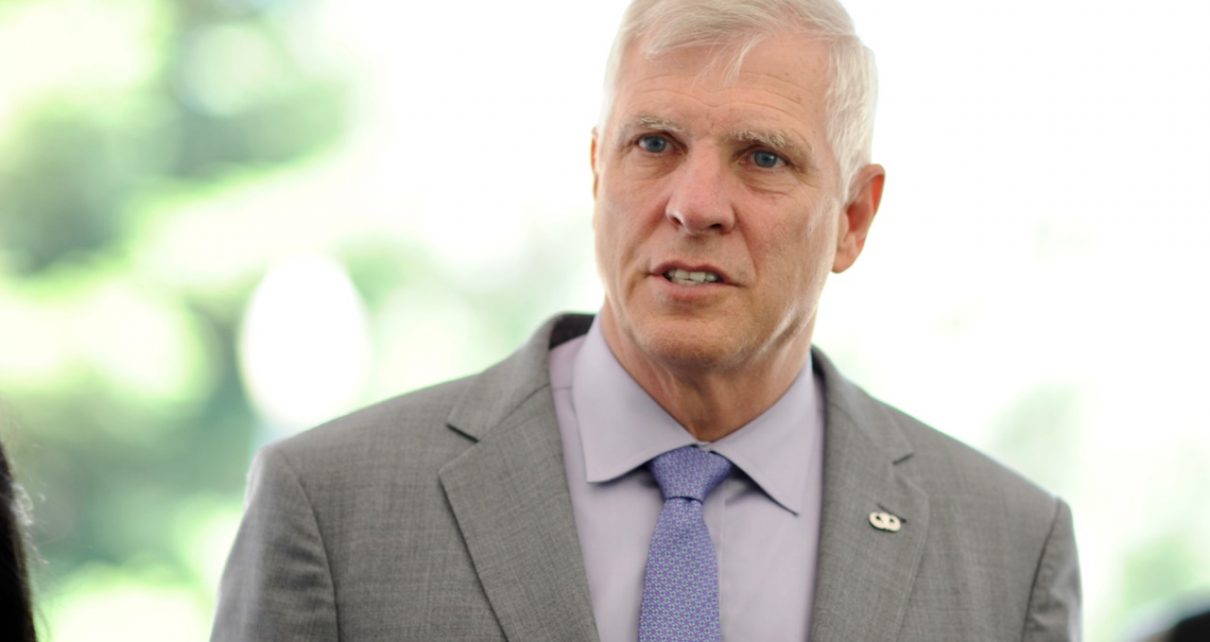
Senator Tom Umberg (Photo: Kevin Sanders for California Globe)
Bill to Prevent Streaming Services From Airing Ads That Are Too Loud Continues Rise Through The Assembly
‘This is the most popular bill I’ve introduced this year’
By Evan Symon, July 11, 2025 2:36 pm
A bill to prevent video streaming services in California from airing commercial advertisement audio at levels louder than primary video content continued to rise in the Assembly this week, with a full Assembly vote likely to come soon.
Senate Bill 576, authored by Senator Tom Umberg (D-Santa Ana), would prohibit a video streaming service that serves consumers in the state from transmitting the audio of commercial advertisements louder than the video content the advertisements accompany. In effect, the bill would serve as a California-specific add-on to the federal Commercial Advertisement Loudness Mitigation (CALM) Act.
The CALM Act, which was passed by Congress and signed by then-President Barack Obama in 2010 and then went into effect in 2012, requires the Federal Communications Commission (FCC) to stop the audio of TV commercials from being broadcast louder than the TV show they air between. SB 576 would simply bring those standards to streaming services. If signed into law, streaming services would have until July 1, 2026 to comply. In addition, if passed, California would become the first such state to have a volume law for streaming ads, creating a precedent for other states wanting similar regulations in the future.
Senator Umberg wrote the bill because of the increased number of complaints of the “jarring” volume difference streaming service ads and more regulated on TV and on the radio, with the idea of it actually coming from his legislative director Zach Keller, whose baby had been awakened often by the suddenly louder advertisements. He also eyed the practice of companies paying more for very loud advertisements. As a result, he wrote SB 576 to expand the volume regulations.
“Have you noticed the increased volume of ads in the middle of your favorite shows? They’re so jarring!,” Senator Umberg asked last month on Instagram. “The federal government outlawed this practice for cable providers years ago, but streaming services have figured out a loophole and now say they can’t control volume. If they can target ads to me based on my age and favorite cereal, I have the utmost faith they could fix this problem.”
“Her father, at the behest of the baby’s mother, brought a bill idea to me,” added Umberg later on. “I thought, ‘That’s a good bill idea,’ so we introduced it.”
Unanimous approval despite industry opposition
Upon introduction, SB 576 proved to be popular, with the bill garnering bipartisan support. Support for the bill was so strong that, in May, the bill passed the Senate unanimously in a 38-0 vote.
“This is the most popular bill I’ve introduced this year,” said Umberg of the popularity, with none of his other bills coming close to the levels of support.
However, streaming service companies, as well as entertainment groups like the Motion Picture Association of America (MPAA), have been attempting to stop the bill. They have claimed that while TV ad volumes are easy to control, streaming services have ads paired with digital files in real time. As a result, volume control would prove to be difficult.
Umberg and SB 576 supporters have pointed out that are already simple solutions available, including making ads lower in volume ahead of time. He also said that technology could easily adjust volumes on the fly.
“I have a great deal of faith in the entertainment industry, in the technology that they both currently use and are developing, that if they can make ads louder, they can make them less loud,” said Umberg of the complaints by streaming services.
Umberg’s argument appears to be winning, as the bill passed it’s first Assembly Committee last month. That led to this week, where the bill has been read several times in front of the Assembly and slightly amended each time for bill language clarification. These clarifications have included the addition of the July 1, 2026 comply by date if passed.
SB 576 is expected to be brought to an Assembly-wide vote soon, giving the bill ample time to be moved up to the Governor’s desk for his decision.


- Bill to Require Law Enforcement Disclosure if AI Was Used To Help Write Reports - August 7, 2025
- Gov. Newsom Files FOIA Request To ‘Expose True Cost’ Of L.A. Federal Troop Deployment for Anti-ICE Riots - August 6, 2025
- California Redistricting: How Newsom’s Plan Will Demolish Hard Fought GOP Gains - August 6, 2025
RELATED ARTICLES
-
 August 31, 2022
 -
 October 1, 2023
 -
 October 1, 2023
Never mind that Obama had ears the size of Deep Space Network antennae.
Since I have my Windows HTPC (Home Theater PC) hooked up to my TV, I use a small program called “Sound Lock” that prevents the audio from going over a certain level that you can set. That solves the problem without a bunch of legislation that isn’t needed. To be honest, I haven’t seen this as being an issue even before I installed this program.
More stupid legislation from the do-nothing-worthwhile-ever super-majority Dem California legislature. This is a form of the “don’t believe your lying eyes” culture there, because only a state where everything is perfect would propose something ridiculous and unnecessary as this.
They have no shame and aren’t even afraid of being mocked. Who would mock them? Other useless legislative Dems in the super-majority Dem CA legislature?
When, oh when, will we enter into an era of sanity? Soon, please, soon.
The California legislature wasting time on this minitua while Karen Bass is preparing to hand over cash to individuals she classifies as ICE victims.
Our tax money once again being used to destroy us.
At least there is finally a bill which actually improves the quality of life for Californians, albeit a small one.
Technically this is not difficult. It is called a “limiter”. I’m sure Google can figure it out.
If it is too loud or they run a deep boom, boom base line, I mute them and they have no sound.
The obnoxious purpose of raising the sound of commercials is to reach you in the bathroom with the door closed while the programming you want to see is on “commercial break.” This sort of aggressive marketing is also why if you casually check out an item online you are bombarded with ads for weeks on that or similar products. I’m not going to go into lengthy details, but I don’t get telemarketing calls, I don’t get spam emails, and I don’t get internet ads. It took me years to learn how, but anyone can do it.