
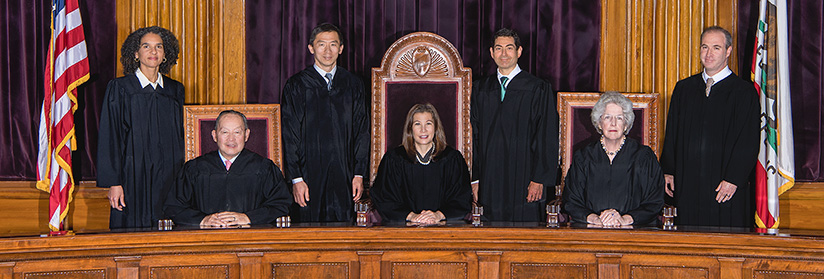
California Supreme Court Justices (courts.ca.gov)
CA Supreme Court Cited a Lobbyist’s Memo as Legislative History
Because of the statutory ambiguity, legislative history was directly cited by the Supreme Court of California in the statutory interpretation case of People v. Castillolopez
By Chris Micheli, October 7, 2026 3:06 pm
As a general rule, California courts exclude or heavily discount statements by lobbyists as cognizable legislative history when interpreting ambiguous statutes. Based upon the landmark decision in Kaufman & Broad Communities, Inc. v. Performance Plastering, Inc. decided by the Third District Court of Appeal, California courts restrict cognizable legislative history to documents that shed light on the collective, objective intent of the Legislature as a whole, rather than subjective or unilateral opinions (which a lobbyist’s point of view likely represents).
As a result of the Kaufman decision, unilateral letters, testimony, or position papers submitted by lobbyists, individual interest groups, or private proponents or opponents are typically viewed as expressions of personal or partisan advocacy—not the collective intent of the body that passed the law.
Nonetheless, there was a case in which a lobbyist’s statement was relied upon as cognizable legislative history. The Supreme Court of California held in People v. Castillolopez (2016) 63 Cal.4th 311 that a standard folding pocketknife with a slip-joint blade—which is held in place by spring tension and can be closed by pushing on the back of the blade—is not a “locked” blade and therefore cannot be prosecuted as a concealed dirk or dagger under California Penal Code Section 21310.
In the Castillolopez case, the California Supreme Court used a lobbyist’s memo to a policy committee in order to analyze the legislative history of Penal Code Section 16470. The high Court relied on this memo to determine that a pocketknife with a blade that does not mechanically lock into place is not a “dirk or dagger” under state law.
How did the high court apply this memo? The Court used the memo—written by lobbyist Chris Micheli on behalf of Buck Knives to the Assembly Public Safety Committee regarding Assembly Bill No. 78 (1997)—to trace the exact evolution of the statutory text. As originally introduced, AB 78 did not explicitly distinguish between locking and nonlocking folding knives.
The Court highlighted that the lobbyist’s memo (see footnote 3 in the published opinion) successfully urged lawmakers to alter the bill. The memo argued that folding knives without mechanical locks should be excluded because they lack the rigid stabbing stability of a true dirk or dagger. By showing that the Legislature amended the bill directly in response to the knife manufacturer’s feedback, the Court concluded that “locked into position” strictly requires a mechanical mechanism that renders the blade immobile.
Because the defendant’s Swiss Army knife could be closed simply by folding the blade back into the handle without releasing a lock, the Court ruled the evidence was insufficient to support a conviction for carrying a concealed dirk or dagger. As a result, the defendant’s conviction was overturned.
Because of the statutory ambiguity, legislative history was directly cited by the Supreme Court of California in the statutory interpretation case of People v. Castillolopez (2016) 63 Cal.4th 311. In this case, the California Supreme Court cited a legislative memorandum prepared by a lobbyist to ascertain the historical intent and statutory definition of what constitutes a “locked” position for a folding knife.


- CA Supreme Court Cited a Lobbyist’s Memo as Legislative History - October 7, 2026
- Chart of Bill Signing Messages thru 2026 - October 7, 2026
- Some Statistics from the 2025-26 California Legislative Session - October 7, 2026
RELATED ARTICLES
-
December 20, 2022
-
 November 16, 2018
 -
 February 27, 2025