

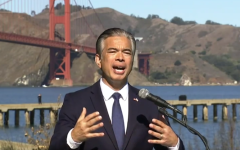
AG Bonta stands in front of the Hollywood sign at a press conference (Photo: @AGRobBonta)
California Leads Coalition of 12 States in Antitrust Lawsuit to Block $110 Billion Paramount-Warner Bros Discovery Merger
In response to Paramount Skydance’s repeated requests for accommodation, Bonta accused the company of ‘blackmail’
By Megan Barth, July 14, 2026 11:09 am
California Attorney General Rob Bonta is leading a multistate coalition in a new antitrust lawsuit aimed at halting one of the largest media mergers in history. On Monday, Bonta and attorneys general from 11 other states filed suit in federal court in San Francisco, seeking to block Paramount Skydance Corporation’s proposed $110 billion-plus acquisition of Warner Bros. Discovery.
The complaint, filed in the U.S. District Court for the Northern District of California, alleges that the deal would violate Section 7 of the Clayton Act by substantially lessening competition or tending to create a monopoly in key markets, including wide-release theatrical film distribution, anticipated top-grossing (blockbuster) films, and the licensing of basic cable television channels. According to the states, combining two of Hollywood’s major studios would create a dominant player controlling nearly one-third of U.S. theatrical motion pictures and a similar share of basic cable programming.
We’ve filed an emergency motion asking the court to stop the merger of Paramount and Warner Bros.
These titans of industry must not move to merge until a court properly evaluates our claims.
We will not let Warner Bros. and Paramount merge without a fight. pic.twitter.com/CurEBsgXkK
— Rob Bonta (@AGRobBonta) July 14, 2026
Post-merger, just three distributors would control about 75% of wide releases, and four majors would hold over 86%. The coalition argues this concentration would harm movie theaters, basic cable providers, workers, and ultimately consumers through higher prices, reduced content quality and variety, fewer films, and diminished creative competition.
Bonta, who has positioned himself as a defender of competitive markets, stated: “Today, I am leading a coalition of states in challenging the proposed merger of Warner Bros. and Paramount and asking the court to block the deal. The unlawful merger of these two entertainment behemoths would lead to higher prices, lower quality, and less content for film and television, harming movie theaters, basic cable distributors, and ultimately, audiences on every sofa and movie theater seat in the U.S.”
He added that California’s film and entertainment industry is a source of pride and employment for the state, and that excessive consolidation risks fewer opportunities for stories and perspectives to reach audiences.
“With this lawsuit, California and our sister states are fighting for free and fair markets, not rigged markets. America has no kings in government or our economy,” Bonta said.
The Democrat-led coalition includes the attorneys general of Arizona, Colorado, Connecticut, Massachusetts, Minnesota, Nevada, New Jersey, New Mexico, New York, Oregon, and Washington, in addition to California.
The states are asking the court to prevent the companies from closing the deal until the full judicial process is complete. If the parties refuse to agree to a standstill, the coalition has indicated it will seek a temporary restraining order. The proposed transaction—described as the largest in Hollywood history—would merge two companies with deep roots in film and television, including iconic titles and franchises from both studios. Paramount and Warner Bros. have competed for decades in content creation, theater negotiations, and cable licensing deals.
This lawsuit comes amid heightened tensions over California’s burdensome business climate.
In a related development reported by California Globe Editor-in-Chief Katy Grimes, Paramount is reportedly considering moving its headquarters and pulling an estimated $30 billion in annual spending out of California if the state’s legal challenge proceeds.
The company has made repeated requests to Bonta’s office to reach an accommodation that would allow the merger to close. Bonta responded publicly, accusing Paramount of attempting “blackmail” by threatening to relocate operations and spending out of California.
Such a relocation would represent a significant blow to California’s entertainment economy, which already faces competition from other states offering more favorable tax incentives and regulatory environments. Industry observers warn that aggressive state intervention could accelerate the exodus of production and jobs, further eroding Hollywood’s historic dominance in the Golden State.
Notably, the U.S. Department of Justice had previously cleared aspects of the deal, setting up a potential conflict between federal and state enforcement priorities.
Paramount Skydance has pushed back strongly against the lawsuit, arguing it distorts antitrust law and that the combined company would be better positioned to compete with streaming giants like Netflix, Amazon, and Disney. The company has pledged increased film output (at least 30 films annually in some statements), more jobs, and greater investment in content and California production.
In a statement, Paramount said, “We continue to engage constructively with the remaining few regulators around the world still considering the merger, including State Attorneys General, and are prepared to address any legitimate antitrust issues.” It added: “We are confident this transaction raises no such concerns, as demonstrated by the dozens of antitrust authorities around the world that have carefully reviewed the transaction.”
Critics of the state action, including some in the industry, have questioned whether the suit primarily serves political or regulatory goals rather than genuine consumer protection, especially given California’s heavy reliance on the entertainment sector for jobs and tax revenue.
The legal battle could delay or derail the merger’s expected late-summer closing timeline and may involve significant litigation costs for taxpayers in the participating states.
This marks the latest high-profile antitrust move by Bonta’s office amid ongoing debates over media consolidation, streaming economics, and the future of Hollywood. The case will now proceed in federal court, where judges will weigh the states’ competitive harm claims against the companies’ arguments for efficiencies and strengthened competition in a rapidly changing media landscape.


- Ninth Circuit Forces California Response as DOJ Presses to Sequester 20,000 Suspected Noncitizen Ballots - October 24, 2026
- Nevada U.S. Attorney’s Office Charges Alien for Illegal Voting Amid Ongoing Federal Crackdown - October 23, 2026
- Amodei Calls Flippo a ‘Fraud’ on CNN as Nevada’s GOP Stronghold Turns Competitive Amid Early Voting Edge for Democrats - October 23, 2026
RELATED ARTICLES
-
-

-

-

-
 February 18, 2026
Paramount should just move its headquarters and spending out of California because Newsom, Bonta, and the criminal Democrat thug mafia that controls the state have made it impossible to do business here.
Who the hll cares????
Apparently the American and in particular Californian minions are unable to entertain themselves.
I know somehow Bonta is very familiar with blackmail. Hes a wanna be thug that can’t think without his boy toy Gavin. Hes gotta go too.
@DOJ
@FBIDirectorKash
Bonta is a also a documented criminal.
BONTA must go.
Californians Against Bonta!
#NEVERVoteDemoNcratAgain
#VoteRepublican2026