
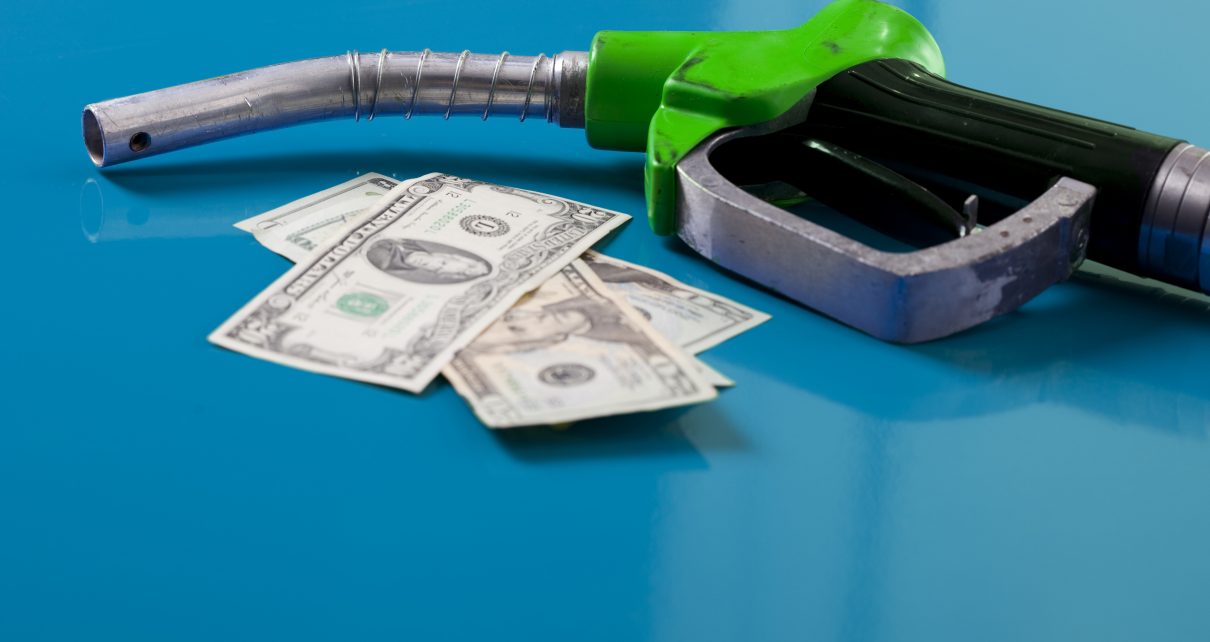
Gas Pump with Bills. (Photo: Shutterstock)
California’s Proposed Sustainable Aviation Fuel Tax Credit Will Raise Gas and Diesel Prices and Deliver Meager Carbon Reductions
It’s all being driven by dishonest climate policies
By Katy Grimes, August 28, 2026 12:46 pm
“Governor Gavin Newsom is advancing a plan that could funnel hundreds of millions in road dollars to a struggling oil refinery — pitching it as a cleaner jet fuel initiative. The credit, drawn from funds voters designated for highways and local streets, could also raise gas prices for most drivers,” the AP reported in April.
“Struggling?” The shareholder returns beg otherwise. And, according to the Securities and Exchange Commission, Q2 alone was very strong: Renewable Fuels generated $544 million of earnings, compared with a $133 million loss in Q2 2025.
California’s proposed tax credit is a sustainable aviation fuel (SAF) incentive, included in Gov. Newsom’s budget proposal, that would primarily benefit Phillips 66’s Rodeo Renewable Energy Complex in Contra Costa County.
According to the UC Berkeley Energy Institute researchers, “the proposed tax credit would reduce road funding, raise gasoline and diesel prices, and deliver small and expensive carbon emissions reductions.”
Critics of the tax credit include the Legislative Analyst’s Office, which has urged rejection of the proposal because of impacts on transportation funding and potential for higher-than-expected costs, including incentives for out-of-state firms to acquire California entities with diesel tax liability. Those analyses project limited net carbon reductions (because SAF would largely divert biofuels from surface transport like renewable diesel), higher gasoline prices estimates in the 11–14 cents gallon range, higher diesel prices, and high costs per ton of emissions reduced.
One analysis noted that without the credit, more waste-oil and fats feedstocks might flow to renewable diesel, benefiting facilities like Phillips 66’s that already emphasize those, while the SAF credit would shift production toward aviation fuel with smaller overall climate gains relative to the fiscal and price impacts,” according to UC Berkeley.
A source told the Globe that Phillips also produces renewable diesel but if they get the credit, they will be the only one with the credit, disadvantaging all others.
The proposal drives up the cost at the pump for diesel because they are made from the same feed stocks, but when you give sustainable aviation fuel a $1-2 per gallon credit, they will be buying more of the feedstocks and driving up the price that renewable diesel refiners have to pay, according to the UC Berkeley Energy Institute.
California’s proposed sustainable aviation fuel tax credit really will raise gas and diesel prices while delivering meager carbon reductions.
AP confirms this:
The state estimates that Newsom’s proposal could cost between $165 million and $300 million, but California’s nonpartisan legislative analyst warns that figure could be far higher. That’s because the tax credit is so high that it could incentivize companies outside California to acquire California companies with diesel tax liabilities, said Helen Kerstein, who evaluates climate programs for the Legislative Analyst’s Office. A major California refiner like Chevron could also buy a renewable fuel company elsewhere and ship the fuel here, she said.
According to OPIS, a Dow Jones Company, this is how the credit works:
Producers of qualifying sustainable aviation fuel (jet biofuel made from renewable feedstocks such as waste oils, fats, greases, or vegetable oils) that also have diesel excise tax liability in California could claim a credit against those diesel taxes.
- Base credit of about $1 per gallon for SAF that achieves at least a 50% reduction in carbon dioxide equivalent emissions compared with conventional jet fuel.
- Additional 2 cents per gallon for each further 1% emissions reduction, up to a maximum of roughly $2 per gallon for cleaner fuels.

The trailer budget proposal from the governor proposed that monthly tax returns filed by SAF producers with diesel excise tax liability in the state after Nov. 1, 2027, and before Jan. 1, 2036, will be eligible for a $1 gal base tax credit under the Diesel Fuel Tax Law.
“Only two companies currently produce state-certified jet biofuel and also owe diesel excise tax in California — the conditions required to claim the credit, said Andrew March, a Department of Finance budget analyst,” the AP reports. “Of those, only Phillips 66 has publicly confirmed it would qualify for the credit. The company spent $1.25 billion converting its Rodeo refinery in Contra Costa County from traditional petroleum refining to biofuels.”
Notably, the formula for credits isn’t flat — the cleaner the fuel, the bigger the credit, ranging from $1 to $2 per gallon.
It’s all being driven by dishonest climate policies.


A California native and Navy mom, Katy lives in Sacramento, CA.
- Private Prison Company GEO Group Files Federal Lawsuit Challenging California’s New Detention Center Law - October 8, 2026
- Becerra’s Baggage Would Have Taken Down Anyone Else - October 8, 2026
- Theater Kids Have Taken Over Weather Forecasting - October 7, 2026
RELATED ARTICLES
-
 March 4, 2021
 -
 February 21, 2022
 -
 March 18, 2023
This will have zero impact on the environment.
You can’t fix stupid. Seriously, we have to get rid of the Democrats. Every year is worse than the last year. Nothing will stop this madness until people start voting Republican.
If I understand correctly, biofuel is expensive to produce as the fuel and labor to plant, nurture, and harvest is almost a breakeven process. Also, if I understand correctly, diesel engine manufacturers are not happy with the product being run in their engines. I have heard that Mercedes-Benz will not warranty an engine that has been running on Biodiesel. To do this is just trying to keep the petroleum industry in California after spending time and money to run it out! What a clown show!!