
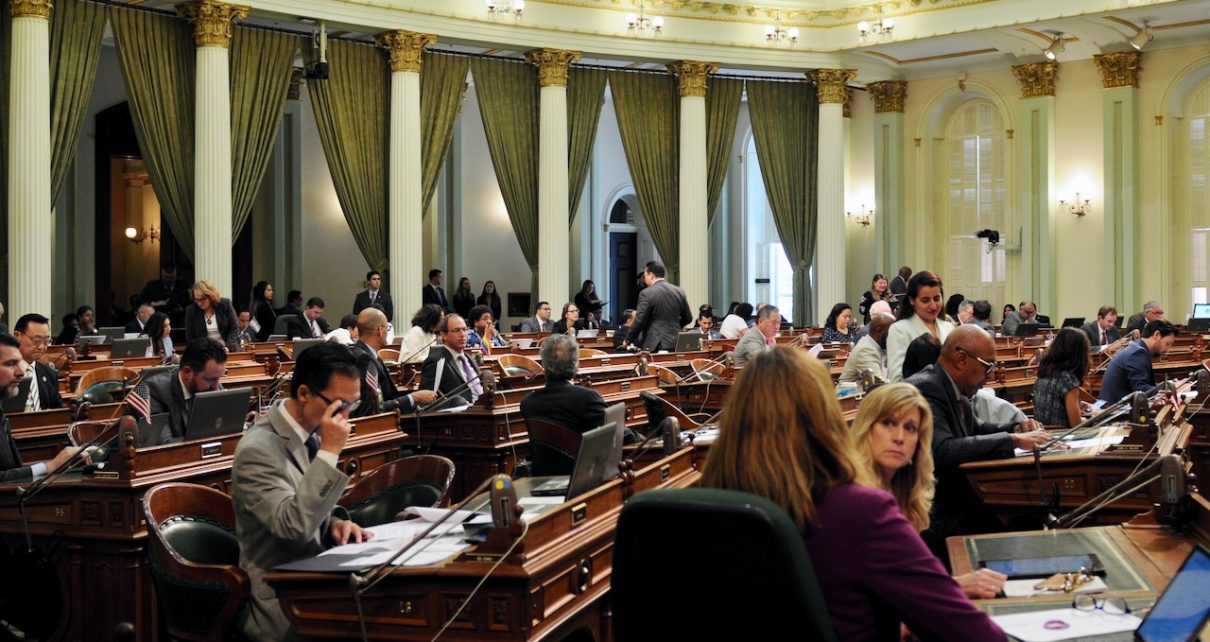
California State Assembly Chamber. (Photo: Kevin Sanders for California Globe)
Even More Notes on California Legislative Drafting
From one bill: It is the intent of the Legislature that this paragraph have retroactive application
By Chris Micheli, July 8, 2026 2:30 am
As I continue to review legislation pending in the 2026 California Legislative Session, I have come across more instances that warrant highlighting to those working in and around the State Capitol. The following are those examples:
From one bill:
(C) It is the intent of the Legislature that this paragraph have retroactive application.
(j) Nothing in this section shall be deemed to alter Sections 822 and 823.
Specifying what a bill does not do:
(a) This chapter does not prevent a city or county from adopting or enforcing ordinances on the keeping of roosters that are more restrictive than the requirements set forth in this part.
(b) This chapter does not limit or affect the application or enforcement of any other law that protects animals, including, but not limited to, Sections 597, 597b, 597c, 597i, 597j, and 599aa of the Penal Code.
(c) This chapter does not limit or authorize any act or omission that violates Section 597, 597b, 597c, 597i, 597j, or 599aa of the Penal Code, or any other local, state, or federal law that protects animals.
Specific (i.e., section), permissive rulemaking authority grant:
The department may adopt regulations as necessary to implement this section.
General (i.e., chapter), mandatory rulemaking authority grant:
The department shall adopt rules and regulations necessary to implement this chapter.
This bill has three intent statements, followed by one “not the intent of the Legislature” statement:
(a) It is the intent of the Legislature to do all of the following:
(1) Ensure alignment of resource valuation methods across electricity supply procurement programs to improve efficiency in regulatory implementation processes to meet the short-term, midterm, and long-term reliability needs of the state.
(2) Improve information and transparency by consolidating compliance reporting requirements to facilitate improved stakeholder participation and regulatory decisionmaking.
(3) Minimize the state’s reliance on backstop procurement mechanisms through continuously improving interagency coordination to position the state for effective participation in a regional energy market.
(b) It is not the intent of the Legislature to prescribe any specific technical method or compliance structure, but to ensure consistency and close alignment between multiple programs affecting ratepayer cost.
These findings and declarations cite court decisions:
The Legislature finds and declares all of the following:
(a) The intent of the Legislature in enacting this act is to codify the holding of In re David T. (2017) 13 Cal.App.5th 866. 866 and People v. Haro (2013) 221 Cal.App.4th 718, and to disapprove the holdings of In re Taylor C. (2024) 101 Cal.App.5th 492 and In re Parker B. (2026) 120 Cal.App.5th 382.
(b) The Legislature reaffirms that once a juvenile court dismisses a juvenile petition pursuant to Section 782 of the Welfare and Institutions Code, the petition is effectively erased as if the subject of the petition had never suffered it in the initial instance. People v. Haro (2013) 221 Cal.App.4th 718.
(c) In adding subdivision (e) to Section 782 of the Welfare and Institutions Code via Assembly Bill 2629 of the 2021–22 Regular Session (Chapter 970 of the Statutes of 2022), the Legislature intended to reaffirm existing law that dismissal pursuant to Section 782 of the Welfare and Institutions Code, and sealing of records pursuant to applicable sealing statutes, are related yet distinct procedures. The Legislature did not intend to modify or reduce the relief afforded by a dismissal granted pursuant to Section 782 of the Welfare and Institutions Code, to change the character of that section as a general dismissal statute, or to alter established law holding that a dismissal under Section 782 of the Welfare and Institutions Code removes restrictions on sealing that may be contained in the sealing statutes. See In re David T. (2017) 13 Cal.App.5th 866, 878.
This is a new one (I guess it is intended to help with the fiscal impact?):
It is the intent of the Legislature to provide funding for purposes of this chapter.
Shouldn’t more be required to accompany this statement?
The amendments of Sections 280 and 884.5 of the Public Utilities Code made by this act do not constitute changes in, but are declaratory of, existing law.
Here’s how to determine if a bill is a tax increase (language in Digest and vote requirement and fiscal committee re-referral in the Digest Keys):
This bill would take effect immediately as a tax levy.
This bill would include a change in state statute that would result in a taxpayer paying a higher tax within the meaning of Section 3 of Article XIII A of the California Constitution, and thus would require for passage the approval of 2/3 of the membership of each house of the Legislature.
Digest Key
Vote: 2/3 Appropriation: NO Fiscal Committee: YES Local Program: YES
Uncommon Special Statute (usually applies to a statute applying to one or more local jurisdictions; in this case, it does not apply to a single jurisdiction):
66499.47. This chapter shall not apply to the City and County of San Francisco.
SEC. 4. The Legislature finds and declares that a special statute is necessary and that a general statute cannot be made applicable within the meaning of Section 16 of Article IV of the California Constitution because of the unique circumstances of the City and County of San Francisco.
This is a properly done section including F&D and intent statements:
SECTION 1.
(a) The Legislature finds and declares all of the following:
(1) California has established comprehensive statutory goals to reduce greenhouse gas emissions, including the goals set forth in the California Global Warming Solutions Act of 2006 (Division 25.5 (commencing with Section 38500) of the Health and Safety Code) and subsequent legislation requiring statewide reductions in greenhouse gas emissions. Consistent with those laws, reducing emissions from the transportation sector is critical to achieving the state’s climate objectives.
(2) The transportation sector is the largest source of greenhouse gas emissions in California, and reductions in vehicle miles traveled are necessary for the state to meet its climate, air quality, and public health goals.
(3) Public transportation provides Californians with safe, efficient, and affordable mobility options that reduce vehicle miles traveled and thus greenhouse gas emissions.
(4) Increased investment in public transportation infrastructure, transit operations, transit service reliability, and transit accessibility, can increase transit ridership and support reductions in greenhouse gas emissions from the transportation sector.
(5) Public transportation investments also advance state goals related to reducing air pollution, improving public health, increasing access to employment and essential services, promoting equitable economic opportunity, and supporting sustainable community development.
(6) The projects and services described in Section 2 of this act reduce greenhouse gas emissions consistent with state law and further the objectives of the Greenhouse Gas Reduction Fund.
(b) (1) It is therefore the intent of the Legislature to recognize that investments in public transportation are an effective strategy for reducing greenhouse gas emissions and for advancing California’s climate policies and statutory greenhouse gas reduction targets.
(2) It is the further intent of the Legislature that the projects and services described in Section 2 of this act be provided streamlined access to funding from the Greenhouse Gas Reduction Fund.

- What are Some Unique Aspects of California’s Judicial Branch? - October 20, 2026
- Employer Subrogation - October 20, 2026
- Unruh Act - October 19, 2026
RELATED ARTICLES
-
 September 11, 2024
 -
 August 19, 2025
 -
 October 30, 2025