

In California, doctors face greater scrutiny while patients face diminished choice. Will it work? (Photo: Halfpoint/Shutterstock)
Federal Judge Enjoins California Medical Boards from Punishing Doctors for Rejecting the Government’s COVID Narrative
The Kory v. Bonta decision arrives just as ‘The Science’ pleads the Fifth
By Rita Barnett-Rose, August 7, 2026 10:43 am
Some good news out of California this week.
On August 5, U.S. District Judge William B. Shubb of the Eastern District of California granted a preliminary injunction in Kory v. Bonta, barring California’s medical licensing boards from investigating, prosecuting or sanctioning Drs. Pierre Kory, Le Trinh Hoang and Brian Tyson based on the viewpoint of the COVID-19 advice they give their patients.
The injunction applies only to these three physicians and is not a final decision on the merits. But what Shubb said is significant.
California officials may not punish them “based on the viewpoint of the information, recommendations, or advice they give a patient about COVID-19,” including because that advice departs “from the position of the public health authorities.”
Nor may regulators evade the First Amendment simply by putting another label on the speech:
“The Boards may not recharacterize as an informed-consent violation or a standard-of-care departure any refusal by a Physician Plaintiff to convey the government’s position on a contested question concerning COVID-19.”
That sentence goes to the heart of an extraordinary battle that began during some of California’s darkest COVID days, when dissent from government-approved public-health policy was censored, ridiculed and, for physicians, potentially career-ending.
When California Tried to Define “The Science”
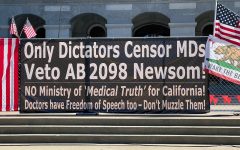
In 2022, California enacted AB 2098, one of the more Orwellian pieces of legislation to emerge from the pandemic.
The law made it “unprofessional conduct” for a physician to disseminate COVID-19 “misinformation” to a patient as part of treatment or advice, defining “misinformation” as false information “contradicted by contemporary scientific consensus contrary to the standard of care.” It covered COVID’s risks, prevention and treatment, as well as the “development, safety, and effectiveness” of COVID vaccines.
There were two obvious problems. Who determined the “contemporary scientific consensus”? The law never said, although its legislative findings relied heavily on pronouncements from the Centers for Disease Control and Prevention and the Food and Drug Administration. And since when did disagreement with a “consensus” make a proposition false?
This was especially troubling during a fast-moving declared emergency involving a “novel” virus, evolving evidence and fierce disagreements over masking, transmission, vaccination, natural immunity and early treatment, including hydroxychloroquine and ivermectin.
Nevertheless, California attempted to turn the government’s preferred understanding of these evolving questions into a professional orthodoxy enforceable through a doctor’s license. The message was difficult to miss: depart from the officially accepted COVID narrative at your peril.
The First Amendment, however, presented a problem.
AB 2098 was challenged in multiple lawsuits. In January 2023, Judge Shubb himself preliminarily enjoined the law in Høeg v. Newsom, finding its definition of “misinformation” unconstitutionally vague. California ultimately repealed AB 2098, effective January 1, 2024.
But the underlying assertion of power did not disappear with it.
AB 2098 Was Gone. The Claimed Power Wasn’t
Despite the repeal of AB 2098, California’s medical regulators maintained that existing disciplinary laws could still reach doctors’ COVID communications.
“Misinformation” could instead be characterized as a departure from the “standard of care,” inadequate “informed consent,” or other professional misconduct—turning what looked suspiciously like regulation of speech into regulation of professional “conduct.”
On January 2, 2024—the day after AB 2098’s repeal took effect—Kory, Hoang, Tyson and organizational plaintiffs filed Kory v. Bonta, challenging the Boards’ continuing authority to regulate their COVID-related speech.
They initially lost.
Judge Shubb denied their preliminary-injunction motion in April 2024, concluding that California’s general disciplinary statute regulated professional conduct rather than speech. The Ninth Circuit affirmed.
Then the Supreme Court changed the legal landscape.
“The First Amendment Is No Word Game”
On March 31, 2026, the Supreme Court decided Chiles v. Salazar, involving a Colorado restriction on certain talk therapy provided by licensed counselors. The case had nothing to do with COVID, but the constitutional question was familiar: Can a state avoid meaningful First Amendment scrutiny by characterizing a professional’s speech as “conduct” or “treatment”?
Justice Neil Gorsuch, writing for an 8-1 Court, said no.
“Her speech does not become conduct just because the State may call it that,” Gorsuch wrote. “The First Amendment is no word game.”
Nor does a professional license place speech beyond ordinary First Amendment protection. “The Constitution does not protect the right of some to speak freely; it protects the right of all,” Gorsuch wrote. “It safeguards not only popular ideas; it secures, even and especially, the right to voice dissenting views.”
He then warned of official efforts to control “the content of doctor-patient discourse,” emphasizing that the dangers of censorship are no less acute “in the fields of medicine and public health.”
Gorsuch also rejected the notion that states could simply call disfavored speech “substandard care,” which taken to its logical conclusion would create a vast “First Amendment Free Zone.”
His conclusion could have been written for California’s COVID experiment:
“The First Amendment stands as a bulwark against any effort to prescribe an orthodoxy of views.”
After Chiles, the Kory plaintiffs returned to Shubb and renewed their request for an injunction.
This time, they won.
The Problem with Enforcing “Consensus”
The constitutional problem exposed by Kory points to an even larger one.
California presumed that during a rapidly evolving emergency, government could determine the correct scientific position with enough certainty to punish doctors who disagreed.
That was not only dangerous. It was profoundly arrogant.
Science advances through disagreement. Evidence changes. Hypotheses fail. Treatments once dismissed sometimes prove useful; interventions once proclaimed effective may prove less so. A scientific “consensus” may reflect the best available evidence at a particular moment, but it is not synonymous with immutable truth.
Government should be especially reluctant to turn a provisional consensus into an enforceable orthodoxy when knowledge is changing fastest.
And the timing of the Kory decision provides an extraordinary illustration of why.
Now “The Science” Is Pleading the Fifth
At almost the same moment Judge Shubb issued his injunction, Americans were receiving a very different look at the official COVID narrative California once expected physicians to follow.
Recently released contemporaneous records from Dr. Anthony Fauci reveal a considerably messier picture behind the confident public pronouncements of the pandemic years.
His records show officials privately confronting evidence that vaccinated people who became infected could transmit COVID just as readily as infected unvaccinated people, while vaccine mandates and booster campaigns continued. They show that Fauci pushed CDC Director Rochelle Walensky to massage public-health language when he knew the vaccines were not stopping infection or transmission—and that he was expressly concerned that saying so too clearly could undermine the booster rollout and Justice Department litigation defending coercive vaccine mandates.
They show Fauci knew of the myocarditis risk to young males while federal officials continued pushing expanded vaccine approvals and uptake. And they show he initially acknowledged evidence that hydroxychloroquine had demonstrated some efficacy, only to later support removal of its Emergency Use Authorization.
These were not peripheral disagreements. They concerned infection, transmission, vaccine effectiveness, vaccine injury and early treatment—the very subjects on which physicians challenging the official narrative were censored, condemned and threatened with professional discipline.
Then, on July 29, 2026, the man who had become the public face of that supposedly objective scientific authority appeared before the Senate Homeland Security and Governmental Affairs Committee and invoked his Fifth Amendment right against self-incrimination 111 times, refusing to answer questions about the COVID response and his own contemporaneous records. The Committee has since voted to hold him in contempt.
The irony is difficult to miss.
California officials and medical regulators were willing to destroy physicians’ careers for departing from an official COVID narrative presented as objective, settled science. We now know that much of that narrative was shaped by officials who possessed contrary information, suppressed or massaged inconvenient facts, and made public-health messaging decisions with political, policy and litigation objectives in mind.
The “scientific consensus” California enforced with the threat of a doctor’s license was not some pristine body of objective scientific truth handed down from on high. It was being constructed by human beings with agendas, institutional interests and enormous power—and some of the doctors California sought to silence may have been far closer to the truth than the officials demanding their conformity.
A Doctor’s Duty Is to the Patient, Not the State
At the heart of the doctor-patient relationship is a physician’s duty to exercise independent medical judgment and to speak honestly to the patient sitting before him about what he believes is the best course of care. That duty runs to the patient—not to the CDC, the California Department of Public Health, the Medical Board, or the State.
Having the State insert itself into that relationship and threaten a doctor’s livelihood unless he conveys the government-approved position is not the practice of medicine. And, as Kory and Chiles now make increasingly clear, it presents a profound First Amendment problem.
Kory v. Bonta does not yet settle the issue for every California physician. The injunction protects three doctors while the case proceeds.
But it is an important step in the right direction.
California’s lesson from COVID should not merely be that government sometimes gets “The Science” wrong.
It should be that government should not be in the business of enforcing medical orthodoxy at all.


- Federal Judge Enjoins California Medical Boards from Punishing Doctors for Rejecting the Government’s COVID Narrative - August 7, 2026
- The Second Circuit Just Narrowed Religious Liberty – Did It Misread the Supreme Court’s Remand? - July 14, 2026
- Boston Activist Judge Decides He Alone Can Set Federal Health Policy - March 17, 2026
RELATED ARTICLES
-
-

-
 February 15, 2021
“It should be that government should not be in the business of enforcing medical orthodoxy at all.”
Unfortunately, that’s not how today’s Democratic Party works. Their goal is to use any means possible, including a crisis, to institute an authoritarian government. How COVID was handled in the Democrat states should worry anyone who values freedom.
Amen… agree 100%