

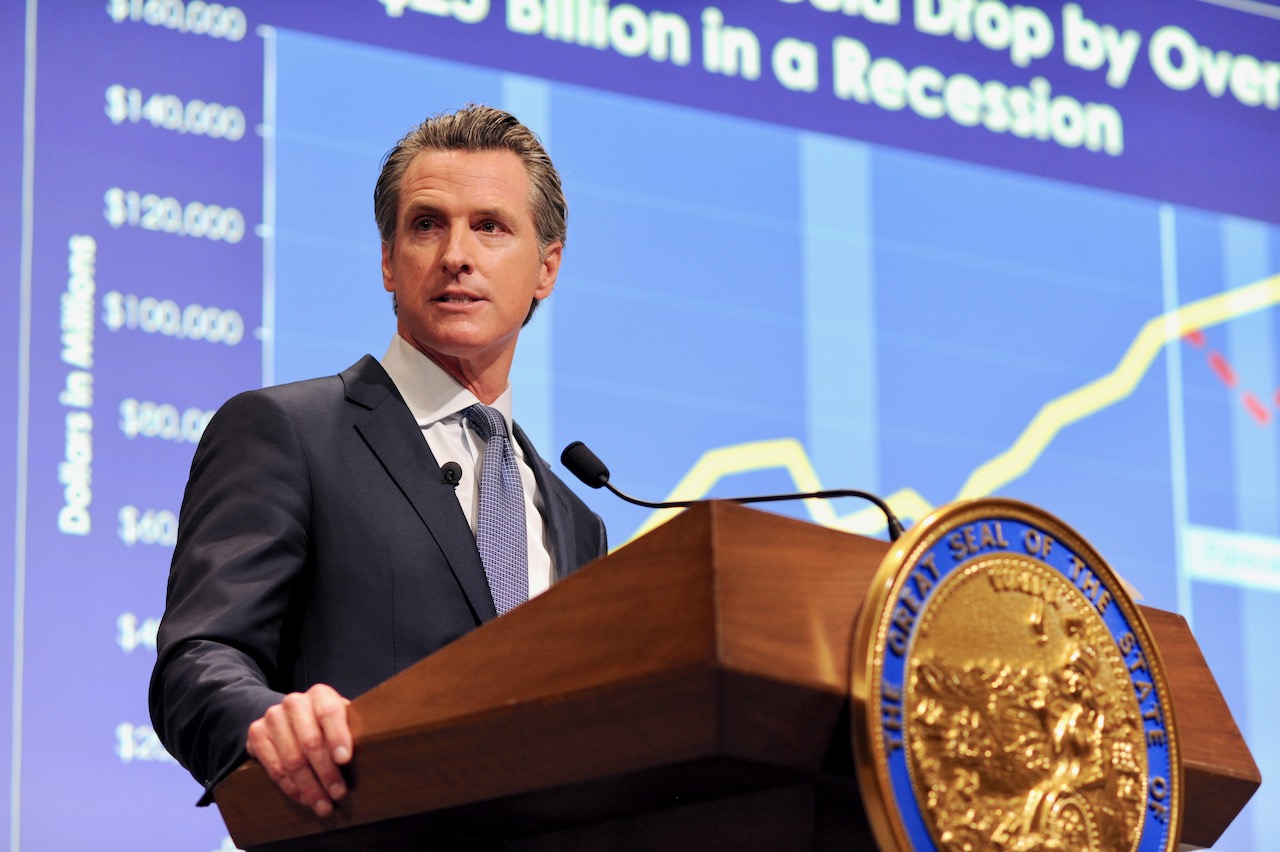
Gov. Gavin Newsom's final State of the State address. (Photo: gov.ca.gov)
Gov. Gavin Newsom Has Increased the California Budget 60%-70% in 7+ Years
California’s structural deficit reflects crazed policy goals colliding with volatile revenues and rising mandatory costs in a high-cost state
By Katy Grimes, July 21, 2026 1:51 pm
California Governor Gavin Newsom has increased California’s state budget 60% to 70% in the 7 years since he took office in 2019.
The 2018-19 enacted budget (pre-Newsom or early transition, signed by Gov. Jerry Brown) was $201 billion.
Gov. Newsom’s first full budget 2019-20 enacted was $215 billion.
Newsom’s 2022-23 budget exceeded $300-310 billion.
Newsom’s 2026-27 final enacted budget, signed June 2026 is $352 billion in total spending, which includes the $251.5 billion General Fund. This is up from the prior year’s $321 billion or so in some comparisons.
From $201 billion in 2018-19 to $350 billion in 2026-27, is an increase of about 74%.
In April, the Legislative Analyst’s Office examined the dramatic increase in state spending since 2019-20, Newsom’s first full budget, as noted above.
The LAO reports that the state faces structural deficits ranging from $20 billion to $30 billion annually. Structural deficits occur when a government’s spending consistently exceeds its tax revenue, regardless of the state of the economy, and current government spending is being financed by borrowing. A structural deficit problem implies that borrowing is becoming increasingly unsustainable or expensive.
“During Gavin Newsom’s governorship, California’s state budget grew over 63 percent, rising from around $200 billion in 2019 to about $327 billion in the current fiscal year ending June 30,” the Hoover Institution’s Lee Ohanian reported in a 2024 report titled, After California’s Budget Grew 63 Percent in Five Years, Newsom’s Next Budget Needs a Reality Check. “After adjusting for inflation and California’s population losses since 2019, this represents a 38% per person increase in real (inflation-adjusted) state government spending.”
“Put another way, California’s state government spends about $23,000 per household. In contrast, Florida, which is one of the fastest-growing states in the country—meaning that they are building expensive new schools, hospitals and infrastructure to accommodate their growing population—is spending $14,000 per household and since 2019 has increased its per-person spending at less than half the rate of California.”
The 2026-27 budget is described as “balanced” by the governor, with reserves preserved, but structural pressures remain – rising program costs outpacing revenues long-term.
Much of the growth stems from:
- Pre-existing programs (about 70% of the increase sustains commitments made before Newsom, per the Legislative Analyst’s Office).
- Big rises in education (e.g., +$37 billion for community colleges, K-12 expansions like transitional kindergarten and after-school programs).
- Health care, especially Medi-Cal (+$25 billion, with Gov. Newsom’s expansions to cover more people including illegal immigrants).
- Other areas like higher education, developmental services, childcare, in-home support, and state operations.
The LAO says General Fund spending has grown just over $100 billion since the COVID‑19 pandemic – from $146 billion in 2019‑20 to $248 billion under the Governor’s budget proposal for 2026‑27.

The LAO reports Discretionary Choices to Expand or Create New Services or Support:
Since 2019‑20, the Legislature has enacted roughly $12 billion in discretionary choices that expand or create new services and supports. (This estimate accounts for budget reductions enacted in recent years and those proposed in the 2026‑27 Governor’s Budget.) These choices represent about 20 percent of local assistance growth over the period (meaning roughly 80 percent of increases have sustained existing services rather than created new ones). Major actions in this category include: (1) expansion of comprehensive Medi‑Cal coverage to undocumented immigrants; (2) expansion of child care slots; (3) a 10 percent increase in CalWORKs grants, provided on top of other grant increases funded from realignment funding (which roughly kept pace with inflation relative to 2019‑20 levels); and (4) expanded eligibility for Middle Class Scholarships (MCS) to include students who also receive Cal Grant awards.
- Gov. Newsom increased spending for community colleges by $37 billion.
- $25 billion in increases for Medi-Cal, and $21.1 billion for the Department of Developmental Services, up $2.4 billion from the prior year.
- $12.5 billion General Fund for IHSS in-home supportive services (part of $33.4 billion total funds), an increase of $1.1 billion (9.7%) from the revised 2025-26 estimate.
- The budget includes $7.5 billion for child care programs in 2026-27, up ~$150 million from revised prior-year levels, with a 2.41% cost-of-living adjustment.
- California universities will see notable increases, according to EdSource, continuing multi-year compacts while navigating deficit pressures through some deferrals.
- University of California receives approximately $5.3 billion in General Fund support. This includes $350.6 million in new base funding.
- California State University receives approximately $5.6 billion in General Fund support, with $365.7 million in new base funding.
- The analysis also found the state has spent $9 billion more on State Operations, including IT services.

As for the structural deficits, LAO projections have shown annual structural deficits of $20–35 billion in out-years starting 2027-28, are driven by spending outpacing revenue growth. Recent May revision actions (higher revenues, some cuts, and solutions) have reduced future deficits by roughly half, but the underlying imbalance remains.
The LAO explains budget revenue structure volatility:
- Heavy reliance on personal income tax from top earners and capital gains — often 40%+ of General Fund. This amplifies booms (e.g., current AI/stock surge) but also busts (2022 declines).
- Sales and corporation taxes are less dominant but also cyclical.
- Constitutional formulas (Prop 98 for education, Prop 2 for reserves and debt) lock in much of any revenue upside, limiting flexibility.
California’s structural deficit reflects crazed policy goals colliding with volatile revenues and rising mandatory costs in a high-cost state.
And Gov. Gavin Newsom is handing this hot mess off to the next governor.


A California native and Navy mom, Katy lives in Sacramento, CA.
- Gov. Gavin Newsom Has Increased the California Budget 60%-70% in 7+ Years - July 21, 2026
- HHS Sec Kennedy Announces Trump Admin is Pausing over $1 billion in Medicaid Payments to California and Minnesota Over Suspected Fraud - July 21, 2026
- California’s Failing Schools: Everyone Gets a Trophy and 4.5 GPA - July 20, 2026
RELATED ARTICLES
-
 September 15, 2021
 -
 March 30, 2021
 -
 January 11, 2019