

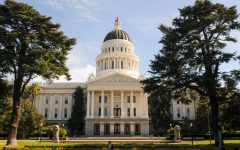
San Francisco City Hall (Photo: Evan Symon for California Globe)
Greenberg: Holocaust Payments and Black Reparations Cannot Be Compared
This analogy is intellectually dishonest, morally misleading, and historically illiterate
By Richie Greenberg, February 11, 2026 8:00 am
In reparations debates, the reference to Germany’s payments to Holocaust survivors as a precedent for compensating descendants of American slaves is a rhetorical sleight-of-hand.
“If Germany can pay Jews,” the argument goes, “why can’t San Francisco pay Black people?”
Reality is, this analogy is intellectually dishonest, morally misleading, and historically illiterate. The two cases are separated by differences so vast, in time, victims, perpetrators, documentation, and legitimacy, that any comparison collapses under scrutiny.
Germany’s payments are compensation to living victims of a horrendous crime that ended in 1945. Just under 200,000 Jewish Holocaust survivors worldwide remain alive. Germany has committed billions for their home care plus supplemental hardship payments extended through 2028. Since just after WWII, in 1952, negotiations with the successor state (Germany) saw it formally accept guilt and legal responsibility after total military defeat. Jewish recipients are identifiable through Nazi records, camp documents, and survivor testimony. Payments address specific, personal harms: lost health, forced labor and property confiscated. Germany’s program is not symbolic; it keeps frail elderly survivors out of nursing homes and provides monthly pensions to those who were actually gassed, shot at, or starved. More than 50% of remaining survivors today live in Israel, having moved there after establishment of the state in 1948.
Contrast this with San Francisco’s current reparations plan for American slavery, which ended in 1865, more than 160 years ago. Every direct victim has been dead for generations. No living person today was ever enslaved under the U.S. system, Union nor Confederate. Proposals today therefore target descendants, a category that is legally and genealogically riddled with loopholes and weak boundaries. It breaks the chain of direct restitution.
Perpetrator identification is an insurmountable problem. Germany in 1952 was the direct legal successor to the Nazi regime that perpetrated the Holocaust. On the other hand, San Francisco, and United States itself in 2026, is not the Confederacy through 1860’s. Taxpayers today have no immediate connection to slavery at all. Forcing us to pay trillions (most commonly quoted estimate is $175 billion for the one-time payout, plus ongoing costs) to close a nebulous “racial wealth gap” created by events centuries ago is not atonement; it is collective race-based punishment of the innocent for the sins of the long-dead Confederates. San Francsico is not the perpetrator.
Documentation is another chasm. Holocaust claims relied on extensive Nazi regime records and living witnesses. Slavery descent claims rely on incomplete genealogies and racial self-declaration, methods that courts have rightly rejected in other contexts as inviting fraud.
The moral category is also different. Holocaust reparations are corrective justice for identifiable Jewish individuals who suffered in their own lifetimes. Black reparations proposals are distributive justice dressed up as “repair,” an attempt to engineer present-day outcomes based on ancestral grievance. One closes a specific historical account; the other opens an infinite ledger of historical resentment.
Invoking the Holocaust to justify race-based wealth transfers in 2026 does not honor survivors; it cheapens Jewish survivors’ suffering by equating a meticulously documented genocide with a diffuse, centuries-old institution, and that Union Army soldiers fought at the cost of 360,000 lives. The comparison is not only false. It is corrosive. It transforms a unique moral horror into a political talking point, while pretending that handing out checks to people who were never enslaved can somehow replicate the dignity of paying people who actually were.
The two cases are not analogous. They are antithetical, manipulative and invalid.


- Deliberate Erasure of Congressional Candidate Marie Hurabiell - April 30, 2026
- Courts Could, and Arguably Should, Yank The Billionaire Tax Before Voters Ever Get a Chance To Weigh In - April 28, 2026
- San Francisco’s Voters are Screwed - April 20, 2026


The reparations grift is just another deflection from the issues that truly ail the modern-day foundational Black American community. The nihilism and narcissism of the race baiters and hustlers fly in the face of truth and historical facts. Blacks comprise about five percent of California’s and San Francisco’s population, respectively. California was admitted into the Union as a FREE/non-slavery state. Even though there have been people of African descent in California since the Spanish and Mexican eras, most Black Californians are descended from people who migrated to California of their own volition during the mid-20th Century (1930s/40s/50s) for employment opportunities. No amount of money will address what is truly holding back the Black community: fatherless homes, low-marriage rates, low educational attainment and overall cultural and moral decline.
I would agree with your assessment of this, so let’s ask if the $20k Reagan gave internment camp survivors, another well documented group who suffer actual harm, in the same time frame, as German Jews? Maybe task SF with raising some money to that group?
I have met them, over the years, and that was an insult to many of them.