
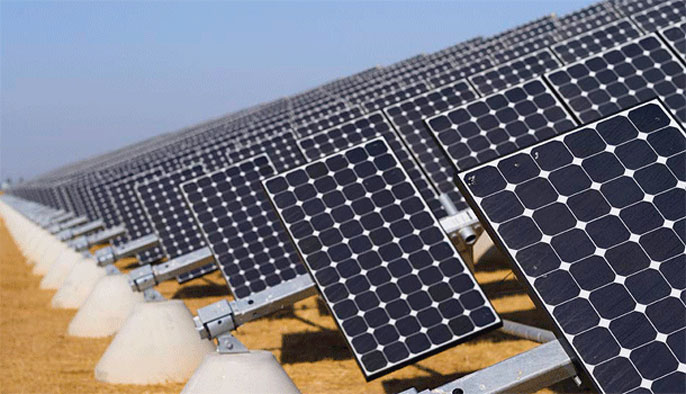
"Green" energy. (Photo: universityofcalifornia.edu)
Hoping for an Energy-Intensive Future
Rationing power does not produce an industrial base, a modern health system, or a mechanized farm sector
By Vijay Jayaraj, August 13, 2026 11:00 am
For campaigners of the net zero agenda, “climate action” must come first, even if it means throttling the energy lifelines for billions of the poor. The data say something very different. A sweeping analysis by Kevin Dayaratna and Kat Miller, “Energy Abundance and Human Flourishing: A Data‑Driven Global Analysis,” shows what history has already taught us: No nation has ever overcome poverty without first burning, drilling, or mining its way to energy abundance.
Affordable, Reliable Energy – and Plenty of It
The record is that prosperity and energy use rise together across nations, with no exceptions. Countries that consume only a few hundred to a few thousand kilowatt‑hours per person struggle with subsistence incomes of $1,000 to $3,000 a year; those with per capita consumption of tens of thousands of kilowatt‑hours, like the United States and Norway, enjoy vastly higher earnings.
Then there is public health, where the report argues the link to energy extends beyond correlation to cause and effect. You cannot refrigerate a vaccine, sterilize a surgical suite, or run a dialysis machine on carbon credits. Global life expectancy climbed from 32 years around 1900 to over 73 years today, while American life expectancy rose from 49 to nearly 80.
Today, the gap between poor and rich nations remains stark: Life expectancy in Somalia and Chad is below 60 years, while that of Norway, Japan, and Switzerland is above 80. Following a similar arc for child mortality, nations using little energy lose more than one in 10 children while the death rate in energy-intensive countries is one-tenth that.
Industrial output is even more tightly tied to energy, as per capita production rises from a few thousand dollars a year in poor countries to tens of thousands for richer nations.
While some advanced economies exhibit an apparent “decoupling” of output from energy, the report says that this is largely because of efficiency gains and structural shifts from manufacturing to services, not a reduced need for energy itself. In the U.S., real GDP (gross domestic product) grew almost tenfold between 1950 and 2024, while primary energy use rose less than threefold. This means each unit of energy now supports over three times as much output as it did 75 years ago.
The agricultural sector provides another compelling testament to energy’s power. American corn yields are nearly 11 metric tons per hectare compared to a global average of under 6, a gap created by using artificial fertilizers, irrigation pumps, and mechanized equipment, all of which require hydrocarbons. Without natural gas-derived fertilizer and diesel fuel, the American bounty vanishes.
None of this should surprise anyone who has watched India, Vietnam, or Bangladesh pull hundreds of millions out of poverty over the past 30 years. They did it the same way Britain and Germany did it two centuries earlier – with coal, then oil, then natural gas, and eventually a broader mix that includes nuclear and hydro.
The Future Will Be Energy-Intensive
Global electricity demand is set to surge again, driven primarily by Asia. In the United States the demand will come predominantly from AI data centers, advanced manufacturing, and vehicle electrification. Projections show 2% annual growth in American electricity demand through 2030, half from data centers.
If a wealthy, energy-saturated economy like the United States still needs a substantial expansion of new generation, what does that imply for nations that have not yet electrified half their villages?
The critical point is that developing nations are seeking not marginal improvements but rather fundamental, dramatic transformations in living standards. This necessitates massive investments in infrastructure, industrialization, and agricultural modernization – all energy-intensive.
Here is the uncomfortable truth some Western policymakers avoid: A family in Lagos or Lahore cannot reach the living standards of a family in Ohio on rooftop solar panels and battery banks. Rationing power does not produce an industrial base, a modern health system, or a mechanized farm sector. All need whatever mix of coal, gas, oil, hydro, and nuclear can be built the fastest and most affordably.
Vijay Jayaraj is a Science and Research Associate at the CO2 Coalition, Fairfax, Virginia. He holds an M.S. in environmental sciences from the University of East Anglia and a postgraduate degree in energy management from Robert Gordon University, both in the U.K., and a bachelor’s in engineering from Anna University, India. He served as a research associate with the Changing Oceans Research Unit at University of British Columbia, Canada.


- Hoping for an Energy-Intensive Future - August 13, 2026
- What Climate Crisis? Indonesia Taps Fossil Fuels - June 18, 2026
- South Korea’s Net Zero Boast Crumbles - April 28, 2026
RELATED ARTICLES
-
 July 1, 2022
 -
 March 22, 2023
 -
 July 31, 2020
Mayby 50 years ago fat cat globalists were saying that american workers made way too much money compared to the rest of the woirld, and would have to be reduced to third world income.
Curtailing energy consumption is the road to that goal.
Inexpensive, abundant energy will be more important than ever going forward. Our lives will be determined by computing power, and that take energy. Just about every electronic device will have a processor, and those need energy.
The Democrats want poverty and a large government dependent underclass to gain authoritarian power. Democrats are rationing and making energy expensive to accomplish that goal. If you want to live in a civilized society, you must vote Republican. Pushing our society back to the stone age is not the answer.