

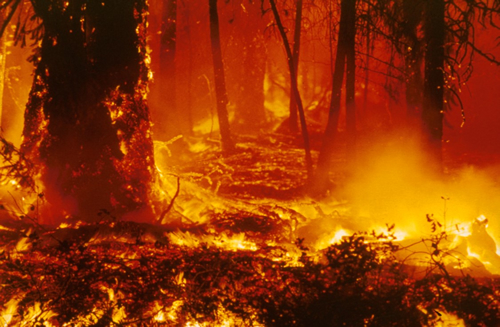
Pacific Palisades home destroyed by wildfire, Feb. 7, 2025. (Photo: Katy Grimes for California Globe)
Insurance Companies Aren’t Fleeing California – They’re Being Driven Out by a State That Refuses to Do Its Job
California has been on the road to serfdom for twenty years – the insurance crisis is not an isolated failure
By Herb Morgan, April 7, 2026 1:21 pm
California is the world’s fourth-largest economy, a magnet for every industry that values growth, innovation, and customers. Insurance companies are no exception. They are sophisticated financial powerhouses staffed with armies of lawyers, accountants, and actuaries who know how to price risk, comply with regulations, and turn a profit. They want to do business here. So why are major carriers shrinking their homeowners’ books or walking away from high-risk areas?
There is only one answer: they cannot make money under current conditions. If the market were profitable, carriers would be competing aggressively to enter and expand. Prices would fall. That is how free markets work. But markets require a competent public-sector partner—one that enforces contracts, protects property rights, aggressively prevents and contains catastrophes, and creates the conditions for fair competition. In California, that partner has failed for years.
The hemorrhaging losses stem overwhelmingly from wildfire claims. Those claims have exploded because the state and its subsidiaries have fallen short on the most basic governmental responsibility: preventing and containing catastrophic fire. Decades of inadequate forest and brush management—prioritizing ideology and litigation over people and property—have left fuel loads dangerously high. When fires ignite, responses too often prove slow or insufficient. The result is billions in insured losses that no sustainable actuarial model can absorb, even as recent 2025 Los Angeles wildfires drove further massive claims and FAIR Plan payouts in the billions.
Insurance Commissioner Ricardo Lara appears uninterested in basic economic and business realities. Instead of confronting root causes like vegetation management and rapid containment, the focus remains on rate suppression, mandates, and workarounds. Californians in fire-prone zones face non-renewals or shifts to the FAIR Plan, with premiums surging 50% or more in many cases, while being told to feel lucky they still have coverage.
The state’s FAIR Plan—the insurer of last resort—has become a textbook case of failure. Residential policies have surged over 146% since 2022, with total exposure reaching $724 billion as of late 2025. What was intended as a narrow backstop now covers hundreds of thousands of properties, including many in lower-risk urban areas, shifting wildfire costs broadly across the system through assessments on private carriers. This is not competition; it is a deliberate step toward socializing risk.
We have seen this playbook before in health insurance. California’s aggressive intervention through Covered California and Medi-Cal expansions was sold as a way to make coverage more “affordable” and accessible. Instead, underlying costs spiraled. When enhanced federal premium subsidies expired at the end of 2025, Californians faced a financial shock: average premiums through Covered California were already slated for a 10.3% increase, but without the subsidies, many enrollees saw effective monthly costs nearly double—averaging a 97% jump, with some facing even steeper hikes or shifting to higher-deductible plans. Enrollment in new plans dropped sharply (32% decline reported), and consumers confronted tough trade-offs between health care, housing, and food. Access expanded on paper, but affordability eroded, choice narrowed, and the system grew more dependent on government backstops and subsidies. The same pattern is now repeating in property insurance: heavy regulation and socialization of losses drive private carriers out, leaving Californians with fewer options and higher costs.
Rate regulation and FAIR Plan expansion are not fostering a healthy market—they are accelerating its collapse. If the state would simply stay in its proper lane—aggressively manage vegetation to protect lives and homes, demonstrate the capacity to contain fires quickly, and allow actuarially sound pricing—loss experience would drop dramatically. Rates would follow. Carriers would return and compete. The free market is not the villain; government’s refusal to be a responsible partner is.
It is long past time for real accountability. California’s Constitution grants the State Controller vast powers as the chief fiscal officer: to superintend the state’s financial concerns, audit every claim against public funds, perform independent audits of state agencies and programs at discretion, review disbursements, and oversee fiscal operations across government. These are not ceremonial duties—they are substantive tools to root out waste, inefficiency, and mismanagement that threaten the state’s finances.
Yet Controller Malia Cohen has treated the office as more form than substance, offering little visible leadership or aggressive use of these authorities amid cascading crises like the insurance collapse. She appears to lack basic financial understanding of how unsustainable regulatory regimes and government failures in core functions (such as wildfire prevention) distort markets, socialize losses, and burden taxpayers and ratepayers. Across all sectors of state government, the Controller could—and should—do far more to demand transparency, efficiency, and results rather than rubber-stamping the status quo.
The Controller should immediately launch a full, independent audit and investigation of the Department of Insurance and the FAIR Plan. Californians deserve to know precisely how much of their premium dollars and assessments are subsidizing policy failures rather than genuine risk management, and whether the current regime is hastening the erosion of the private insurance market.
California has been on the road to serfdom for twenty years. The insurance crisis is not an isolated failure—it is the predictable outcome of a state that has abandoned its proper role in prevention and protection while expanding into wealth redistribution and market distortion. Enough. Time to restore competent governance: prevent fires instead of socializing their consequences, and hold every office—including the Controller’s—accountable for delivering substance over ceremony.


- California’s Unclaimed Property Regime Turns Private Assets into a State Revenue Stream - August 13, 2026
- California Needs a Controller Who Puts Classrooms and Cops Before Bureaucracy - July 15, 2026
- Asymmetric Pension Smoothing: A Prudent Reform to Strengthen CalPERS and CalSTRS Funded Ratios - June 26, 2026
RELATED ARTICLES
-

-
-
 April 19, 2024
The Democrats’ goal is to destroy the middle class in this state to cement their powerbase. Making insurance unaffordable is part of their plan.
California Taxpayers are still awaiting the investigation into the extravagant travel of Insurance Commissioner Ricardo Lara, who jetted around the world in 1st class, staying at 5-star hotels and resorts at conferences related to how one’s sexual orientation possibly affects insurance markets.
After the taxpayers paid the bills and asked for answers to this misuse of funds months and months ago, nothing has happened other than the crickets continue to chirp and our insurance costs keep soaring and policies keep getting canceled.
Thank you for describing in layman’s terms how California’s Democrat majority is completely incompetent and unprepared to meet the technical challenges posed by actuarial science and risk management.
No wonder Lara is procrastinating by flying to LBGTQ conferences that he can understand as I doubt he has any technical training in statistical analysis and modeling or risk projections.
And we California homeowners suffer because this jackwagon thought a tour through Insurance Comminssioner would provide him with name recognition for his next fail-upward political campaign…
Unfortunately the bill for years of mismanagement came due on his watch…
Vote Stacy Korsgaden to begin the process of repairing the broken California economy, along with Herb Morgan (author) and the rest of Steve Hilton’s “Golden Ticket” team…