
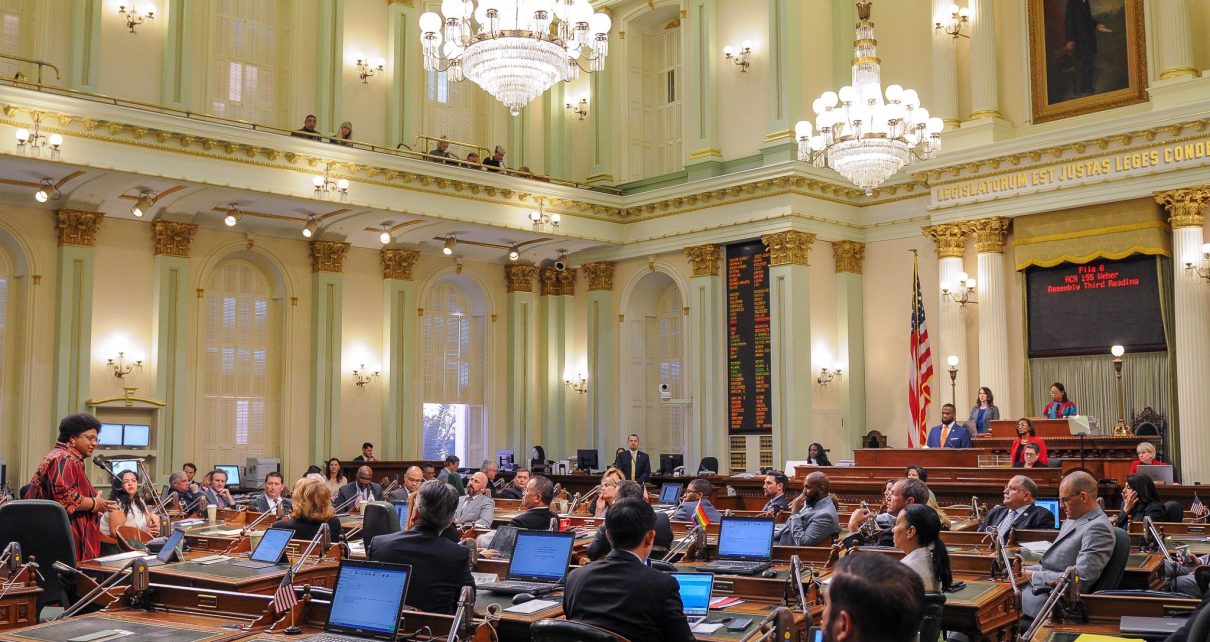
California State Assembly in Session. (Photo: Kevin Sanders for California Globe)
New Measures in Print from the Legislature for 2026 Statewide Ballot
Including two of the bills that came into print and were made public that are to be enacted into law by this Thursday, June 25
By Chris Micheli, June 22, 2026 5:55 pm
The following are two of the bills that came into print and were made public that are to be enacted into law by this Thursday, June 25.
SB 417 (Senate PT Limon and Speaker Rivas)
15 Senate co-authors and 28 Assembly co-authors
Adds Part 16.1 (commencing with Section 54050) to Division 31 of the Health and Safety Code, and to adds Article 5ab (commencing with Section 998.750) to Chapter 6 of Division 4 of the Military and Veterans Code
2/3 vote required due to urgency clause
Places the bond act before vote on the 11/3/26 ballot
The Veterans and Affordable Housing Bond Act of 2026
$5.1 billion to the Housing Rehabilitation Loan Fund established to be used for the Multifamily Housing Program. At least 10 percent of assisted units in each development receiving these funds shall be affordable to extremely low income households.
$1.750 billion to the Housing Rehabilitation Loan Fund to offer capitalized operating subsidy reserves for supportive housing units in developments receiving these funds. ($150 million for youth housing)
$750 million to be appropriated by the Legislature, to the program commonly known as the Portfolio Reinvestment.
$200 million to be appropriated by the Legislature, to a program, to be administered by the Department of Housing and Community Development, to fund the acquisition and rehabilitation of unrestricted housing units and attach long-term affordability restrictions on the housing units, while safeguarding against the displacement of current residents.
$600 million to be deposited into the Self-Help Housing Fund and made available for the CalHome Program to provide direct, forgivable loans to assist development projects involving multiple home ownership units.
$600 million to be deposited into the Self-Help Housing Fund and made available for the CalHome Program to provide direct, forgivable loans to assist development projects involving multiple home ownership units, including single-family subdivision, for self-help mortgage assistance programs, and for manufactured homes.
$500 million to be deposited into the Home Purchase Assistance Fund to be continuously appropriated to the California Housing Finance Agency for purposes of the home purchase assistance program.
$450 million to be appropriated by the Legislature, to deposited into the Joe Serna, Jr. Farmworker Housing Grant Program to fund grants or loans, or both, for the construction or rehabilitation of housing for agricultural employees and their families or for the acquisition of manufactured housing.
$200 million to be appropriated by the Legislature to the Tribal Housing Grant Program Trust Fund to finance housing and housing-related activities that will enable tribes to rebuild and reconstitute their communities.
$500 million for the Infill Infrastructure Grant Program of 2019 for infill incentive grants to assist in the new construction and rehabilitation of infrastructure that supports high-density affordable and mixed-income housing in locations designated as infill.
$350 million to be appropriated by the Legislature for new affordable student housing projects. This funding shall be split evenly among the University of California and the California State University.
$200 million to be deposited in the Affordable Housing Innovation to fund competitive grants or loans to local housing trust funds.
$1.25 billion for the purpose of creating a fund to provide farm and home aid for veterans in accordance with the Veterans’ Farm and Home Purchase Act.
SB 623 (Senator Umberg and Assembly Member Papan)
Adds Section 3333.9 to the Civil Code, and amends Section 5445.2 of, and adds Section 5451 to, the Public Utilities Code
Majority vote; no urgency clause
The Civil Code sections added apply to any civil case, claim, action, or arbitration against a network company, its subsidiary, or an app-based driver, arising out of an automobile accident occurring on or after January 1, 2027, in which a claimant obtained medical treatment by a lien-based provider.
The maximum recovery of a plaintiff for damages for any medical expense for services rendered by a lien-based provider shall not exceed the 70th percentile of FAIR Health, Inc.’s billed charges, or the 70th percentile of a comparable commercially recognized billed charges database for the same or similar service in the applicable geographic area at the time the service was rendered. No plaintiff may recover past medical expense damages in excess of that amount.
The court may authorize recovery above the maximum recovery provided only upon a finding, by clear and convincing evidence, and supported by expert testimony, that the service involved exceptionally rare or highly specialized treatment for which no reasonably comparable provider or service was available.
The amount billed, charged, or claimed by a lien-based provider for past medical expenses in excess of the maximum amount recoverable under this section is void and unenforceable, and no person or entity may recover, collect, enforce, assert, seek payment of, or seek reimbursement, indemnity, contribution, or subrogation for that excess amount.
No party may introduce, reference, disclose, or present to the trier of fact any billed charge, lien amount, invoice, statement, or claimed value for past medical expenses exceeding the recoverable amount pursuant to this section.
A plaintiff shall not recover as damages for medical expenses an amount greater than the amount actually billed by the lien-based provider for that service.
Damages for medical expenses under this section are recoverable only if supported by itemized medical bills identifying the services provided at the procedure-code level using generally accepted health care billing and coding standards, including applicable Current Procedural Terminology (CPT), Healthcare Common Procedure Coding System (HCPCS), International Classification of Diseases (ICD), or successor coding systems.
Any agreement relating to the sale, assignment, financing, factoring, or transfer of a medical lien, receivable, or right to payment, and the consideration paid or payable therefor, including any contingent, deferred, recourse-based, or future payments, shall be discoverable and shall be disclosed to the plaintiff, the plaintiff’s attorney, the defendant, the defendant’s attorney, and any applicable insurer within 30 days after the transaction and, in all events, before any settlement or distribution of settlement proceeds. No undisclosed lien sale, assignment, financing, factoring arrangement, or transfer may be asserted against a defendant, insurer, settlement, judgment, or settlement proceeds.
Upon request, a lien-based provider shall provide a declaration under penalty of perjury stating whether the plaintiff was referred by the attorney, law firm, or any person acting on their behalf and the approximate number of patients referred by that attorney or law firm to the provider during the preceding 24 months. The declaration shall be discoverable.
It is unlawful for an attorney representing a plaintiff under a contingency fee agreement to refer a client to a health care provider in which the attorney or a member of the attorney’s immediate family has a direct ownership interest.
It is unlawful for an attorney representing a plaintiff to fee split, receive kickbacks, rebates, or referral compensation in connection with the furnishing of lien-based provider medical treatment for that plaintiff.
It is unlawful for an attorney or law firm to provide bonuses, incentives, or compensation for referrals of clients to lien-based providers for lien-based treatment.
An attorney shall not charge any additional contingency fee, administrative fee, management fee, or similar fee based upon the reduction, compromise, or resolution of a medical lien. Nothing here shall prevent an attorney from retaining a third party to negotiate any lien reductions at a cost with client consent.
A transportation network company shall not contract with, employ, or retain a driver if the driver has been convicted of any violation of Section 243.4, 245, 273a, 273.5, 288, 288.5, 288.7, 289, 368, 646.9, or 647.6 of, Sections 311.1 to 311.11, inclusive, of, Sections 451 to 455, inclusive, of, subdivision (a) of Section 192 of, subdivision (d) of Section 243 of, or paragraph (1) of subdivision (e) of Section 243 of, the Penal Code.
A TNC cannot contract with or employ someone who, in the last seven years, has bee convicted of driving under the influence of an alcoholic beverage or a drug, weapons charges, or violation of a protective order.
A TNC has to perform a background check, prior to activation of a transportation network company driver’s account, and once annually thereafter for each participating driver who is authorized to use the transportation network company’s online-enabled application or platform.
A transportation network company, or charter-party carrier of passengers may allow a woman passenger on its online-enabled application or platform or a participating woman driver to indicate a preference to be matched with a woman driver or woman passenger, respectively, and facilitate passenger-driver matches based on such preferences.
AB 736 (Assembly Members Mark Gonzalez and Wicks and Senators Gonzalez and Grayson)
Adds Section 11911.5 to the Revenue and Taxation Code
Begins 1/1/27 and prohibits a local jurisdiction from collecting a transfer tax levied on the sale or transfer of a real property interest conveyed if the combined transfer tax rate levied by local jurisdictions exceeds 1.5 percent of the consideration paid for or value of the real property interest conveyed.
A local jurisdiction may collect a transfer tax levied on the sale or transfer of a real property interest conveyed if it stops collecting, reduces rates on, or eliminates transfer taxes so that the combined transfer tax rate levied is 1.5 percent or lower of the consideration paid for or value of the real property interest conveyed. The local jurisdiction shall first reduce or stop collecting the rates for all transfer taxes that are not general taxes.
Beginning on 1/1/27, if the combined transfer tax rate levied by a local jurisdiction includes a combined rate greater than 1.5 percent from general taxes that were in effect as of June, 30, 2026, the local jurisdiction shall not need to stop collecting a transfer tax, reduce rates, or eliminate transfer taxes to meet the limitations except for any transfer taxes that are not general taxes.
The combined transfer taxes cannot exceed the lesser of the combined transfer tax rate for those taxes that are general taxes in effect as of June 30, 2026, or 3 percent.
Beginning on 1/1/27, the limitations do not apply to any transfer taxes on a single-family housing property when the consideration or value of the interest or property conveyed is five million four hundred thousand dollars ($5,400,000) or higher, which is adjusted annually by the CA CPI.
A local jurisdiction shall not levy a transfer tax on the first sale of single-family housing property occurring within five years of one or more housing units on the real property being destroyed or made uninhabitable by a natural disaster.
Section 2 of the bill applies it to charter cities (and not just general law cities).


- Some Statistics from the 2025-26 California Legislative Session - October 7, 2026
- Amendment of Corporate Articles - October 7, 2026
- S Corporation Tax Treatment - October 6, 2026
RELATED ARTICLES
-

-
 January 30, 2022
 -
 June 30, 2024