
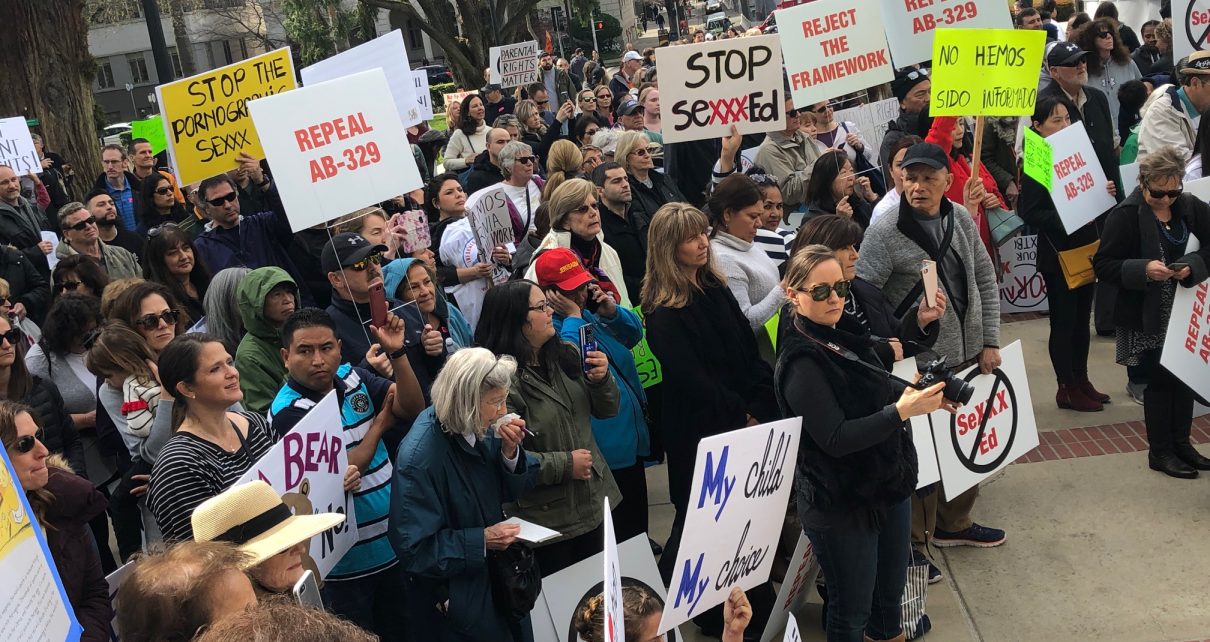
Outraged parents rallying at State Capitol. (Photo: Katy Grimes for California Globe)
Ninth Circuit Delivers Promising Injunction Against CA’s SAFETY Act’s Parental Secrecy Rules
This is a small victory to reclaim parental rights in California from an increasingly aggressive nanny-state
By J. Mitchell Sances, July 12, 2026 9:00 am
In a modest yet symbolically important ruling, the U.S. Court of Appeals for the Ninth Circuit has granted a preliminary injunction blocking enforcement of Sections 5 and 6 of Assembly Bill 1955—the Support Academic Futures and Educators for Today’s Youth Act, or SAFETY Act—against the specific parent plaintiffs in City of Huntington Beach v. Newsom.
Handed down on June 18, 2026, after reconsideration, the order applies only to those parents involved in the lawsuit and only with respect to information about their own children. It does not invalidate the provisions statewide or extend relief to every family in California. Still, the judicial panel’s reasoning rests on solid constitutional ground and could serve as a foundation for broader challenges that ultimately strike down these sections in full.
The decision turned decisively on the U.S. Supreme Court’s per curiam order earlier this year in Mirabelli v. Bonta. In that case, the high court recognized that parents hold fundamental rights under the Due Process Clause of the Fourteenth Amendment to direct the upbringing and education of their children. This includes the right to participate in decisions about their children’s mental health and to receive relevant information from schools, particularly regarding matters like gender dysphoria or identity issues.
The Supreme Court found that policies shielding such information from parents were likely unconstitutional and that objecting parents were likely to succeed on the merits. It effectively lifted barriers that had prevented injunctive relief from taking effect in related challenges.
Citing this precedent, the Ninth Circuit panel concluded that the Huntington Beach parents “very likely have standing because they are objects of the challenged exclusion policies.” The court stressed that “parents—not the State—have primary authority with respect to the upbringing and education of children” and possess “the right not to be shut out of participation in decisions regarding their children’s mental health.” It further held that AB 1955 “forbids the mandatory policies that the Constitution requires,” that depriving parents of these rights constitutes irreparable harm, and that the injunction advances child safety by ensuring fit parents remain involved in consequential decisions about their own kids.
Sections 5 and 6 of the SAFETY Act added Education Code provisions that prohibit school employees or contractors from being required to disclose information related to a pupil’s sexual orientation, gender identity, or gender expression to any other person without the pupil’s consent (unless otherwise required by law). They also bar school districts from enacting or enforcing policies that would mandate such disclosures. While sold as protecting student privacy and preventing “forced outing,” these rules effectively empower schools to keep parents in the dark about significant developments in their children’s lives.
This limited injunction represents a small victory in the larger struggle to reclaim parental rights in California from an increasingly aggressive nanny-state. Sacramento’s progressive policymakers have shown a troubling pattern of inserting government officials and ideologically aligned school personnel between parents and their children on deeply personal matters like health, education, values, and identity.
The SAFETY Act stands as a prime example: a statute whose very name drips with irony. Marketed as promoting “safety,” it instead institutionalizes secrecy that can shield schools from accountability while potentially leaving families uninformed about risks or changes affecting their own sons and daughters. Advocates for these policies claim they shield vulnerable youth from unsupportive homes. The courts, however, have begun reaffirming the longstanding constitutional presumption that fit parents, not distant bureaucrats or activist educators, hold primary responsibility and authority over their children’s welfare. Blanket rules prioritizing a minor’s “consent” to withhold information from parents erode that foundation and invite overreach.
The Ninth Circuit’s analysis here, anchored firmly in Mirabelli, appears sturdy enough to support wider invalidation of these provisions in ongoing or future litigation. As cases progress, parents and advocates should press for relief that extends beyond individual plaintiffs, restoring transparency and restoring the natural order in which families, not the state, guide the upbringing of the next generation.
For now, it is a narrow win. But in California’s ongoing fight against government overreach in the classroom and the home, every principled inch matters. The tide may be turning, one injunction at a time.


- Big Brother Behind the Counter: The Ninth Circuit Blesses California’s Gun-Store Listening Law - September 30, 2026
- Hollywood Producer Chuck Lorre Uses Charity Stage to Give a Political Sermon - September 30, 2026
- An Editorial Board Will Not Save CNN, but a Return to Reporting Might - September 29, 2026
RELATED ARTICLES
-

-

-
 June 29, 2026